
FullDots
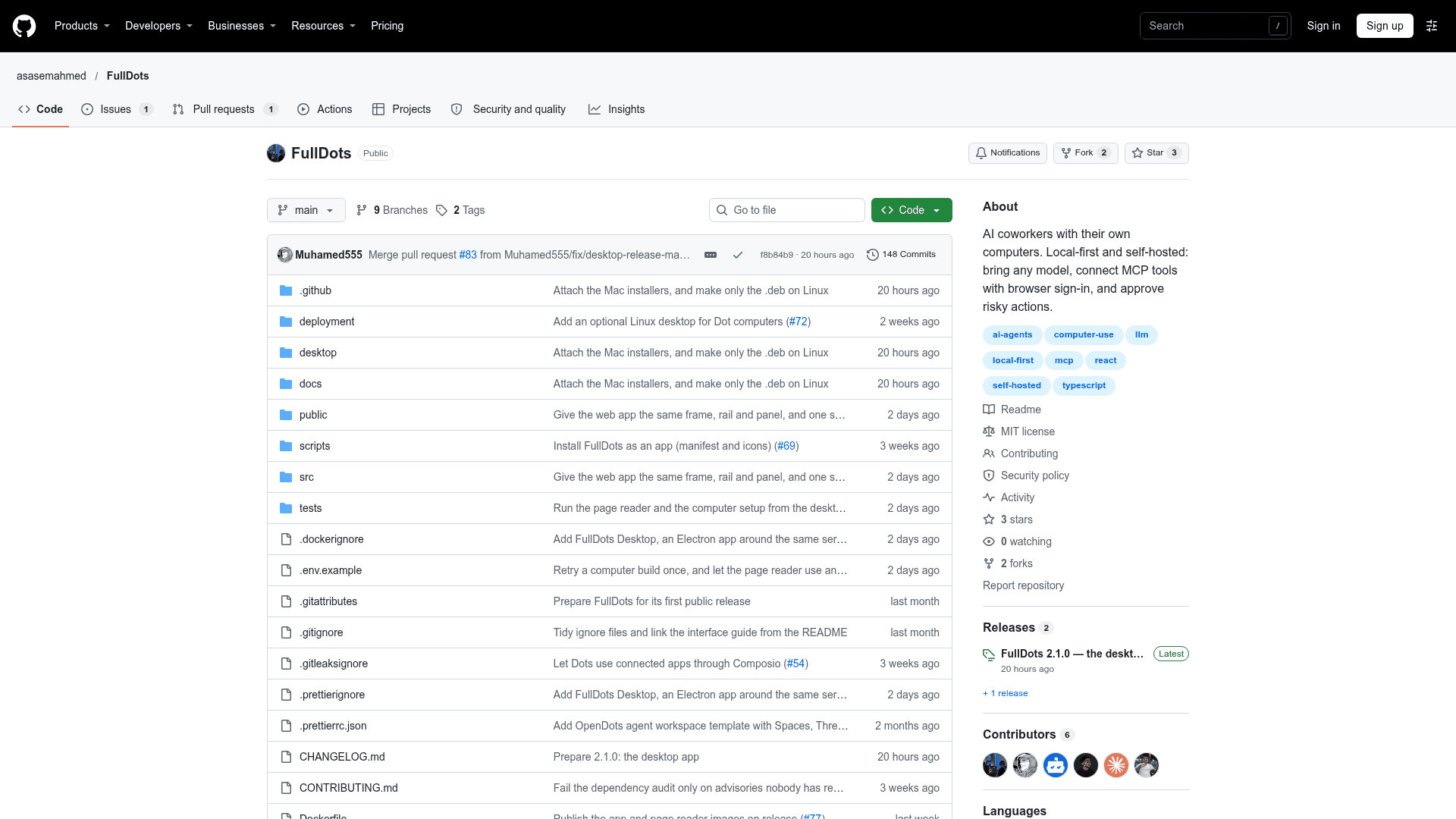
Self-hosted, local-first platform for creating AI coworkers called Dots that use any model, MCP connectors and their own computers, with approval for risky actions.
At a Glance
Self-hosted, local-first FullDots core released under the MIT license. Model provider costs are external and bring-your-own.
Engagement
Available On
Listed Nov 2026
About FullDots
FullDots is an open-source, self-hosted app for building a small team of AI coworkers called Dots. Each Dot has a role, a model, the tools you grant it and, optionally, its own computer with a browser, files and a shell. The repository is published under the MIT license and lists version 2.0.0 as its latest release, with an alpha status badge in the README.
What It Is
FullDots is a single-owner agent workspace that runs on your own machine or server. You chat with Dots, give them standing goals, let them hand work to teammates and review what they did. Data lives in one SQLite file, and the README states there are no accounts, no telemetry and no hosted service in the middle. It began as a fork of CopilotKit OpenDots and is described as an independent project.
How Work Flows
Every turn runs through the server, where an approval gate checks each action against the Dot's grants and approval mode. Sending, paying, deleting, publishing and destructive commands pause for the owner, and an approval covers that exact action once. Dots can pass part of a task to a teammate whose role fits, and results such as CSVs, reports and HTML pages are saved into Spaces and open beside the chat. Automations include standing goals, schedules, webhook triggers and connector polls, with per-Dot token budgets.
Models, Connectors and Computers
The app ships fourteen provider presets, including OpenAI, Anthropic, Gemini, Ollama and LM Studio, plus any OpenAI-compatible server, and each Dot can use its own model. Connectors use MCP with browser sign-in and are read-only by default. Dot computers run as Docker containers with a live screen, replay, take-over and an audit trail. Optional Slack and Telegram channels let listed owner accounts talk to a Dot.
Setup Path
It requires Node.js 24 or newer and either a provider API key or a local Ollama or LM Studio server. You can run it from source with npm, with Docker Compose, or deploy it on a VPS or Dokploy. Keys and tokens are encrypted at rest with AES-256-GCM, and the README notes the project has not been independently audited.
Community Discussions
Be the first to start a conversation about FullDots
Share your experience with FullDots, ask questions, or help others learn from your insights.
Pricing
Open Source (MIT)
Self-hosted, local-first FullDots core released under the MIT license. Model provider costs are external and bring-your-own.
- MIT License
- Self-hosted and local-first
- Bring any model (external provider costs not included)
- Teams, Spaces with files, approvals, MCP connectors
- Single SQLite file; no accounts, no telemetry, no hosted service
Capabilities
Key Features
- Teams of Dots with hand-offs between roles
- Spaces for pages and files such as CSVs, reports and HTML
- Per-Dot computers with browser, files and shell in Docker
- Approval gate for sending, paying, deleting and publishing
- Standing goals, schedules, webhook and poll triggers
- Per-Dot daily token budgets and limits
- MCP connectors with browser sign-in and per-Dot grants
- Fourteen model provider presets plus OpenAI-compatible servers
- Mission control and inbox
- Single SQLite file storage with encrypted secrets and backup command
- Slack and Telegram channels
- Light, dark and system themes