
gawkbot
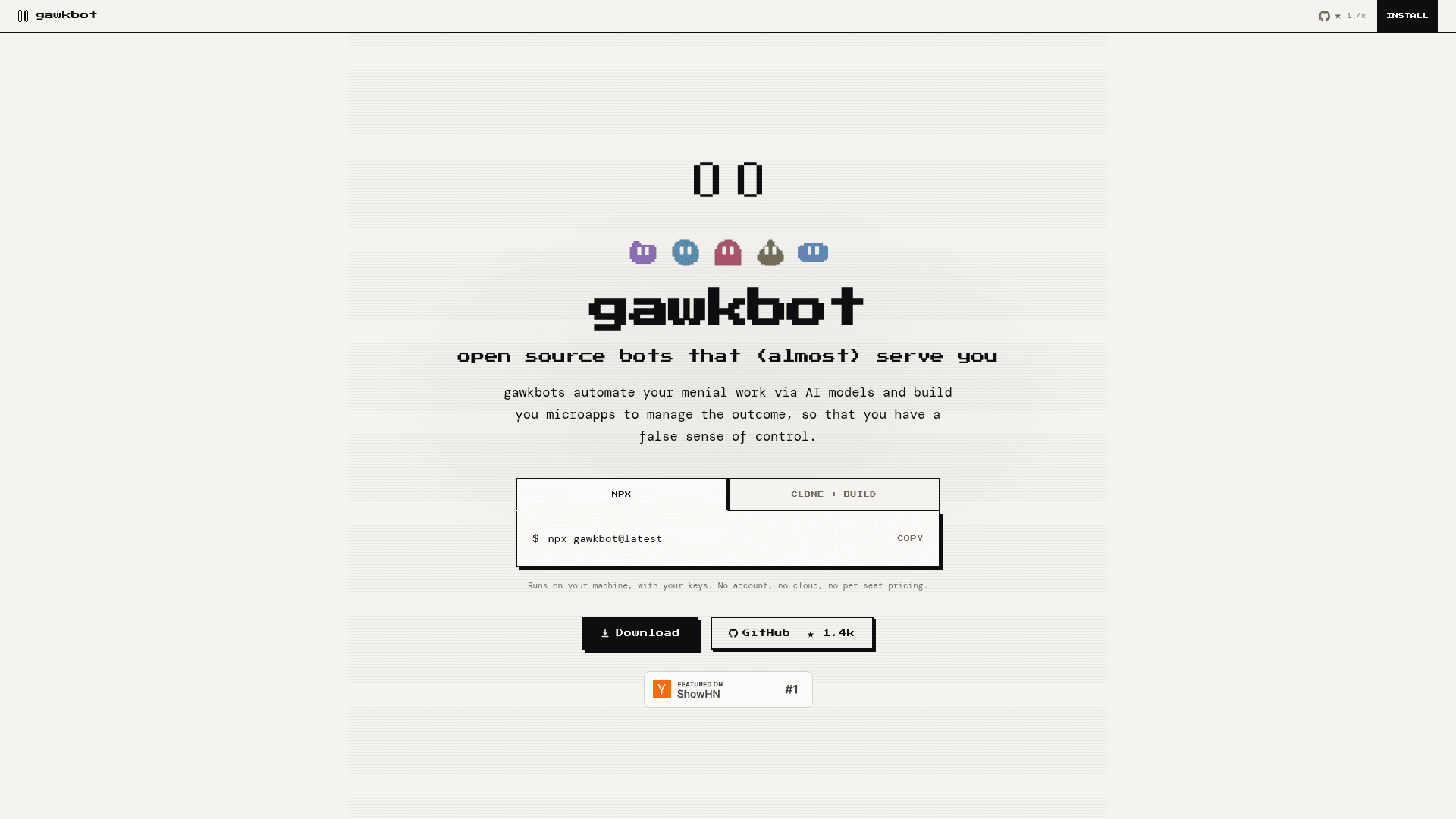
An open-source, self-hosted AI bot framework that automates menial workflows on your own machine and builds microapps to manage the results, with human approval gates on every external action.
At a Glance
Free to self-host for internal business and non-commercial use under the Sustainable Use License. No account, no seats, no usage fees. Requires your own AI provider API keys.
Engagement
Available On
Alternatives
Listed Sep 2026
About gawkbot
gawkbot is an open-source, self-hosted AI bot framework built in Go that runs entirely on your own machine using the AI coding runtime you already have — Claude Code, Codex, Opencode, or a local model. It was created by Najmuzzaman Mohammad and positions itself explicitly as an open-source alternative to xAI's Grok Bot, running on your keys instead of a vendor's cloud. The project reached the top of Hacker News Life of Product Week and has accumulated over 1,300 GitHub stars since its March 2026 creation.
What It Is
gawkbot is a multi-agent automation framework that turns natural-language workflow descriptions into always-on AI bots, each with its own working directory, tool allowlist, browser, and schedule. Rather than a single monolithic assistant, each bot is scoped to one workflow — expense filing, inbox triage, invoice reconciliation, file renaming — and when it finishes the job, it builds a microapp so you have a dashboard to review the outcome. The name is a deliberate parody: "gawk" means to stare blankly, which is what you do at the dashboard after the bots have already done the work.
How the Bot-and-Microapp Workflow Works
Every gawkbot ships with six components out of the box:
- The app — a real UI screen built live as the bot is created, reading and writing actual workspace data
- Routines — cron-style scheduled runs with versioned prompts and per-run transcripts
- Tools — self-authored capabilities the bot can teach itself from chat
- Knowledge — Wikipedia-style pages about the bot with citations back to source data
- Data + integrations — per-bot typed tables plus 1,200+ integrations via Composio
- Approval gate — reads are free; every write, send, commit, or delete waits for a human tap
Bots can consult each other: mention a second bot in a conversation and the first goes off to coordinate rather than pulling it into the thread. The build streams live in front of you — screen, routine, and tools assembling in real time.
Permissions and Trust Model
The permissions design is a first-class feature, not an afterthought. Each bot operates in its own directory with its own tool allowlist, so blast radius is per-bot rather than per-workspace. Approvals are per-action and do not persist — a blanket grant is not possible. Permissions that stop being used expire rather than accumulating silently. Every tool call is written to a local log. The project states that pointing gawkbot at a local model means nothing leaves the machine at all.
Setup Path and Runtime Options
Installation is a single npx gawkbot command; the browser opens, you verify your runtime, name your workspace, and describe your first workflow. A global npm install and a source build (requiring Go and Bun) are also supported. Runtime flags let you override the AI provider, change the web UI port (default 7891), or run multiple isolated workspaces side by side. Supported providers include Claude Code, Codex, Opencode, Ollama, Hermes Agent, and OpenClaw HTTP endpoints, all switchable via CLI flags or environment variables.
Update: v0.238.1
The latest release is v0.238.1, published 8 September 2026, with the repository last pushed on 9 September 2026. The project is under active development — the GitHub README includes a live claim-status table tracking shipped vs. planned features, and the comparison page against Grok Bot is dated 1 September 2026 with a standing invitation to file issues for any outdated rows. One planned item — packaging the routine runner into the npx/desktop installs — is listed as upcoming. The project is licensed under the Sustainable Use License, which permits free self-hosting for internal business and non-commercial use but prohibits reselling gawkbot as a hosted product.
Community Discussions
Be the first to start a conversation about gawkbot
Share your experience with gawkbot, ask questions, or help others learn from your insights.
Pricing
Self-Hosted
Free to self-host for internal business and non-commercial use under the Sustainable Use License. No account, no seats, no usage fees. Requires your own AI provider API keys.
- Full multi-agent bot framework
- Microapp generation
- 1,200+ integrations via Composio
- Runs on your own machine with your own keys
- Supports Claude Code, Codex, Opencode, local models
Capabilities
Key Features
- Multi-agent bot framework with one bot per workflow
- Microapp generation — bots build a UI dashboard after completing work
- Human approval gate on every external write, send, commit, or delete
- Runs entirely on your own machine with your own API keys
- Supports Claude Code, Codex, Opencode, Ollama, Hermes, and OpenClaw runtimes
- 1,200+ integrations via Composio
- Per-bot typed data tables
- Cron-style routines with versioned prompts and per-run transcripts
- Self-authored bot tools teachable from chat
- Knowledge pages with inline citations
- Multi-workspace support with isolation
- Team sharing via Tailscale/WireGuard or Cloudflare tunnel
- Local memory stored in files under ~/.wuphf/
- Usage cost readout (dollars, tokens, runs) in Settings
- Optional anonymous telemetry, off by default on stock builds
- Per-bot directory and tool allowlist for blast-radius control
- Permissions expire when unused
- Full local log of every tool call