Octop
A self-hosted, open-source multi-user and multi-agent AI assistant platform with browser automation, terminal AI, remote desktop, and IM channel integrations.
At a Glance
About Octop
Octop is an open-source, self-hosted AI assistant platform built by TencentCloud and released under the MIT license. It runs as a single process on your own machine, keeping all conversations, workspaces, and credentials local under ~/.octop/. The project has accumulated over 4,900 GitHub stars since its July 2026 launch.
What It Is
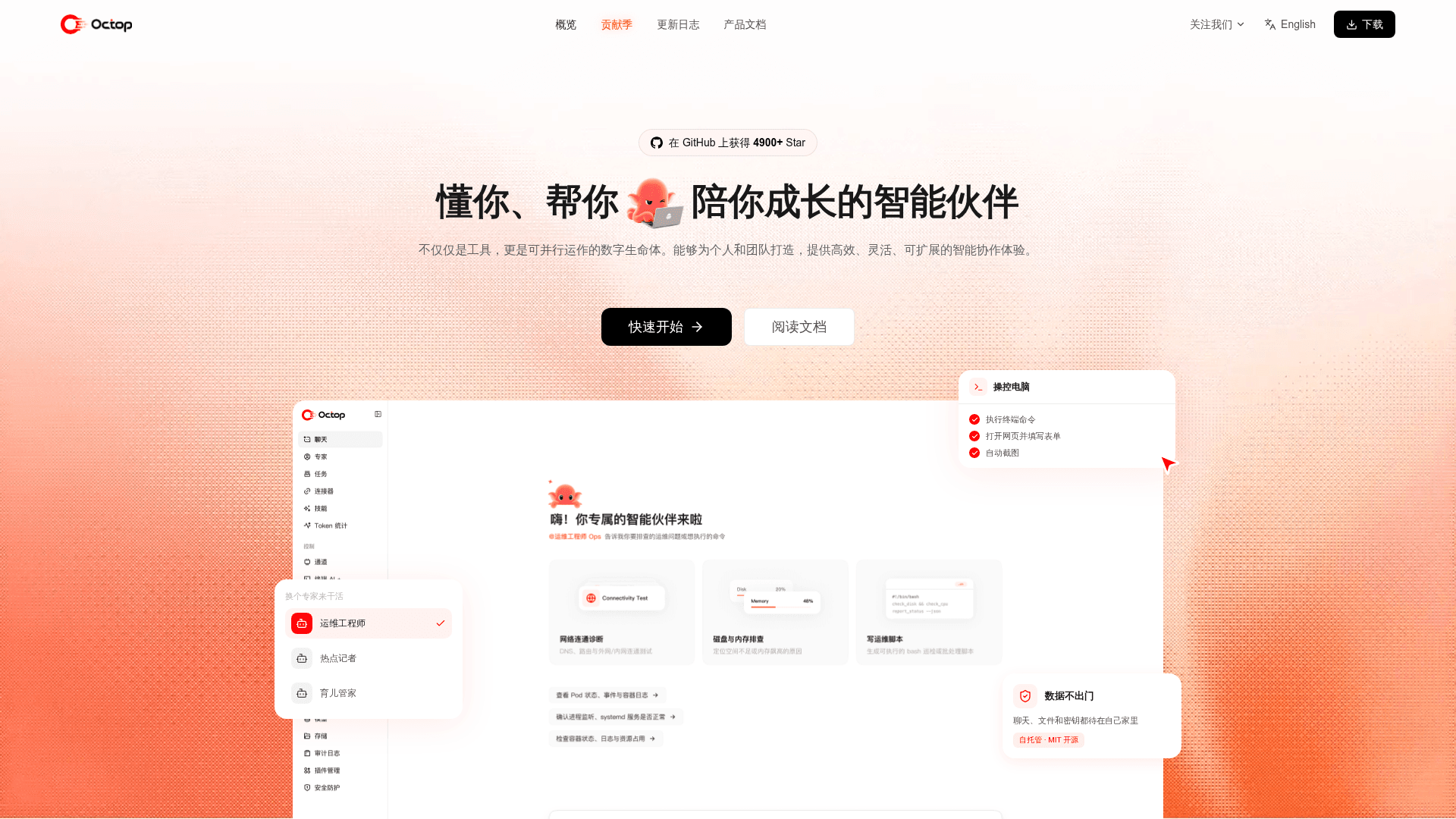
Octop is a self-hosted AI assistant platform designed for individuals, households, and small teams. Rather than a single chatbot, it provides a multi-agent environment where each user gets their own team of specialized agents — called "experts" — that can be switched per task. The platform exposes a web dashboard, a CLI, IM channel integrations, and a programmatic HTTP/SSE/WebSocket API, all served from one octop run command.
Architecture and Core Technology
Octop is built on the "Harness stack," a set of focused runtimes composed into one process:
- harness-agent — agent runtime handling model routing, tools, skills, and conversation checkpointing
- harness-gateway — multi-platform IM channel bridge normalizing messages into a single pipeline
- harness-memory — hierarchical recall with full-text search; memory travels with the agent workspace
- harness-browser — CDP-based browser automation with persistent profiles
The backend is Python 3.12+ with FastAPI and uvicorn; the frontend is React 18 + TypeScript + Vite + Ant Design. The control-plane database defaults to SQLite (WAL mode) with optional PostgreSQL. All routing — Web UI, IM, and cron — goes through one in-process HarnessProcessor, making the entire state rebuildable from the database on restart.
Key Capabilities
- Multi-user expert team: one deployment serves multiple users, each with isolated agents and workspaces; 16 MBTI persona templates plus custom system prompts
- Browser AI+: headless Chromium sessions via Playwright for web automation, form filling, and screenshots
- Terminal AI+: interactive browser-based shell with AI-assisted command execution
- Remote desktop: live screen and input from the dashboard on Linux, Windows, and macOS; one-click isolated desktop on headless Linux
- Connector ecosystem: OAuth and MCP gateway; built-in connectors for Tencent Docs, Weibo trends, and news feeds
- ACP (Agent Client Protocol): bidirectional — expose your Octop agent as a stdio ACP server for IDEs like Zed, or delegate outbound coding tasks to OpenCode, Claude Code, CodeBuddy, or Codex
- Knowledge base: RAG over uploaded documents with semantic retrieval
- IM channels: Feishu, DingTalk, QQ, Telegram, Discord, WeCom
- Cron automation: natural-language scheduled tasks
- Plugins: third-party plugin install and management via
octop plugin
Deployment Model
Octop is designed for local-first, self-hosted operation. Installation requires no pre-installed Python — the one-line installer uses uv to provision Python 3.12 in an isolated venv under ~/.octop/. Docker Compose is recommended for production. Desktop app installers are available for Windows (NSIS), macOS (DMG), and Linux (tarball), as well as an FnOS NAS package. The PyPI package (pip install octop) is also supported for users who manage their own Python environment.
Security features include JWT multi-user isolation, tool approval gates, shell command guardrails, and PII redaction — all data stays on the host machine.
Update: v1.0.2b2
The latest release is v1.0.2b2, published on September 23, 2026. The repository was created in July 2026 and has seen active development, with the last push on September 25, 2026. The roadmap lists planned features including shared resource pools, expert sharing between users, browser skill recording, AgentTeams for multi-step orchestration, self-evolution (distilling conversations into reusable skills), and native PC/mobile clients. The harness-* sub-projects are described as being prepared for open-sourcing with repository links to be added once published.
Community Discussions
Be the first to start a conversation about Octop
Share your experience with Octop, ask questions, or help others learn from your insights.
Pricing
Open Source
Fully free and open-source under the MIT license. Self-host on your own machine with all features included.
- Multi-user self-hosted deployment
- Multi-agent expert library
- Browser AI+ and Terminal AI+
- Remote desktop
- IM channel integrations
Capabilities
Key Features
- Multi-user self-hosted deployment
- Multi-agent expert library with role switching
- 16 MBTI persona templates
- Browser AI+ (headless Chromium automation)
- Terminal AI+ (browser-based interactive shell)
- Remote desktop (Linux, Windows, macOS)
- ACP bidirectional integration (IDE and coding agents)
- IM channels: Feishu, DingTalk, QQ, Telegram, Discord, WeCom
- RAG knowledge base over private documents
- Connector ecosystem with OAuth and MCP gateway
- Cron automation with natural-language scheduling
- Third-party plugin system
- JWT multi-user isolation and PII redaction
- SQLite (default) or PostgreSQL control-plane database
- Desktop app for Windows, macOS, Linux
- Docker and FnOS NAS deployment support
- Portable agent memory (harness-memory)
- CLI with full admin and agent management commands