
gitai by Federico Elia
Open-source, server-centric Git hosting layer for AI coding agents, implementing the publicly described design of Anthropic's Scion.
At a Glance
gitai, an open-source, self-hostable version control server for AI agents, MIT licensed. Independent of Anthropic's internal Scion and Claude pricing.
Engagement
Available On
Alternatives
Listed Nov 2026
About gitai by Federico Elia
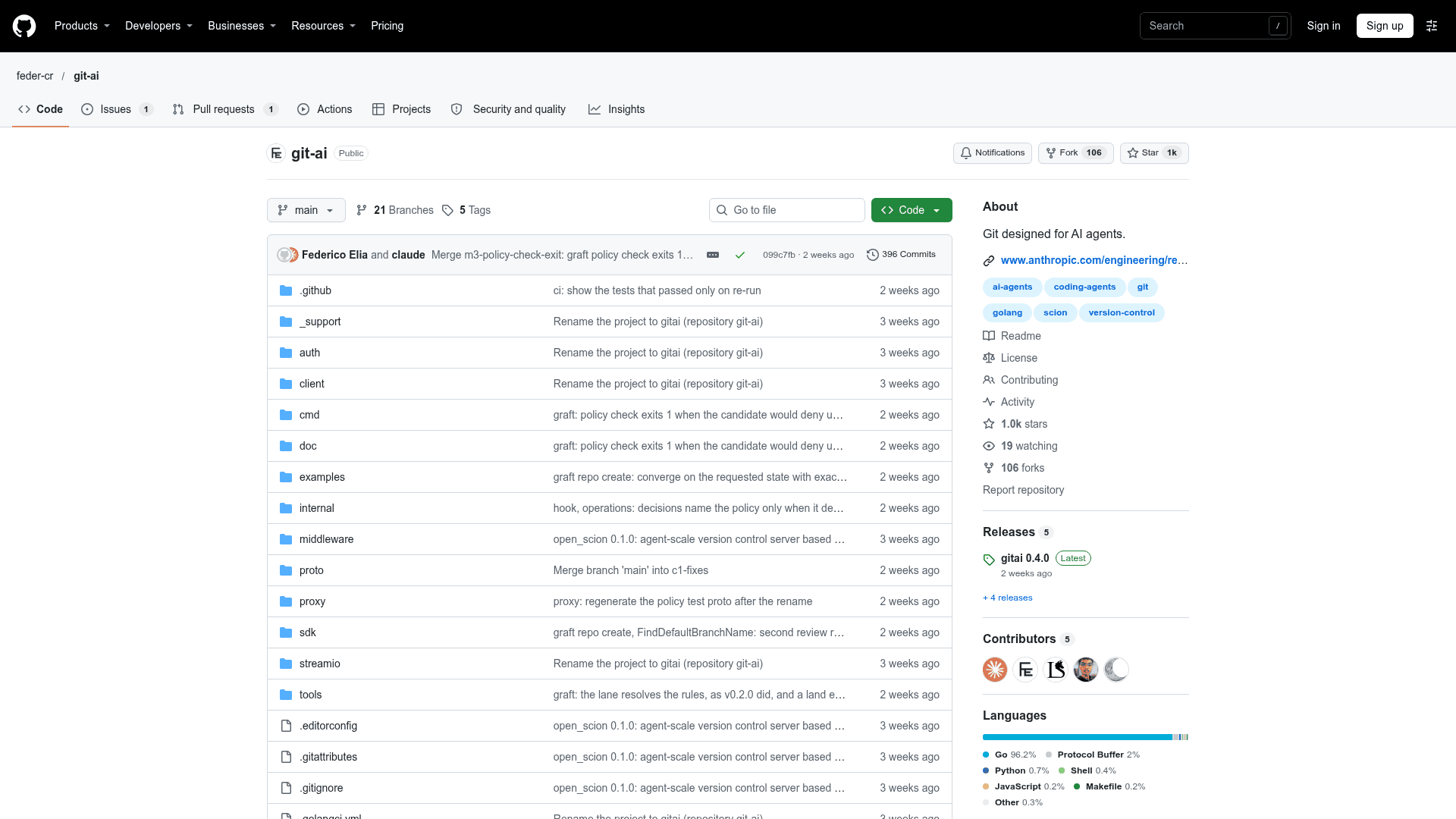
gitai is an open-source, MIT-licensed implementation of the server-centric source control design Anthropic described in its post on redesigning source control. It was built by Federico Elia (feder-cr) as an independent project, not affiliated with or endorsed by Anthropic, and runs on top of normal Git repositories. The latest release listed is v0.4.0.
What It Is
gitai is a Git server extension for workloads where many coding agents read, write and land code on the same branches at once. It started as a fork of GitLab's Gitaly and adds extensions called Graft, including a graft CLI and a Go SDK. Instead of full clones and client-side history walks, clients stay online and fetch only the objects or sparse paths they need, while history questions such as blame, path history, ancestry and code search are answered by the server and memoized as derived data.
How Landing and Conflict Resolution Work
Changes are landed by rebasing onto the current tip and applying a compare-and-swap, with concurrent lands on one branch batched into a single reference update rather than going through a merge queue. When a land conflicts, a resolver you choose can propose a fix: any LLM provider, a deterministic tool, or none. The server itself never calls a language model. A model's resolution lands automatically only if the configured verify.command passes on the exact tree that would land. Otherwise the agent receives the conflict package with the proposal. After landing, graft-verify can test the tip, bisect a failure and revert the offending change.
Storage, Review and Agent Controls
Each change is recorded as a changeset in a write-ahead log in SQLite or PostgreSQL, with packs stored in file, S3, GCS or Azure object storage. Server nodes act as caches that any node can rebuild, so capacity scales by adding nodes, and graft-cache provides verified daemon and regional cache tiers. Other documented pieces include an ordered changelog clients can list or watch, review with semantic approval rules, monitoring agents ("superfans") that report through Slack, and per-agent tokens, RPC allowlists and branch policies.
Setup Path and Status
Building requires Linux or macOS, Go 1.26, a C toolchain, and Meson and Ninja, because the build compiles a bundled Git. A quickstart script starts a server, a cache daemon and two agents and performs a land. The README states interfaces may change before 1.0 and lists known gaps, such as garbage collection of packs in the storage core, in a limitations document.
Community Discussions
Be the first to start a conversation about gitai by Federico Elia
Share your experience with gitai by Federico Elia, ask questions, or help others learn from your insights.
Pricing
Open Source (self-hosted)
gitai, an open-source, self-hostable version control server for AI agents, MIT licensed. Independent of Anthropic's internal Scion and Claude pricing.
- MIT licensed core (all content outside the optional non-MIT ee/ directory, which is not part of this repository)
- Self-hosted server, graft CLI and Go SDK
- Vendor neutral: server never calls a language model; AI features work with any provider or none
- SQLite or PostgreSQL storage with file, S3, GCS or Azure object storage
- Server-side landing with compare-and-swap, changeset log, review, search and verification
Capabilities
Key Features
- Sparse clone and checkout that fetch only requested paths
- Server-side blame, path history, ancestry and code search memoized as derived data
- Landing via rebase and compare-and-swap with batched reference updates
- Pluggable conflict resolution (any LLM provider, deterministic rules, or none) gated by verification
- Changeset write-ahead log in SQLite or PostgreSQL with object storage packs
- Post-landing test, bisect and revert with graft-verify
- Monitoring agents (superfans) with Slack reporting
- Review with semantic approval rules
- Per-agent tokens, RPC allowlist and branch policies
- Tiered graft-cache with object verification