
LayerFS
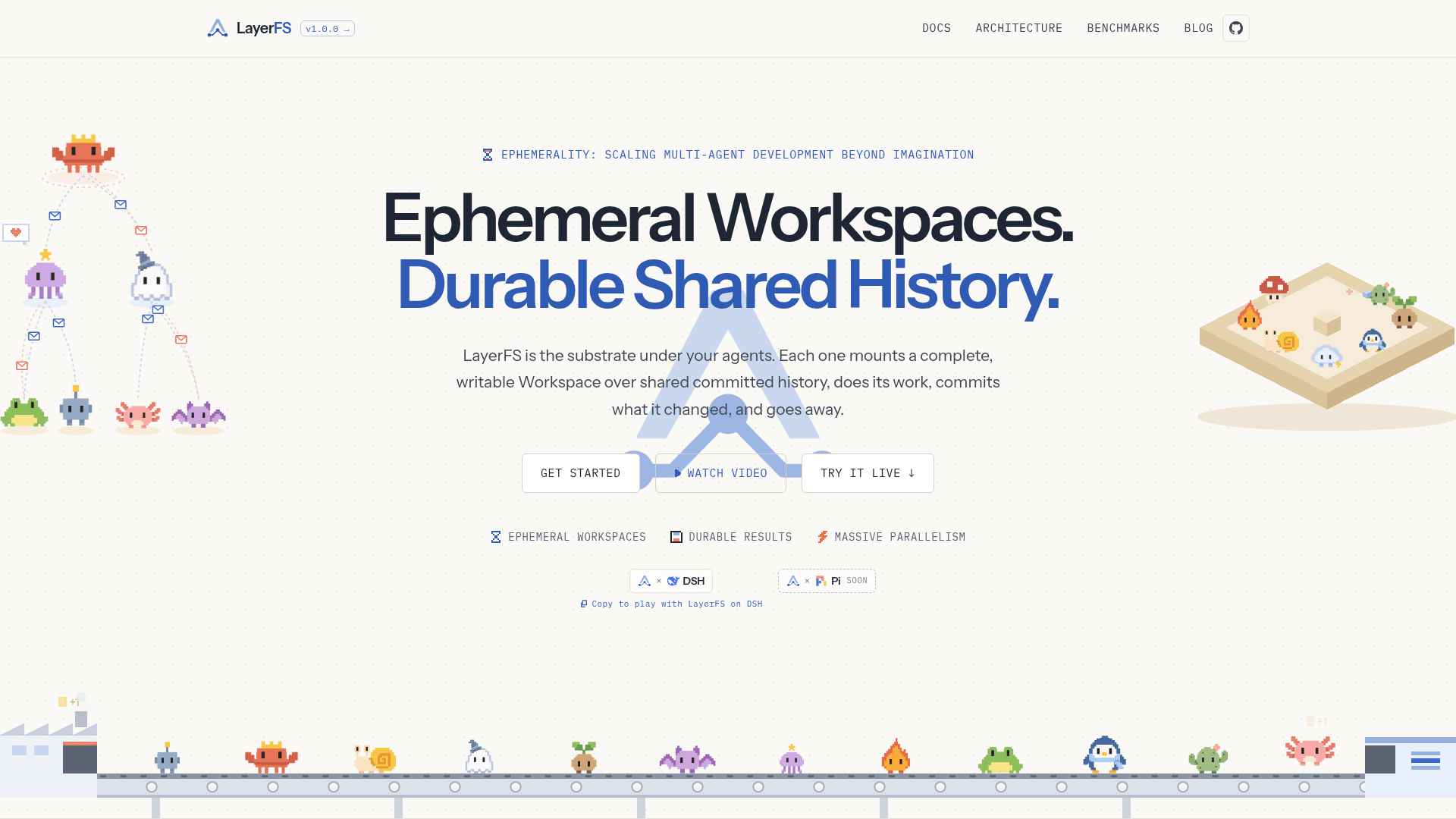
LayerFS gives each AI agent an ephemeral writable filesystem Workspace over shared, deduplicated committed history.
At a Glance
LayerFS core released as source under the MIT License; free to use, copy, modify and distribute.
Engagement
Available On
Listed Oct 2026
About LayerFS
LayerFS is an open-source filesystem substrate for multi-agent development from Ephemeral-AI-Lab. Each agent mounts a complete, writable Workspace over shared committed history, does its work, commits what changed, and goes away. Version 1.0.0 is the first official release, published as source under the MIT license.
What It Is
LayerFS stores every Branch, Commit and content object in a single SQLite file, so there is no database server. File tool calls go to the Store in process through the SDK and each becomes a Commit. Each Bash call mounts a FUSE-based Workspace inside a Sandbox daemon, runs the command, commits, and unmounts. Unmounting deletes the overlay but never history.
How Coordination and Storage Work
- Branches are writable lines of Commits, and publishing a Branch to main adds a Layer.
- Forks are metadata-only, so agents can fork any Commit recursively at any depth.
- Two Commits that change the same file are refused with a Conflict, unless a .lww rule says the newest edit wins.
- Content is chunked, deduplicated and compressed, and ignored files such as dependencies stay in every commit, so mounts come with them already installed.
- Every step is a checkpoint that can be forked from or read as it was, and blame names the step that wrote each line.
Setup Path and Current Status
LayerFS currently runs through LayerFS × DSH, the dsh-layerfs plugin for DeepSeek Harness, which shows each agent's Branch live in the Work and History tabs. The docs describe a paste-a-prompt setup for a coding agent, which needs Node 22.19+, pnpm and Docker. The JavaScript SDK needs a Linux host, Docker Engine, Node 20+ and an ext4, xfs or btrfs filesystem. The README states the Store runs only in a Disposable profile, with no crash or power-loss durability, so it should not be the only copy of data you cannot rebuild. The project publishes benchmark suites, which the README describes as release measurements rather than a guarantee for any workload.
Community Discussions
Be the first to start a conversation about LayerFS
Share your experience with LayerFS, ask questions, or help others learn from your insights.
Pricing
Open Source (MIT)
LayerFS core released as source under the MIT License; free to use, copy, modify and distribute.
- MIT License
- Released as source (v1.0.0)
- Store runs in its Disposable profile only, with no crash or power-loss durability
- Linux; macOS via DSH; Windows via WSL2 on current main
Capabilities
Key Features
- Ephemeral writable Workspaces mounted over shared committed history
- Every tool call recorded as a Commit with auto checkpoints
- Metadata-only recursive forking of any Commit
- Branches, merging and publishing to main
- Conflict detection with .lww last-writer-wins rules
- Content deduplication and compression in a single serverless SQLite Store
- Instant bootstrap with ignored files and dependencies preserved in commits
- Append-only content-addressed objects
- Per-line blame naming the step that wrote each line
- JavaScript SDK with fs and project APIs