
Greplica
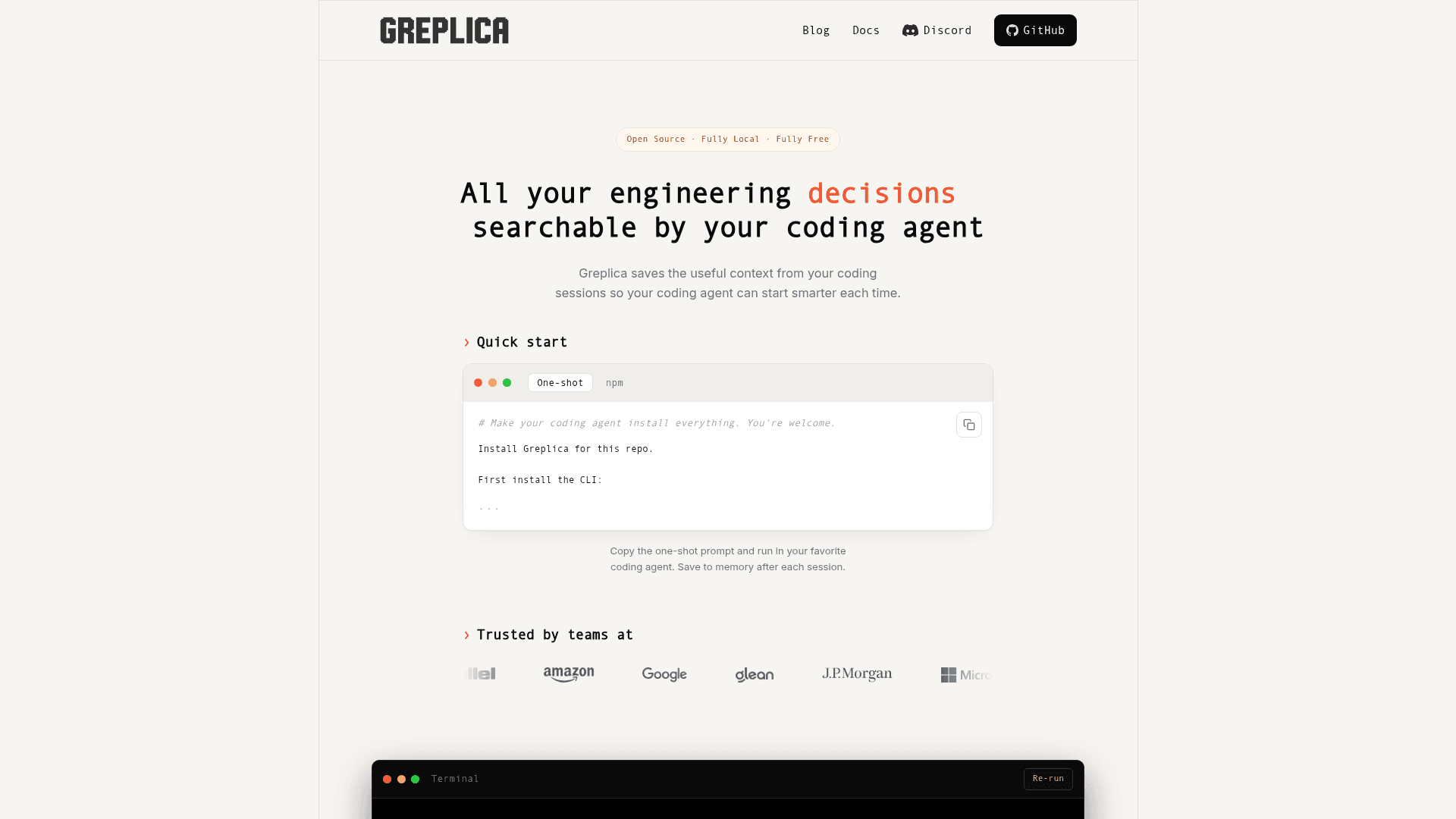
Persistent, searchable engineering memory for AI coding agents that saves context from coding sessions so agents start smarter each time.
At a Glance
Fully free and open source under MIT license. Local mode with no telemetry, no cloud sync, and no API key required.
Engagement
Available On
Listed Aug 2026
About Greplica
Greplica is an open-source CLI tool built by Autoloops that gives AI coding agents persistent, searchable memory of a repository's engineering decisions, constraints, and workflows. It installs via npm, stores a structured knowledge graph locally in SQLite, and integrates with agents like Claude Code, Codex, Cursor, OpenHands, and others. The project is MIT-licensed and fully free to use.
What It Is
Greplica solves a specific problem: every new coding agent session starts cold, forcing the agent to re-learn context it already discovered in prior sessions. Greplica captures the durable parts of those sessions — components, flows, decisions, constraints, and file anchors — and stores them as linked graph nodes. When a new session begins, the agent queries greplica graph context "<question>" to retrieve a ranked Markdown packet of relevant facts before doing any broad exploration. The result is fewer wasted tokens, faster planning, and more reliable agent behavior on complex tasks.
How the Memory Graph Works
Greplica organizes memory into three node types: components (subsystems and modules), flows (multi-step workflows), and claims (specific decisions, constraints, or gotchas). Nodes are linked by edges and anchored to source files. Retrieval combines keyword search, semantic embeddings, and graph traversal to return ranked, relevant results. The graph is stored in ~/.greplica/graph.db on the local machine with no cloud sync and no telemetry in local mode.
- Bootstrap:
greplica-bootstrapinitializes memory for a repo on first use - Update:
greplica-update-working-memorysaves new learnings at the end of a session - Visualization:
greplica graph viewopens an HTML graph view in the browser - Embeddings: supports local (no API key) or OpenAI embeddings
Deployment Model: Local and Managed
Greplica supports two modes. Local mode keeps everything on the developer's machine — no login, no server, no telemetry. Managed mode (requiring v0.2.0 or later) connects a repository to a shared team memory server at memory.autoloops.ai, allowing contributors on different clones and forks to query the same repository memory. Managed mode uses GitHub's browser device flow for authentication and stores only the repository binding, role cache, hook policy, and runtime session metadata locally.
Managed mode includes role-based access (contributor, memory_admin), organization-level inheritance, reusable invite links, and a GitHub Actions reconciliation workflow that audits Memory PRs against exact default-branch code using GitHub OIDC attestation.
Agent Platform Support
Greplica ships agent-native skills and hooks for a wide range of platforms:
- Claude Code and Codex: skills installed to agent home config; hooks inject context guidance and trigger background memory updates
- Cursor: skills at
~/.cursor/skills; guidance delivered via a project rule at.cursor/rules/greplica.mdc - OpenHands: repo-local install to
.agents/skills/and.openhands/hooks.json - GitHub Copilot CLI, OpenCode, Factory Droid, Antigravity: also supported
The recommended setup is a one-shot prompt pasted into the agent, which runs the full installer without manual steps.
Update: Greplica v0.2.1
The latest release is v0.2.1, published July 22, 2026. The v0.2.0 milestone introduced managed shared memory mode. The repository was created in May 2026 and has seen active development, with the last push on July 30, 2026. The GitHub README includes benchmark data from SWE-chat held-out planning tasks: the project claims token savings of 26–75% and time savings of 38% or more in showcased runs, with the strongest case cutting tokens by 75% and finishing ~38% faster. These figures are vendor-published benchmark results from the Autoloops team.
Community Discussions
Be the first to start a conversation about Greplica
Share your experience with Greplica, ask questions, or help others learn from your insights.
Pricing
Open Source
Fully free and open source under MIT license. Local mode with no telemetry, no cloud sync, and no API key required.
- Persistent local SQLite memory graph
- Hybrid keyword, semantic, and graph search
- Local embedding mode (no API key needed)
- Agent skills for Claude Code, Codex, Cursor, OpenHands, and more
- greplica graph context query command
Capabilities
Key Features
- Persistent engineering memory stored as a local SQLite graph database
- Hybrid search combining keyword, semantic embeddings, and graph traversal
- Self-updating wiki that grows with each coding session
- Agent-native skills for Claude Code, Codex, Cursor, OpenHands, and more
- Local embedding mode requiring no API key
- OpenAI embedding mode for higher-quality retrieval
- greplica graph context command returns ranked Markdown for agent use
- greplica graph view visualizes memory as an HTML graph in the browser
- Managed shared team memory mode via memory.autoloops.ai
- GitHub OIDC-attested reconciliation workflow for managed mode
- Role-based access control (contributor, memory_admin) in managed mode
- Reusable repository-scoped invite links for team onboarding
- greplica transcript bundle converts session transcripts to memory bundles
- greplica-fast-session-bootstrap ingests historical session transcripts
- Fully local mode with no telemetry and no cloud sync
- One-shot agent install prompt for zero-manual-step setup