
HarnessEval-W
An agentified benchmark and evaluation pipeline that scores world-model video generation with inspectable evidence trees.
At a Glance
HarnessEval-W evaluation code released under the Apache 2.0 License, as declared in the README.
Engagement
Available On
Listed Nov 2026
About HarnessEval-W
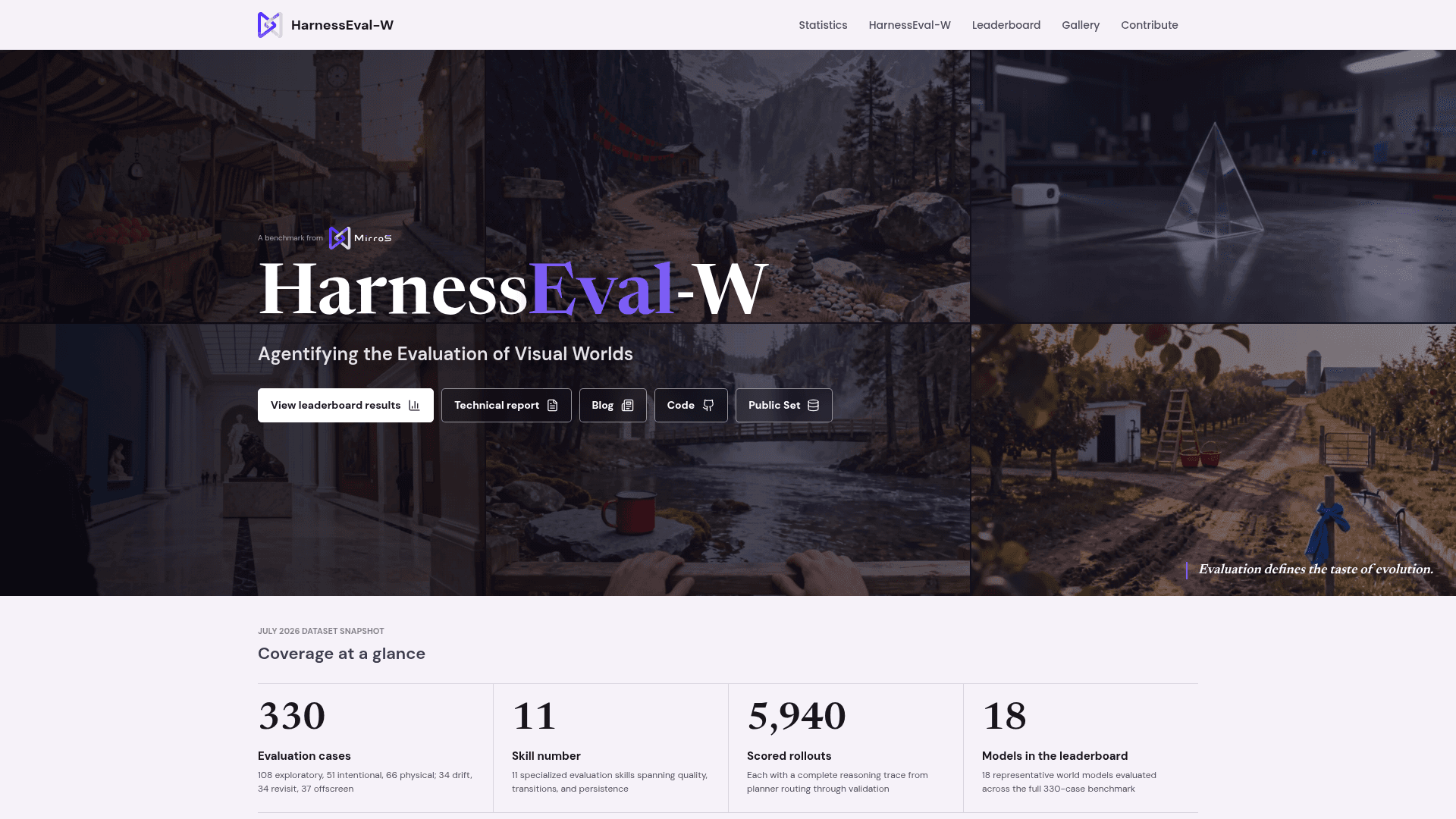
HarnessEval-W is a benchmark and executable evaluation system from MirroS-Lab for judging visual world models. It applies the harness paradigm from the LLM ecosystem: instead of a fixed rubric, a planner routes each case to specialized evaluation skills and sub-agents, and the result is an auditable reasoning trace rather than a bare score. The project provides evaluation code, a public dataset on Hugging Face, and an interactive leaderboard.
What It Is
HarnessEval-W evaluates videos generated by world models, checking whether physics, causality, and world state evolve correctly. Its benchmark covers 330 evaluation cases across exploratory, intentional, and physical transitions, plus drift, revisit, and offscreen persistence cases. The project page lists 11 specialized evaluation skills and 5,940 scored rollouts, and a leaderboard of 18 world models across prompt image-to-video, camera-pose, and native-action interfaces.
How the Evaluation Works
Given a case (initial world, action, probe intent), a planner routes it to the skills that can legitimately evaluate it and records a reason for each skill it skips. Each skill decomposes the question into measurable sub-questions, answered by dedicated sub-agents against rollout evidence. The parent agent validates the evidence and aggregates it into the case score. Routing depends only on case context, never on the model being evaluated. The full trace of questions, answers, scores, and supporting frames is saved as an auditable case card.
Setup and Outputs
Users create three conda environments (launcher/CLI, metric backends, and a physical-plausibility backend), configure credentials, and run the harnesseval eval command on generated videos with a manifest. A harnesseval verify run command checks that a run has all expected scores. A completed run writes summary.json, leaderboard_latest.json and .csv, and LEADERBOARD.md. A bundled example can be evaluated right after setup.
Reported Results and Status
The project page reports a Spearman correlation of 0.93 with human Bradley-Terry ranking on Intentional Transition, and a 4.9x narrower repeat-evaluation envelope than WBench. A 100-case public set and leaderboard were released in September 2026; a hosted submission and evaluation service is still listed as a TODO. The repository invites contributions of cases, skills, and models.
Community Discussions
Be the first to start a conversation about HarnessEval-W
Share your experience with HarnessEval-W, ask questions, or help others learn from your insights.
Pricing
Open Source
HarnessEval-W evaluation code released under the Apache 2.0 License, as declared in the README.
- Code released under Apache 2.0 (declared in README; GitHub metadata shows no license file detected)
- Scope of the license declaration is the code
- Public set of 100 cases on Hugging Face
- Self-hosted CLI evaluation (harnesseval eval / verify)
- Hosted submission & evaluation service is listed as TODO, not available
Capabilities
Key Features
- Agentified evaluation with case-specific skill routing
- Sub-agent decomposition of evaluation questions
- Transparent evidence trees and auditable case cards
- 330-case benchmark with 11 specialized evaluation skills
- Leaderboard of 18 world models
- Public set on Hugging Face
- CLI for evaluating and verifying runs
- Extensible skill library and case contributions
- Model generation adapters for text/image-, action-, and camera-conditioned models