
An open-source coding agent that rewrites its own harness (prompts, tools, compiled Rust core) under a fixed Root that checks, records and can undo every change.
At a Glance
INIT coding agent core, self-hosted under the Apache-2.0 license. Users pay their own model provider (BYOK); spend is metered, not capped.
Engagement
Available On
Alternatives
Listed Nov 2026
About INIT
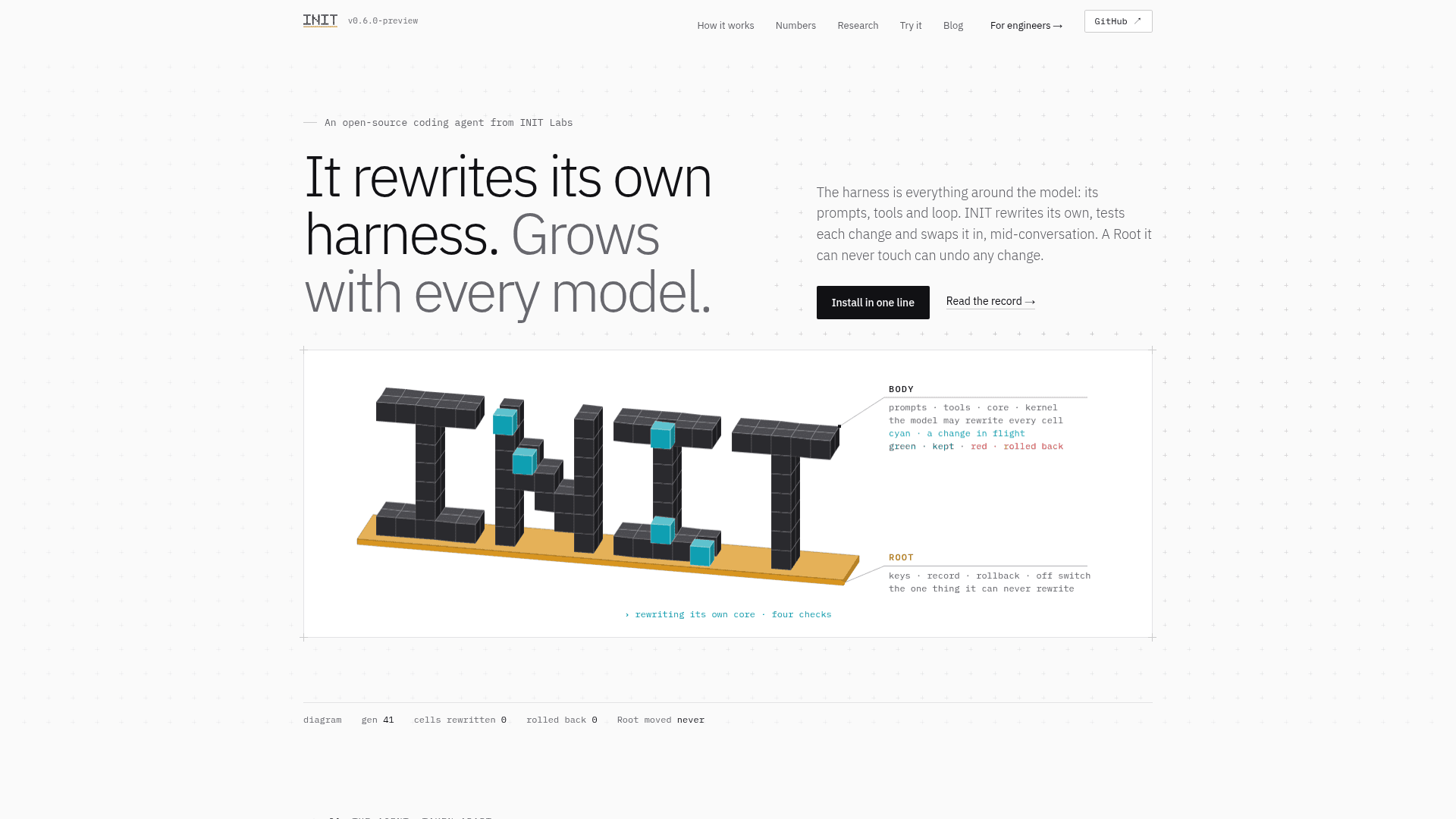
INIT is an open-source coding agent from INIT Labs that rewrites its own harness while it works. The harness is everything around the model: prompts, tools, the loop and how context is kept. A separate process called the Root, which the agent cannot modify, checks each change, records it in a signed log and can roll it back. The project describes version 0.6 as a research preview for macOS and Linux.
What It Is
INIT is a terminal coding agent installed with a one-line script and started with init-agent. On first run it asks you to pick a provider, paste your key and choose a model. Its design premise, per the README, is that a hand-built harness becomes a ceiling as models improve, so the model is allowed to edit its own harness, including the compiled Rust core, mid-task.
How a self-change works
A change to the compiled core goes through five steps: the agent edits a copy on a branch, the copy passes gates, the new process hot-swaps in at a turn boundary on the same conversation log, the change is watched, and it is rolled back if it fails.
- G0 builds the copy and runs tests and clippy.
- G1 regenerates the self-map byte for byte.
- G2 boots the new binary beside the live one.
- G3 has the new version complete a self-edit.
In the default gated mode, a sealed test (G4) on tasks the agent never sees decides whether the change stays. In free mode the Root watches each change with twelve harm signals, such as crashes and spikes in cost or errors. Prompts, skills and Wasm tools reload in place after passing the gate.
The Root and safety model
The Root (init-root) runs as its own service. It holds API keys, the charter, the signing key, the signed lineage, the spend ledger and snapshots. It starts the agent in a sandbox (Seatbelt on macOS, bubblewrap on Linux) and adds the key to each model call, so the agent never holds a key. Controls include /stop, /panic, /undo and /rollback. By default the agent has full access to what the user can access; a workspace mode restricts writes to the start folder and ~/.init. Spend is metered but not capped.
Current Status
The latest release is v0.6.0-preview. The project states it has not yet shown that self-changes make a model better, and lists which providers were and were not live-tested on this release. Supported: macOS 14+ on Apple silicon; Linux x86_64 is experimental; there is no Linux aarch64 bundle for 0.6 and no Windows build. Beyond the agent, INIT Labs lists open research questions on swarms, evolution, metacognition and immunity for self-improving AI.
Community Discussions
Be the first to start a conversation about INIT
Share your experience with INIT, ask questions, or help others learn from your insights.
Pricing
Open Source (Apache-2.0)
INIT coding agent core, self-hosted under the Apache-2.0 license. Users pay their own model provider (BYOK); spend is metered, not capped.
- Apache License 2.0 (OSI-approved) core agent
- Install via one-line curl script
- Bring your own provider API key (external cost)
- Research preview: macOS 14+ on Apple silicon; Linux x86_64 experimental
Capabilities
Key Features
- Rewrites its own harness (prompts, skills, Wasm tools, compiled Rust core) mid-task
- Four-gate checks (build/tests, self-map, boot beside live, self-edit) before a change goes live
- Hot-swap of the new core into the same conversation
- Separate Root process holding keys, signed lineage, snapshots and undo
- Twelve harm signals that trigger automatic rollback
- Sealed G4 test in gated mode
- Commands /stop, /panic, /undo, /rollback
- Workspace mode restricting file access
- Spend metering per model call
- Signed model catalog and local model server support