
jevcore
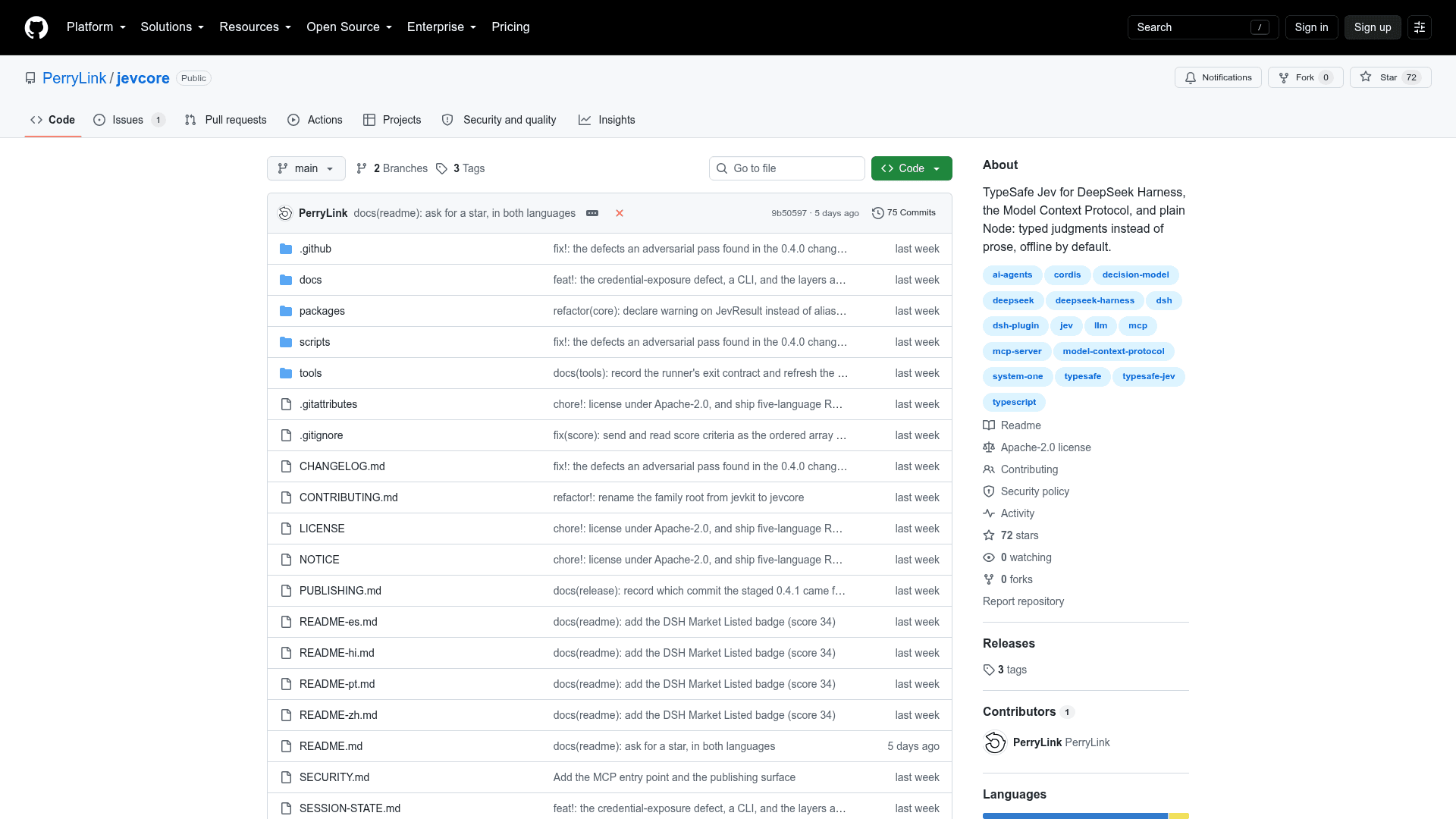
TypeSafe Jev integration for DeepSeek Harness and MCP hosts that delivers typed judgments (yes/no, choice, score) instead of prose, offline by default with explicit egress disclosure.
At a Glance
Free to use, modify, and distribute under the Apache License 2.0.
Engagement
Available On
Listed Oct 2026
About jevcore
jevcore is an open-source TypeScript library that wires TypeSafe's Jev decision model into DeepSeek Harness (DSH) and any Model Context Protocol (MCP) host. It is published under the Apache License 2.0 by PerryLink and part of a stated 40+ plugin family for DeepSeek Harness. The project is offline by default, with every network transmission named explicitly at startup before any data leaves the process.
What It Is
jevcore is a decision-layer adapter, not a chat integration. Jev answers typed questions — noul (yes/no), choice, and score — and returns calibrated probabilities. The project exposes exactly that surface to agents running in DeepSeek Harness or any MCP-capable host, and nothing more. It ships as three coordinated packages: jevcore (the core decision primitives, no harness dependency), jevcore-dsh (the DSH plugin with three tools and two opt-in gates), and jevcore-mcp (the same three tools over stdio MCP).
Three-Package Architecture
The adapter layer is intentionally thin. All decision logic — primitives, providers, egress contract, policy, gates — lives in jevcore (core), so new adapters cannot drift from the guarantees the others make:
jevcore— plain Node ≥20, no Cordis or DSH dependency; use in scripts, services, or custom harnessesjevcore-dsh— DSH plugin requiring Node^22.19.0 || >=24.0.0; registers one service, three tools (jev_ask,jev_rank,jev_check), and two opt-in gates (safety,context)jevcore-mcp— stdio MCP binary (npx -y jevcore-mcp); same three tools for any MCP host that is not DSH
Egress Contract and Privacy Design
The README describes the egress model as "the part worth reading before installing." Every feature defaults to off, and the plugin prints a machine-readable contract at load time listing either egress=OFF or SENDS <feature> { fields } for each active feature. Key design properties documented in the source:
- Default provider is an offline mock; the live path requires both
provider: liveand a resolved credential - A disabled gate registers no event listener at all — verified by test, not policy
- The model cannot widen its own constraints; no tool exposes gate configuration
- An undecided judge answer resolves through explicit config, defaulting to
ask(notallow) - Redaction (
src/redact.ts) runs two passes — sensitive field names and known secret shapes — before any transmission, with an honest caveat that unrecognised secret shapes in free text will pass through
Two live provider routes are supported: TypeSafe directly (api.typesafe.ai) and OpenRouter (openrouter.ai/api), both using the @typesafe-ai/sdk client. The startup report names the active endpoint so operators read the destination rather than infer it.
Tools and Gates
Three tools are exposed to the model, deliberately few and orthogonal:
jev_ask— a batch of typed questions over one state snapshotjev_rank— score and sort candidates against one criterion in a single round-trip; probabilities are independent per-candidate judgments, not a distributionjev_check— claim/evidence verification returningsupported,contradicted,conflicted,insufficient,undecided, orunknown; contradiction outranks support
Two opt-in gates intercept the harness event loop:
gate:safety— judges tool calls before dispatch; opt-in because it runs on every matching call, not just model-initiated onesgate:context— withholds large, uninformative tool results from reaching the agent; fails open unconditionally because losing a real result to a phantom "irrelevant" verdict is treated as worse than keeping an uninformative one
A bundled skill (typesafe-ai-dsh) is registered through the DSH skill registry, teaching an agent when a Jev judgment is appropriate and when it is a category error.
Current Status
The repository was created on 2026-09-20 and last pushed on 2026-09-24. The README documents 410 tests across three packages (314 core, 66 DSH, 30 MCP), all passing without network access or a live API key. The OpenRouter route has been verified against real System One models (typesafe/jev-1.13-20260917). The TypeSafe direct route has been exercised lightly. Gate behaviour on live traffic and long-running or adversarial testing are listed as not yet verified. One known cosmetic issue — a corrupted em dash in jev_ask's description in the currently running process — is noted as fixed on disk but requiring a restart to take effect.
Community Discussions
Be the first to start a conversation about jevcore
Share your experience with jevcore, ask questions, or help others learn from your insights.
Pricing
Open Source
Free to use, modify, and distribute under the Apache License 2.0.
- All three packages: jevcore, jevcore-dsh, jevcore-mcp
- Offline mock provider included
- TypeSafe and OpenRouter live provider routes
- Three tools: jev_ask, jev_rank, jev_check
- Two opt-in gates: safety and context
Capabilities
Key Features
- Typed decision model integration (noul, choice, score)
- Offline by default with mock provider
- Explicit egress disclosure at startup
- Three tools: jev_ask, jev_rank, jev_check
- Two opt-in gates: safety and context
- DeepSeek Harness (DSH) plugin support
- MCP stdio server support
- TypeSafe and OpenRouter provider routes
- Credential redaction before transmission
- Bundled agent skill registration
- Configurable confidence and probability thresholds
- No model-accessible gate configuration
- Fail-safe undecided resolution (defaults to ask)
- 410 tests with no network dependency in CI