
Kiro
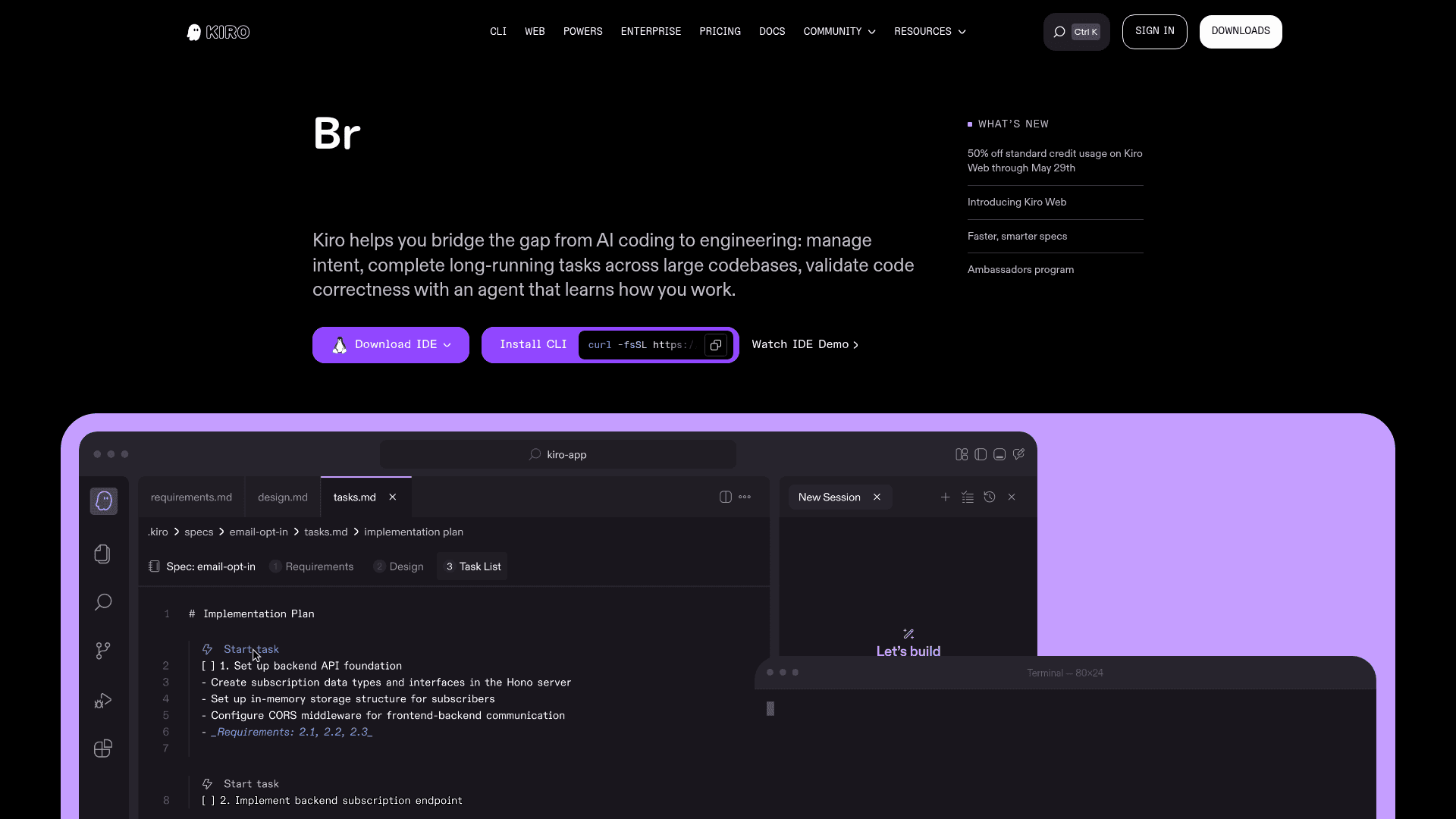
Kiro is an agentic IDE and CLI built by AWS that brings spec-driven development, agent hooks, and advanced context management to help developers ship production-ready code faster.
At a Glance
About Kiro
Kiro is an agentic development environment built and operated by a team within AWS, available as a desktop IDE, CLI, and web interface. It introduces spec-driven development as a structured alternative to vibe coding, turning natural language prompts into requirements, system designs, and implementation task lists before any code is written. The tool is built on Code OSS, making it compatible with VS Code settings, themes, and Open VSX extensions.
What It Is
Kiro is an AI-powered IDE and CLI that sits at the intersection of agentic coding and software engineering rigor. Rather than simply autocompleting code, Kiro works through a structured pipeline: it converts a developer's prompt into EARS-notation requirements, generates an architectural design, and breaks the work into discrete, dependency-sequenced tasks. Agents then implement those tasks, with the developer steering and validating along the way. The tool supports Python, Java, JavaScript, TypeScript, C#, Go, Rust, PHP, Ruby, Kotlin, C, C++, shell scripting, SQL, Scala, JSON, YAML, and HCL.
Spec-Driven Development
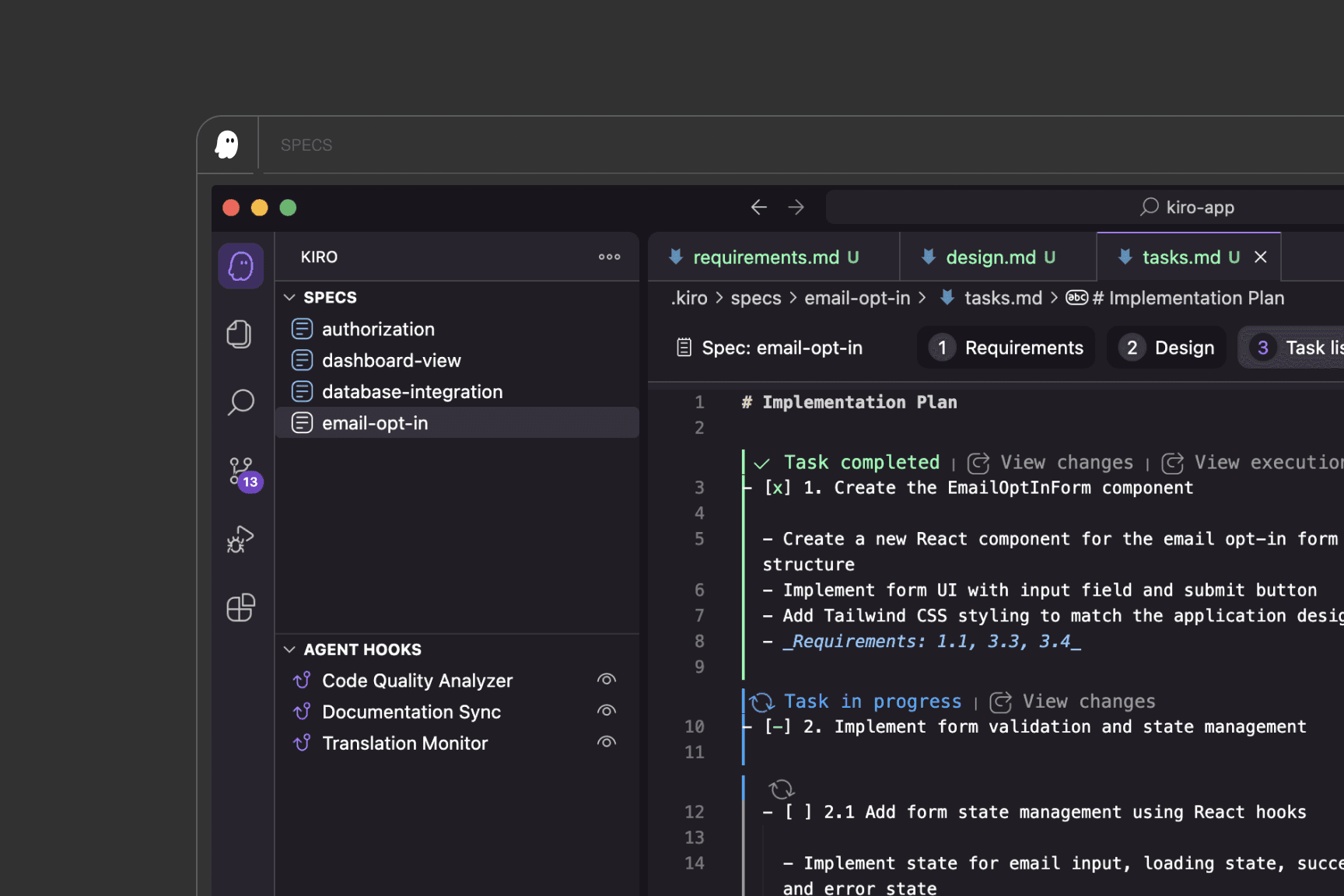
The core differentiator Kiro introduces is spec-driven development. When a developer describes a feature, Kiro produces a structured spec containing requirements in EARS (Easy Approach to Requirements Syntax) notation, an architectural design backed by codebase analysis, and a sequenced task list. This spec becomes the source of truth for implementation, reducing the ambiguity that causes vibe-coded projects to drift or require excessive re-prompting on complex tasks. Specs are executable: agents can be directed to implement individual tasks, and the spec documents the reasoning and decisions made during development.
Agent Hooks and Automation
Kiro's agent hooks allow developers to delegate background tasks to AI agents that trigger on events such as file saves. Pre-defined prompts can instruct agents to automatically generate documentation, write unit tests, or optimize code for performance whenever relevant files change. This lets developers scale their output without manually initiating each auxiliary task.
Interfaces and Deployment
Kiro is available across three interfaces:
- IDE: A standalone desktop application for macOS, Windows, and Linux, based on Code OSS with one-click VS Code settings migration.
- CLI: A terminal-based interface installable via a curl script on macOS, Linux, and Windows, supporting bash, zsh, fish, and over 500 popular CLIs. It carries over steering files and MCP configurations from the IDE.
- Web: A browser-based interface (in preview for paid subscribers) that connects to GitHub repositories, writes code, and opens pull requests autonomously or collaboratively.
All three interfaces share the same credit-based usage model.
Model Access and Context Management
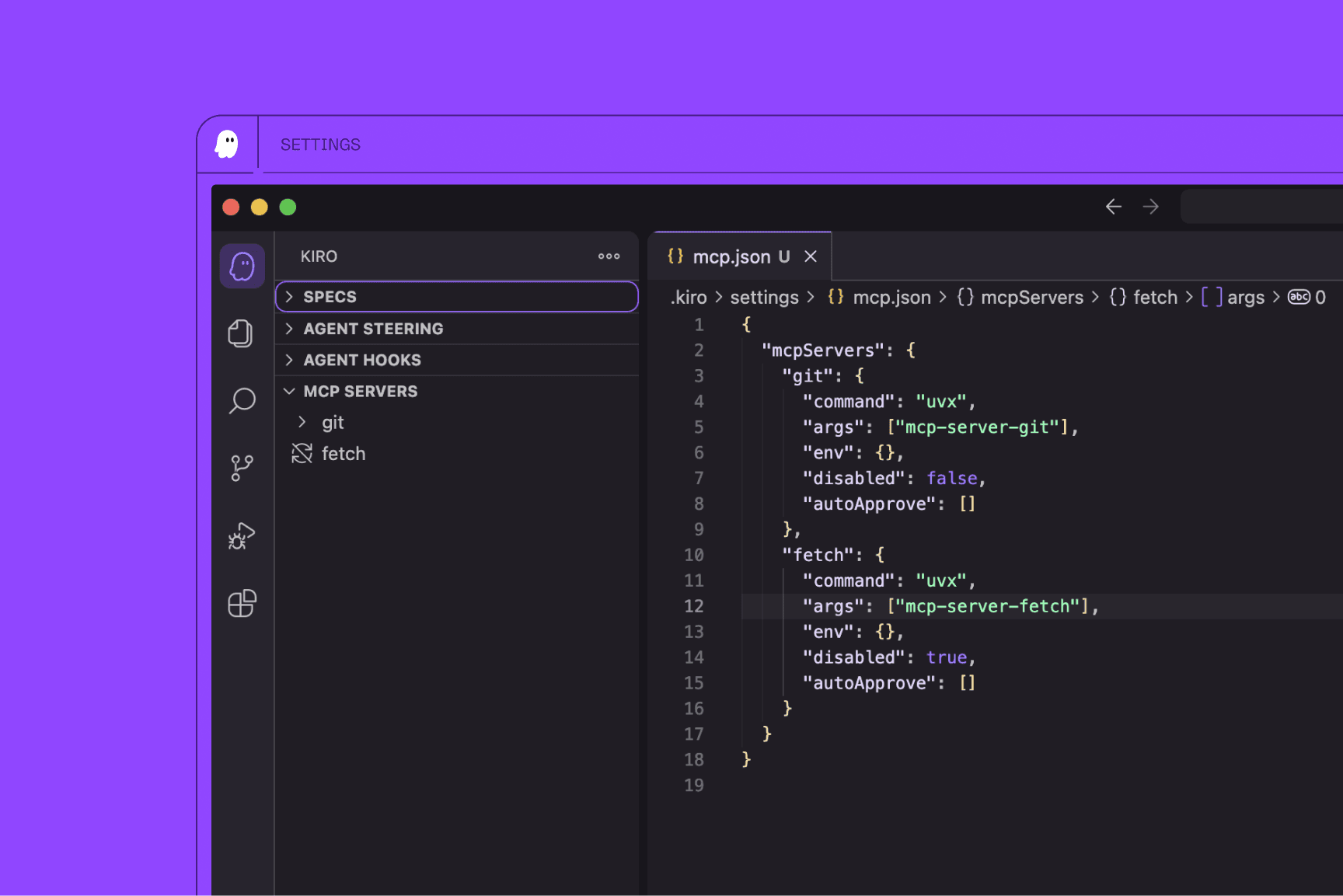
By default, Kiro routes prompts through its "Auto" agent, which uses a mix of frontier models including Claude Sonnet 4.5 and specialized models for intent detection, caching, and task-specific work. Users can also select specific models including Claude Sonnet 4.6, Haiku 4.5, Opus 4.5, Opus 4.6, and Opus 4.7. Context is managed through steering files—markdown documents that encode coding standards, preferred workflows, and project-specific rules—and through native MCP (Model Context Protocol) support for connecting to external docs, databases, and APIs.
Enterprise and Security Posture
Kiro's enterprise offering adds centralized team billing, usage analytics, SAML/SCIM SSO via AWS IAM Identity Center, and an organizational management dashboard. The tool is available in AWS US East (N. Virginia), AWS Europe (Frankfurt), and AWS GovCloud (US) regions. The enterprise page states that Kiro is "designed, built, and operated by following the same security, governance, and encryption standards as the AWS cloud infrastructure," and that paid subscribers receive IP indemnity for generated output per AWS Service Terms. Kiro does not use content from Pro, Pro+, or Power users who authenticate via AWS IAM Identity Center for model training.
Update: Kiro Web and Recent Activity
The GitHub repository (kirodotdev/Kiro) was created in June 2025 and shows active development with over 3,700 stars and 2,800+ open issues as of mid-2026. A blog post titled "Introducing Kiro Web" marks the launch of the browser-based interface, currently in preview for paid subscribers with a promotional half-price credit rate through May 29, 2026. The site also notes "Faster, smarter specs" as a recent update, signaling ongoing iteration on the core spec workflow.
Community Discussions

Some more info on Kiro terminology & LLMs
Specs = tasks. (or subtask) in a tasks.md file in your project. 1 Spec is like a list of steps (around 5 or so) to build some tiny part of your app; I think they bump that up if its a super complex task. Vibes is easy, so like 1 prompt / reply = 1 Vibe. as for LLM so far Kiro has only 2 options Anth…
Pricing
Kiro Free
Perpetual free tier with access to open weight models and Claude Sonnet 4.5.
- 50 credits per month
- Access to open weight models (Qwen3 Coder Next, DeepSeek v3.2, MiniMax 2.1)
- Access to Claude Sonnet 4.5 (with rate limits)
- Kiro IDE, CLI access
Kiro Pro
For individual developers needing more capacity and premium model access.
- 1,000 credits per month
- Access to premium models (Claude Sonnet 4.6, Opus 4.6, Auto)
- Pay-per-use overage at $0.04/credit
- Kiro Web preview access
- Kiro IDE, CLI, Web access
Kiro Pro+
For developers who need higher monthly credit capacity.
- 2,000 credits per month
- Access to premium models (Claude Sonnet 4.6, Opus 4.6, Auto)
- Pay-per-use overage at $0.04/credit
- Kiro Web preview access
- Kiro IDE, CLI, Web access
Kiro Power
For power users requiring the highest monthly credit allocation.
- 10,000 credits per month
- Access to premium models (Claude Sonnet 4.6, Opus 4.6, Auto)
- Pay-per-use overage at $0.04/credit
- Kiro Web preview access
- Kiro IDE, CLI, Web access
Enterprise
Custom enterprise rollout with organizational controls, SSO, and security features.
- Centralized team billing
- Usage analytics and reporting
- SAML/SCIM SSO via AWS IAM Identity Center
- Organizational management dashboard
- Enterprise security and privacy controls
- AWS GovCloud (US) region support
- IP indemnity
Capabilities
Key Features
- Spec-driven development with EARS notation requirements
- Agentic chat with multimodal support
- Agent hooks triggered on file save and other events
- Steering files for project-specific AI guidance
- Native MCP (Model Context Protocol) support
- Kiro Web browser interface with GitHub integration and PR creation
- Kiro CLI for terminal-based agentic workflows
- VS Code settings, themes, and Open VSX extension compatibility
- Auto agent using a mix of frontier models
- Support for Claude Sonnet, Haiku, and Opus model families
- Code intelligence across large codebases
- Autonomous and collaborative agent modes
- Credit-based usage with pay-per-use overage
- Enterprise SSO via AWS IAM Identity Center
- Centralized team billing and usage analytics
- IP indemnity for paid subscribers
- AWS GovCloud (US) region support
- Privacy controls with opt-out of data sharing