Oz Agent Platform
Oz is Warp's cloud orchestration platform for running, managing, and coordinating fleets of coding agents across any harness, model, or repository.
At a Glance
For developers who want a modern terminal with support for agentic coding (up to 10 seats)
Engagement
Available On
Alternatives
Updated Jun 2026
About Oz Agent Platform
Oz is the cloud agent orchestration layer built by Warp, designed to let engineering teams connect, run, and govern fleets of AI coding agents at scale. It sits alongside the Warp Terminal and Warp Agent as the third pillar of Warp's agentic development environment, handling the infrastructure side of multi-agent work: compute provisioning, shared context, observability, and administration. The aim is to let developers direct agents rather than babysit the scaffolding around them.
What It Is
Oz is a cloud-native control plane for orchestrating coding agents. The division of labor across Warp's three products breaks down like this:
- Warp Terminal: the local interface for agentic coding.
- Warp Agent: the agent harness that plans, edits code, runs tests, and reports back.
- Oz: the cloud execution layer that spins up isolated environments, routes tasks across harnesses, persists context between sessions, and gives teams central control.
Warp describes Oz as "agent infrastructure for shared context, observability, and administration."
Multi-Harness Orchestration
Oz's defining capability is running more than one agent harness inside the same cloud environment. Warp calls it the first truly multi-harness control plane for cloud agents. Teams can:
- Run Claude Code, OpenAI Codex, and the Warp Agent side by side.
- Route each task to the harness that fits it best (Warp suggests Claude Code for bug investigation, Codex for codebase migrations).
- Compare harness effectiveness while keeping one consistent layer of governance, access control, and audit logs.
Per Warp's blog post, multi-harness orchestration is available to all users while in beta, and the company notes availability and limits may change as it leaves beta.
Automatic Multi-Agent Orchestration
Beyond running harnesses in parallel, Oz can coordinate them automatically. According to Warp, the Warp Agent can act as a parent run that spawns Claude Code or Codex subagents and coordinates their outputs, while other harnesses cannot act as parents. This targets long-horizon work such as:
- Large feature builds
- Code migrations
- Production deployments
Subagents can run locally or in the cloud, with the full run inspectable in real time and replayable afterward from the Oz dashboard.
Cross-Harness Agent Memory
Agent Memory is the piece that lets a fleet of agents improve instead of repeating the same mistakes. Per Warp's docs, it is a persistent store that lives on Oz and is shared across every supported harness (Warp Agent, Claude Code, Codex, and others as they are added), so a fact learned in one session is available to the next no matter which harness, machine, or teammate triggers the work. It is currently in research preview behind a waitlist.
How Warp describes it:
- Automatic capture: session transcripts are extracted and consolidated in the background, turning mistakes, feedback, and decisions into memory with no manual logging.
- No token or latency cost: memory creation and retrieval run asynchronously, so they do not spend the active task's tokens or slow it down.
- Semantic retrieval: search runs over indexed embeddings instead of slow file-by-file traversal, which Warp says keeps it fast at org-wide scale.
- Pluggable sources: knowledge can come from files (such as skills), MCP servers, databases, or other enterprise apps, and Oz can write to the store itself as it completes tasks.
- Owned and portable: Warp says companies own their memory corpus, can self-host the artifacts, and can read or edit memories through the Oz API and SDK.
The stated payoff is turning team feedback and institutional knowledge into better agent skills, prompts, and evals over time.
Observability, Control, and Infrastructure
Oz gives team leads a single dashboard to monitor and steer every running agent. Key capabilities include:
- Central visibility: monitor all active sessions, view telemetry, and join any session with one click.
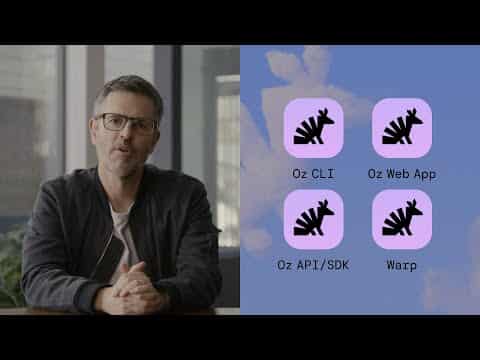
- Triggers and interfaces: start agents from Warp Terminal, Web, or Mobile, and trigger them from Slack, Linear, GitHub, or via CLI, API, and SDK.
- Governance: spend caps, data-control policies, and an autonomy spectrum that ranges from approval at each step to more autonomous runs.
- Where agents run: sandboxed environments hosted by Warp, or self-hosted on your own cloud, VPC, or data center for full data ownership.
Warp's site is the stated source for the autonomy and governance controls.
Update: Multi-Harness Launch and Open-Source Warp
On May 19, 2026, Warp announced the multi-harness upgrade to Oz, adding cross-harness memory, automatic multi-agent orchestration, and deeper enterprise controls. Oz first launched in February 2026.
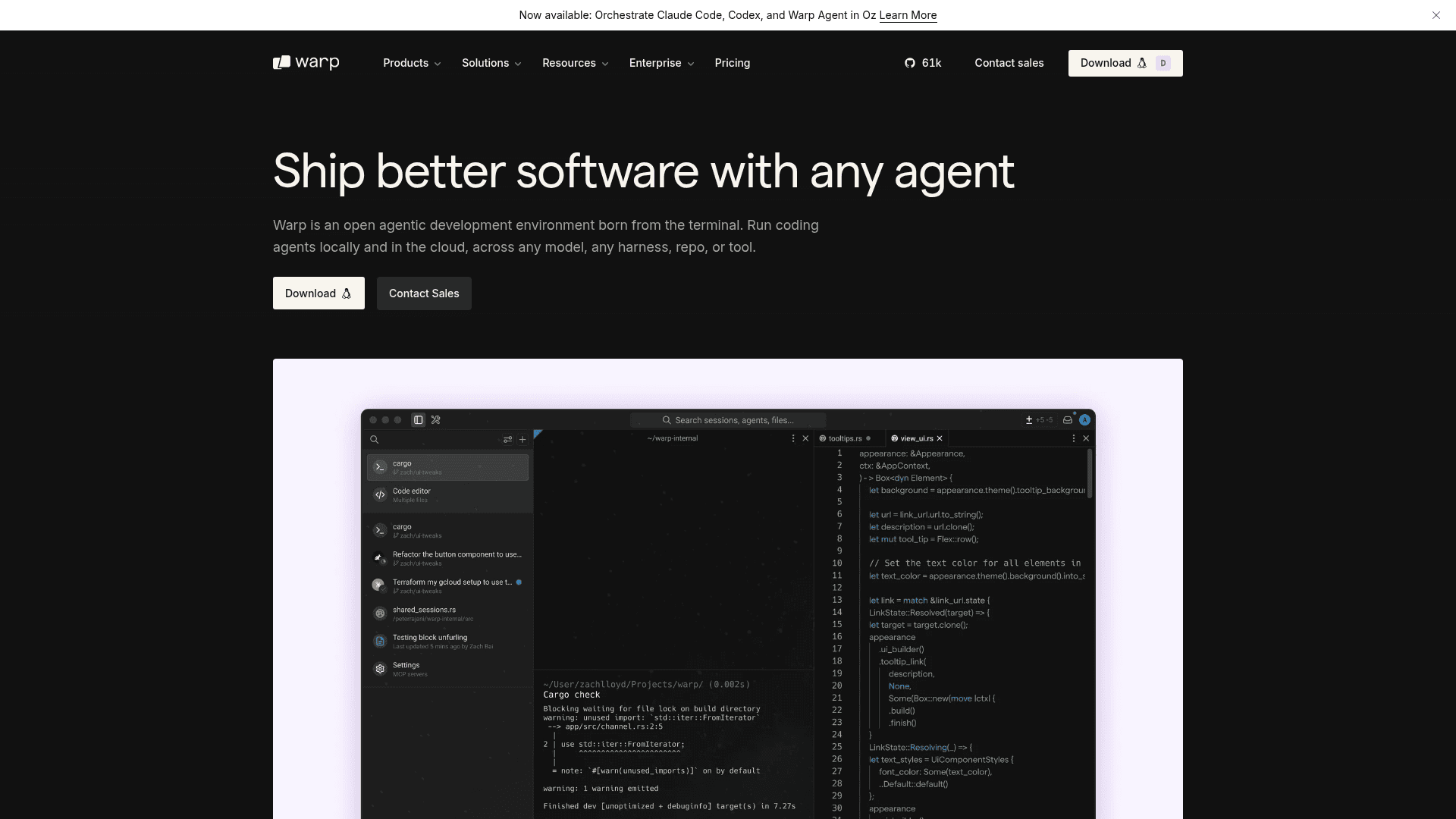
Separately, Warp open-sourced its Terminal client:
- The client code is published on GitHub under AGPL-3.0, with the UI framework crates (warpui_core and warpui) under MIT.
- Warp says OpenAI is the founding sponsor of the repository, and the contribution workflow is itself managed through Oz, with agents handling most implementation while humans focus on direction and verification.
- Warp also runs an "Oz for OSS" program, offering Oz credits to open-source maintainers who want the same agentic triage and PR-review workflows on their own repos.
Community Discussions
Be the first to start a conversation about Oz Agent Platform
Share your experience with Oz Agent Platform, ask questions, or help others learn from your insights.
Pricing
Free
For developers who want a modern terminal with support for agentic coding (up to 10 seats)
- State-of-the-art modern terminal
- Limited Warp Agent access
- Limited cloud agents access (4 concurrent)
- Bring your own API key
- Custom inference endpoint support
Build
For developers who want flexible access to AI that scales with their usage (up to 10 seats)
- 1,500 credits per month for cloud and local agents
- Full Warp Agent access (OpenAI, Anthropic, and Google frontier models)
- Reload credits with volume-based discounts, auto-reload, and team-wide spend cap
- Extended cloud agents access (20 concurrent)
- 4 vCPUs, 8 GiB RAM per cloud agent
- Highest codebase indexing limits (40 codebases, 100,000 files each)
- Unlimited Warp Drive objects and collaboration
- Unlimited cloud conversation storage
- Private email support
- Admin dashboard
Max
For developers who need maximum AI capacity with all the flexibility of Build (up to 10 seats)
- 18,000 credits per month (12× the included credits of Build)
- 20 concurrent cloud agents
- 4 vCPUs, 8 GiB RAM per cloud agent
- Reload credits with volume-based discounts, auto-reload, and team-wide spend cap
- Full Warp Agent access (OpenAI, Anthropic, and Google frontier models)
- Unlimited Warp Drive objects and collaboration
- Unlimited cloud conversation storage
- Private email support
- Admin dashboard
Business
For teams scaling AI-powered development (up to 25 seats)
- 1,500 credits per month per seat for cloud and local agents
- 40 concurrent cloud agents
- 8 vCPUs, 16 GiB RAM per cloud agent
- Team usage metrics
- Admin-configurable data controls (zero data retention enforced team-wide)
- SAML-based SSO
- Reload credits with volume-based discounts, auto-reload, and team-wide spend cap
- Full Warp Agent access (OpenAI, Anthropic, and Google frontier models)
- Unlimited Warp Drive objects and collaboration
- Unlimited cloud conversation storage
- Private email support
- Admin dashboard
Enterprise
For organizations needing advanced control, security, and scale
- Unlimited seats
- Custom shared credit pools and usage terms
- Advanced spend controls
- Enterprise admin controls
- Enterprise Analytics API
- Multi-admin support
- Bring your own LLM (AWS Bedrock, Google Vertex AI, Azure AI Foundry)
- Self-host cloud agents on your infrastructure
- Custom codebase indexing
- Cross-harness agent memory (Research Preview)
- White-glove onboarding and implementation engineer support
- Dedicated account manager and shared Slack channel
Capabilities
Key Features
- Multi-harness cloud agent orchestration (Claude Code, Codex, Warp Agent)
- Warp Agent Memory — cross-harness persistent memory for preferences, project knowledge, and learnings (Research Preview)
- Isolated cloud agent environments with dedicated compute per session
- Central dashboard with real-time visibility into all running agent sessions
- Single-click join for any active agent session
- Configurable agent autonomy spectrum (step-by-step approval to fully autonomous)
- Team-wide spend caps and auto-reload credit management
- Admin-configurable data controls and zero data retention enforcement
- Enterprise Analytics API for usage data export
- Self-hosting for cloud agents on customer infrastructure (Enterprise)
- Bring your own LLM via AWS Bedrock, Google Vertex AI, Azure AI Foundry (Enterprise)
- MCP (Model Context Protocol) support
- Codebase indexing with up to 100,000 files per codebase
- SAML-based SSO (Business and Enterprise)
- SOC 2 Type 2 certified
- Multi-admin controls (Enterprise)
- Oz for OSS partner program for open-source maintainers
Integrations
Demo Video