Magick
Magick is an open-source visual IDE (AIDE) for building, programming, and deploying AI agents using a no-code, node-based graph interface.
At a Glance
Free and open-source self-hosted version available on GitHub under the Apache 2.0 license.
Engagement
Available On
Alternatives
Listed Jul 2026
About Magick
Magick is a visual Artificial Intelligence Development Environment (AIDE) built by Oneirocom, designed to let developers and non-coders alike create, test, and deploy multimodal AI agents without writing traditional code. The project is open-source under the Apache 2.0 license (with portions under the same from Latitude Games' original Thoth project) and is currently available in beta. It is built primarily in TypeScript and hosted on GitHub under the Oneirocom organization.
What It Is
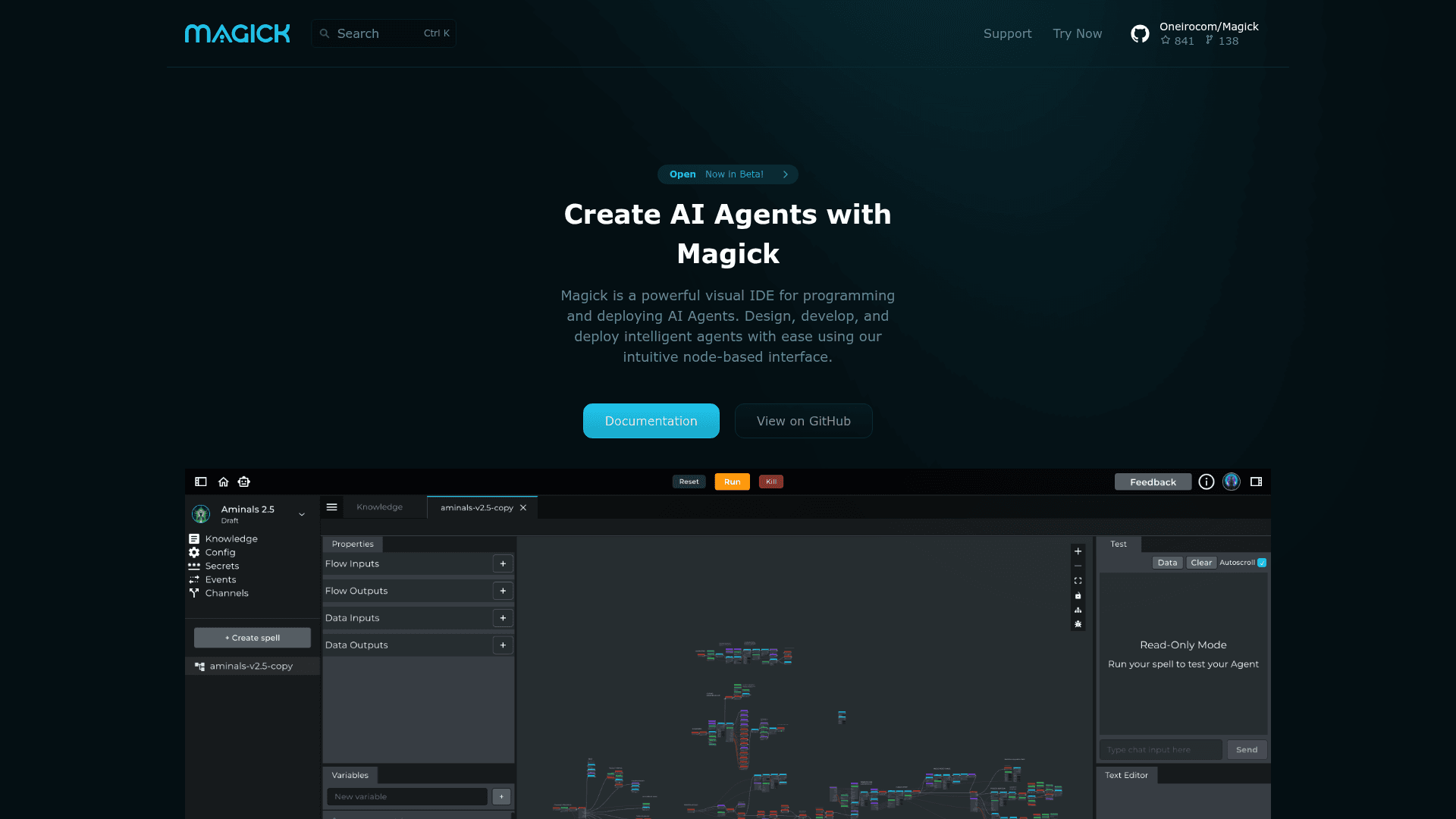
Magick is a no-code, graph-based platform for constructing AI data pipelines and intelligent agents. Users build "spells" — visual workflows composed of interconnected nodes — that define how data flows through transformations, LLM calls, memory lookups, and external service integrations. The environment is designed to handle everything from simple chatbots to complex reasoning systems and realistic interactive characters.
Visual Node Builder and Core Concepts
The heart of Magick is its node-based composer. Users drag, drop, and connect nodes in a visual canvas to define agent behavior:
- Spells: The top-level unit of work — a JSON-serializable graph of nodes, connections, variables, and presets. Spells can be imported, exported, and shared with the community.
- Nodes: The building blocks of any spell. Each node takes input, applies a transformation (an LLM call, a code snippet, a search query, etc.), and passes output downstream. Node types include Input, Prompt Template, Code Node, Generator Node, Wait For All, and many more.
- Triggers: Asynchronous signals that tell nodes when to start processing, enabling event-driven and real-time agent behavior.
- Subgraphs: Spells can be embedded inside other spells, enabling modular, reusable components and rapid community-driven development.
Platform Agnosticism and Integrations
Magick is designed to be model- and platform-agnostic. The homepage states users can freely choose and compare LLMs including GPT-4, Claude, Gemini, and open-source alternatives, selecting the best model for each task within a single workflow. Out-of-the-box social and service connectors include:
- Discord, Twitter, and Twilio
- Google AI services
- Unreal Engine NPC integration
- Vector search and semantic web search (Google, Wikipedia)
- Voice and image generation nodes
- Custom API connections
The GitHub README notes that Zoom, Google Meet, Reddit, and Slack connectors are planned as future plugins.
Open-Source Lineage and Community
Magick traces its lineage to Thoth, an earlier project by Latitude Games, whose original contributors are credited in the repository. The Oneirocom team forked and significantly extended that codebase, and the project now has 27 listed contributors and an active community Discord. The repository has accumulated over 840 stars and 138 forks on GitHub. Development is community-driven and conducted openly, with the default branch named development.
Update: v0.0.13-7
The latest published GitHub release is v0.0.13-7, released on November 28, 2024. The repository was last pushed to in June 2025 and last updated in July 2025, indicating ongoing active development. The homepage notes the product is currently in open beta, with documentation available at the getting-started guide. The GitHub topics tag the project with keywords including agent, agi, no-code, langchain, pgvector, prompt-engineering, and visual-scripting, reflecting the current product direction toward agentic, retrieval-augmented, and multimodal workflows.
Community Discussions
Be the first to start a conversation about Magick
Share your experience with Magick, ask questions, or help others learn from your insights.
Pricing
Open Source
Free and open-source self-hosted version available on GitHub under the Apache 2.0 license.
- Visual node-based agent builder
- Spell-based data pipelines
- Community-contributed nodes and connectors
- Import/export spells as JSON
- Self-hosted deployment
Capabilities
Key Features
- Visual node-based agent builder (no-code)
- Spell-based data pipeline system
- Real-time and event-driven agent execution
- Platform-agnostic LLM support (GPT-4, Claude, Gemini, open-source)
- Social connectors (Discord, Twitter, Twilio)
- Vector search and semantic web search
- Voice and image generation nodes
- Subgraph embedding for modular workflows
- Document processing and knowledge embedding
- Scalable deployment architecture
- Metered billing for cloud usage
- Custom node creation
- Import/export spells as JSON
- Unreal Engine NPC integration
Integrations
Demo Video