
MemT-1.0
A family of memory foundation models that build persistent, dynamically evolving native memory into model computation, served with SGLang.
At a Glance
Repository software is available under the PolyForm Noncommercial License 1.0.0 for noncommercial use only; not OSI-approved. Commercial use requires contacting the authors.
Engagement
Available On
Listed Oct 2026
About MemT-1.0
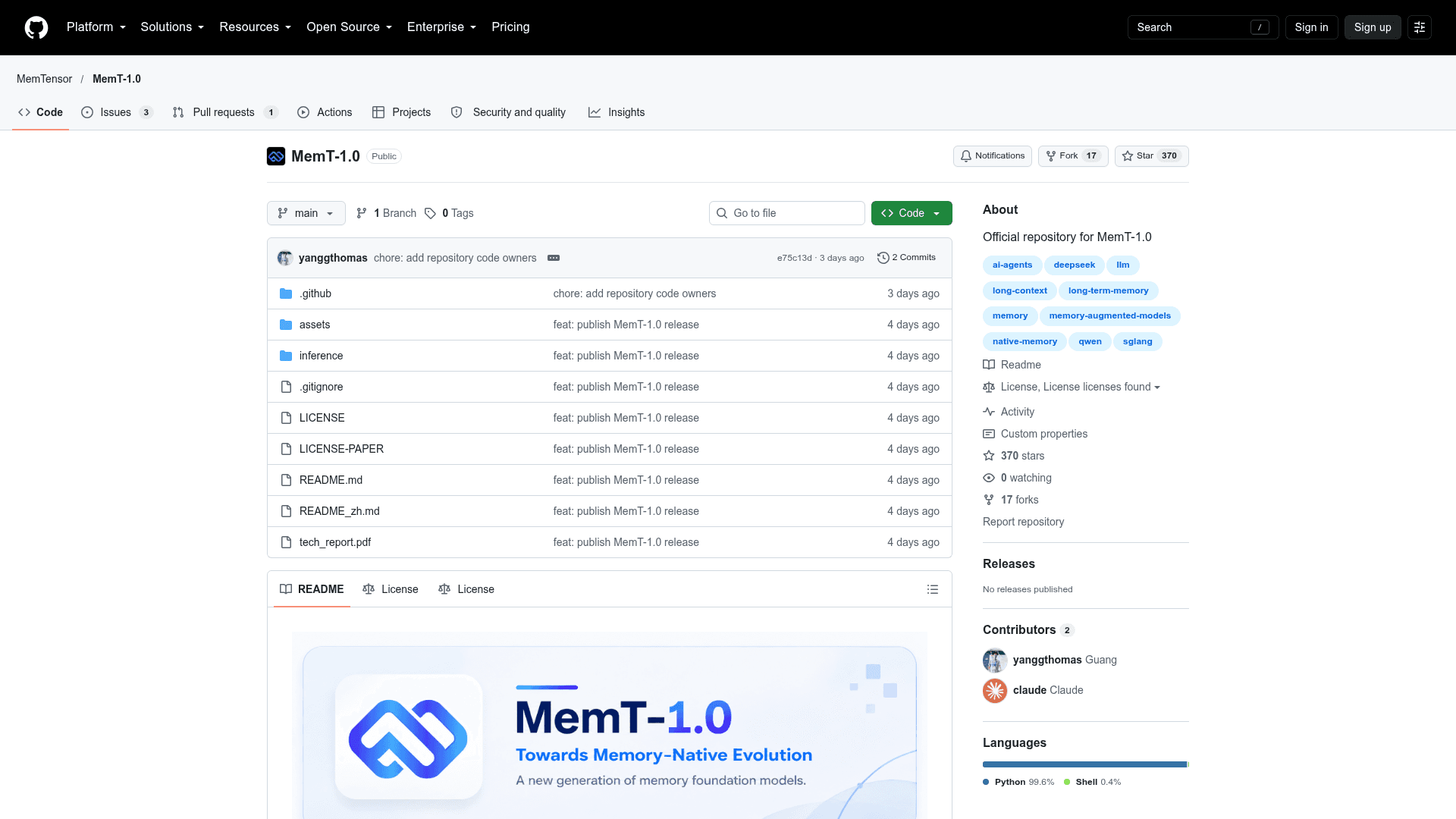
MemT-1.0 is a family of memory foundation models from MemTensor. It integrates dynamic local memory and trainable hyper memory so the model can retain and use historical information without accessing the original context at inference. The repository provides the SGLang-based inference code and a Python client for memory-enabled conversations.
What It Is
MemT-1.0 adds a Native Memory Block alongside the backbone attention. The Local Memory Block maintains a dynamic, multi-channel memory matrix that evolves across interaction steps. The Hyper Memory Block holds trainable memory query, key and value projections, plus erase, write, forget and output gates. During generation, memory attention reads from the current memory state and adds its gated readout to the backbone attention output; at the end of each turn or segment, GDN-2 performs token-level memory updates. The README states the persistent state stays constant in size, reducing storage by about 66x versus a full-context KV cache at 128K history length.
Model Family
Two models are listed. MemT-1.0-Nano uses a Qwen3.6-35B-A3B backbone (36B total, 3B activated parameters). MemT-1.0-Flash uses a DeepSeek-V4-Flash backbone (288B total, 17B activated parameters). Model weights are published in a Hugging Face collection.
Working With Memory
The model is served with SGLang on a Linux server with NVIDIA CUDA and Python 3.11 or newer. The memt_sglang client offers a session API: with enable_memory=True, completed turns are saved into latent local memory and their plaintext context is cleared. Sessions can be saved as snapshots and restored later without the earlier transcript. Memory reading can be disabled for standard chat.
Evaluation and Applications
Across 11 memory benchmarks, the README says MemT-1.0-Flash and MemT-1.0-Nano rank first and second among the evaluated parametric-memory methods. It also notes that strong textual-memory systems remain ahead overall, especially on long histories needing detailed evidence retrieval. The project also demonstrates experience-guided agentic coding, where retrieved experience is stored in native memory rather than added to the task context.
Licensing
The repository software uses the PolyForm Noncommercial License 1.0.0, so commercial use is not permitted without separate licensing. The paper is under CC BY-NC-SA 4.0, and model weights have separate terms.
Community Discussions
Be the first to start a conversation about MemT-1.0
Share your experience with MemT-1.0, ask questions, or help others learn from your insights.
Pricing
Noncommercial License
Repository software is available under the PolyForm Noncommercial License 1.0.0 for noncommercial use only; not OSI-approved. Commercial use requires contacting the authors.
- Licensed under PolyForm Noncommercial License 1.0.0 (not OSI-approved)
- Noncommercial purposes only: personal research, experiment, testing, study, and noncommercial organizations
- Commercial use of the repository software is not permitted
- Model weights, datasets and other assets are not covered by this license; their terms are provided with releases
- Self-hosted inference; requires a Linux server with NVIDIA CUDA and Python 3.11+
Capabilities
Key Features
- Native memory block with local and hyper memory
- Constant-size persistent memory state
- Mixture-of-Storage for scalable memory capacity
- Save and resume memory snapshots
- Toggleable memory reading and writing per session
- Experience-guided agentic coding
- SGLang serving with Python client
- Nano and Flash model variants