
MiMoCode
An open-source, terminal-native AI coding agent with cross-session persistent memory, subagent orchestration, and self-improvement capabilities.
At a Glance
About MiMoCode
MiMoCode is an open-source AI coding agent built by Xiaomi's MiMo team, released under the MIT License. It runs natively in the terminal and extends the OpenCode foundation with persistent memory, intelligent context management, and autonomous multi-agent workflows. The project launched on GitHub in June 2026 and reached over 6,200 stars within days of its initial v0.1.0 release.
What It Is
MiMoCode is a terminal-native AI coding assistant that can read and write code, run shell commands, manage Git, and maintain a deep understanding of your project across sessions. Unlike stateless coding assistants, MiMoCode uses a SQLite FTS5-powered persistent memory system to store project knowledge, session checkpoints, and task progress — so the agent picks up exactly where it left off without relearning context. It is a fork of OpenCode, retaining all core capabilities (multiple LLM providers, TUI, LSP, MCP, plugins) while adding a substantial layer of autonomous and memory-driven features.
Persistent Memory Architecture
MiMoCode's memory system is one of its defining characteristics. It maintains four distinct memory artifacts per project:
- MEMORY.md — long-lived project knowledge, rules, and architecture decisions
- checkpoint.md — structured session state snapshots written automatically by a checkpoint-writer subagent
- notes.md — temporary scratch space for agents during a session
- tasks//progress.md — per-task progress logs tied to a tree-shaped task system (T1, T1.1, T1.2, …)
When a session resumes, all relevant memory is injected automatically using a token-budgeted importance ranking, so the agent does not need to re-explore the codebase from scratch.
Multi-Agent and Autonomous Workflow
MiMoCode ships with three primary agents switchable via the Tab key:
- build — the default agent with full tool permissions for active development
- plan — a read-only analysis mode for code exploration and solution design
- compose — an orchestration mode for specs-driven development using built-in skills for planning, TDD, code review, debugging, verification, and merging
The primary agent can spawn subagents on demand. Subagents share session context, support parallel execution, and have lifecycle tracking and cancellation. The /goal command sets a stopping condition evaluated by an independent judge model, preventing premature autonomous stops.
Self-Improvement: Dream and Distill
Two commands enable the agent to improve itself over time:
/dream— scans recent session traces, extracts durable knowledge into project memory, and prunes outdated entries/distill— identifies repeated manual workflows and packages high-confidence candidates into reusable skills, subagents, or commands
This self-improvement loop is designed to reduce repetitive prompting and accumulate project-specific expertise automatically.
Setup and Provider Support
MiMoCode installs via a one-line curl script or npm install -g @mimo-ai/cli. On first launch, a TUI guides configuration. Supported authentication paths include MiMo Auto (a free-for-limited-time anonymous channel requiring zero configuration), Xiaomi MiMo Platform OAuth login, one-step migration from Claude Code, and any OpenAI-compatible custom API. Configuration lives in .mimocode/mimocode.json per project or globally at ~/.config/mimocode/mimocode.json. An experimental Max Mode enables parallel best-of-N reasoning with judge-based selection.
Update: v0.1.0 Launch
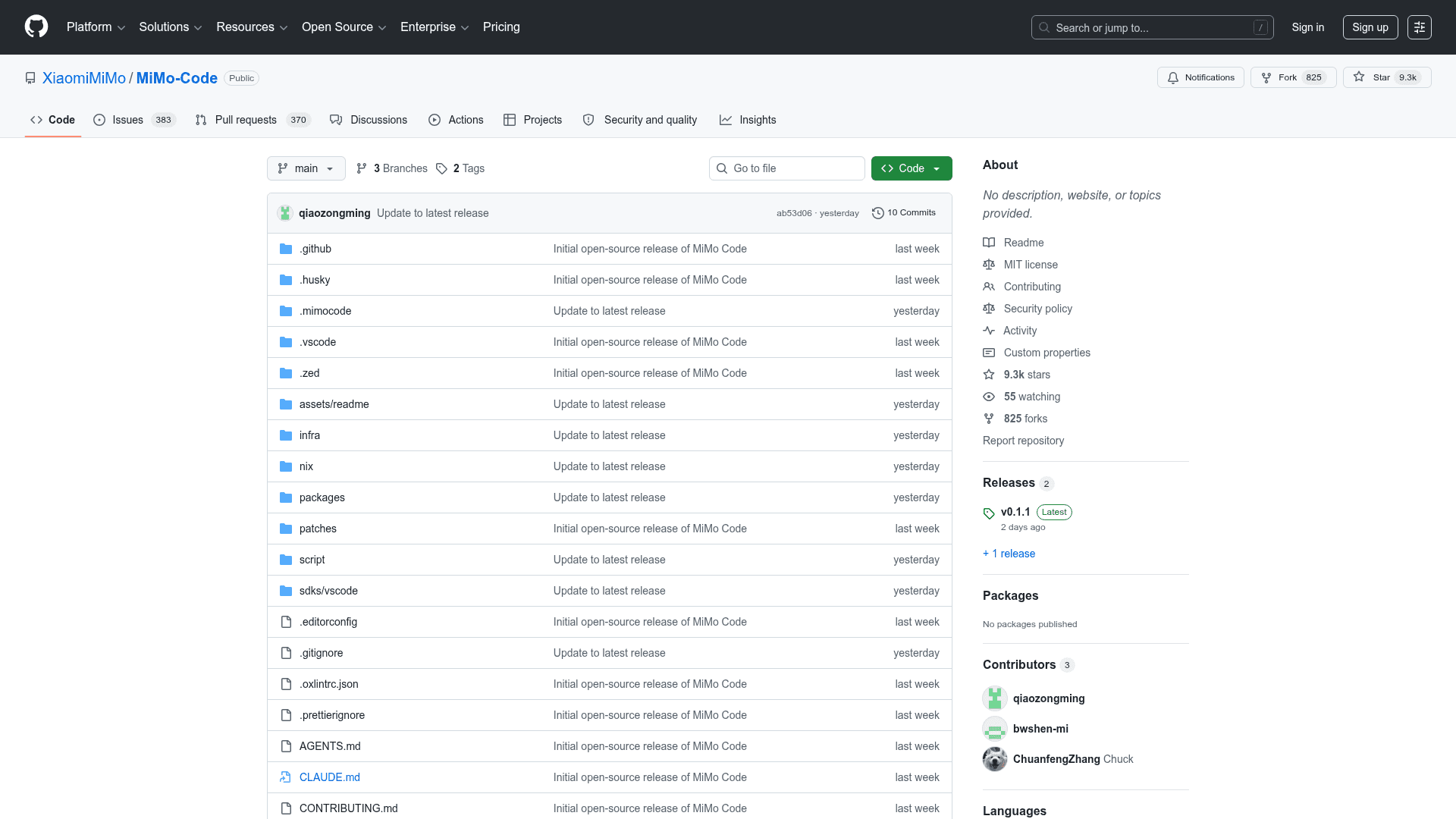
The initial public release (v0.1.0) was published on June 10, 2026, the same day the repository was created. Within roughly two days the project accumulated over 6,200 GitHub stars and 493 forks, signaling strong early community interest. The repository is actively maintained under the XiaomiMiMo GitHub organization, with the MIT License covering the source code and separate terms governing use of Xiaomi MiMo-hosted services and trademarks.
Community Discussions
Be the first to start a conversation about MiMoCode
Share your experience with MiMoCode, ask questions, or help others learn from your insights.
Pricing
Open Source
Free and open-source under the MIT License. MiMo Auto channel included free for a limited time with zero configuration required.
- Full source code access under MIT License
- MiMo Auto anonymous channel (free for limited time)
- Xiaomi MiMo Platform OAuth login
- Custom OpenAI-compatible provider support
- All core agents: build, plan, compose
Capabilities
Key Features
- Cross-session persistent memory via SQLite FTS5
- Multiple agents: build, plan, and compose modes
- Subagent orchestration with parallel execution
- Automatic session checkpoints and context reconstruction
- Tree-shaped task tracking system
- Goal/stop condition with independent judge model
- Compose mode for specs-driven development
- Voice input via TenVAD and MiMo ASR
- /dream command for extracting project knowledge
- /distill command for packaging reusable skills
- MCP server connections
- LSP integration
- Token-budgeted memory injection
- Max Mode: parallel best-of-N reasoning
- OpenAI-compatible custom provider support
- One-step migration from Claude Code
- TUI-based configuration