
moo.md
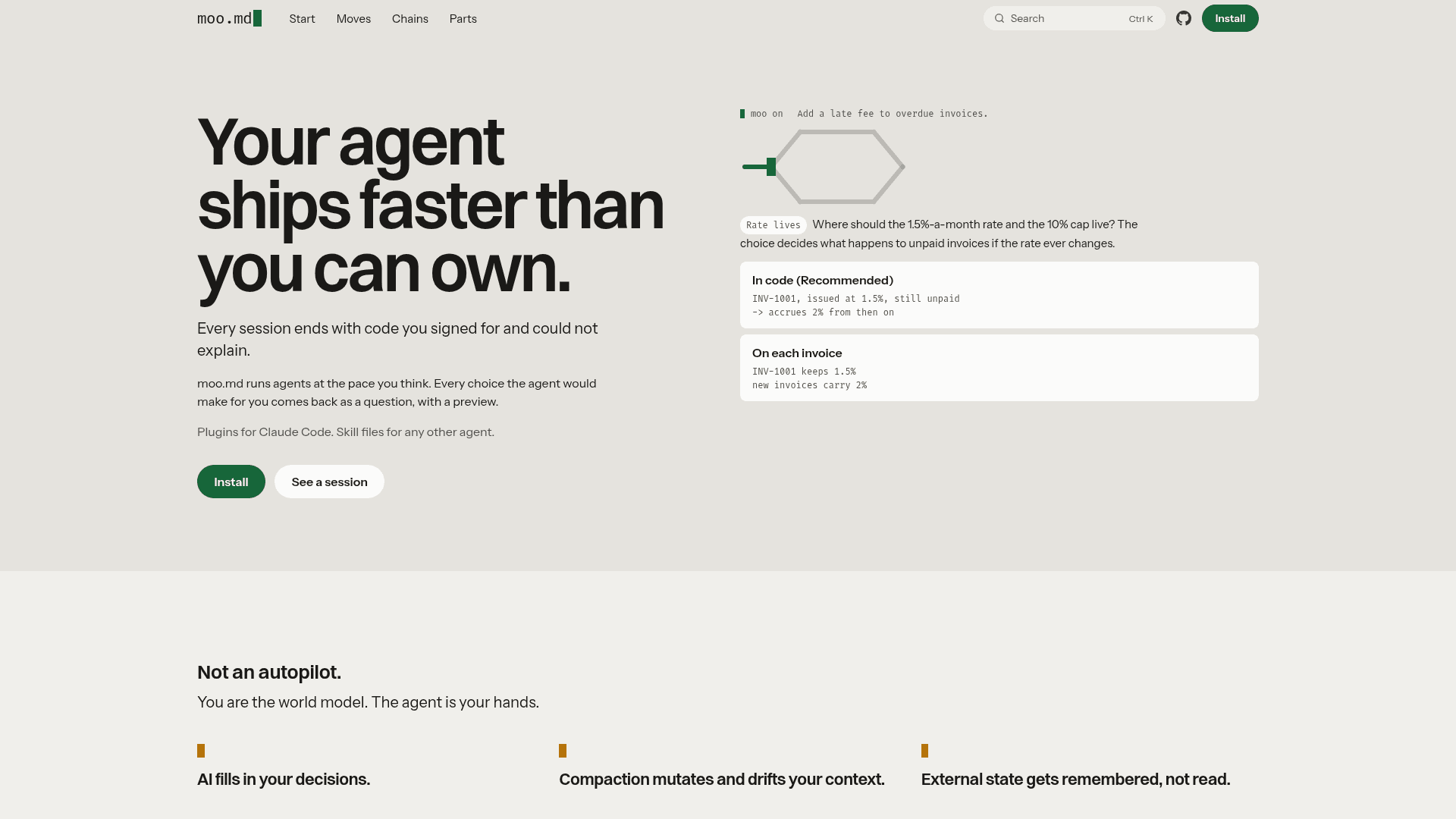
Claude Code plugins and portable skill files that turn an agent's choices into interactive questions so the human keeps owning decisions.
At a Glance
moo.md skills/plugins (hope, hold, hunch, sound) released under the MIT License, free to use, copy, modify and distribute.
Engagement
Available On
Alternatives
Listed Nov 2026
About moo.md
moo.md is an open-source set of Claude Code plugins and skill files by saadshahd that runs coding agents at the pace the user thinks. Instead of letting an agent fill in decisions silently, each choice comes back as an interactive question with a preview. It installs as Claude Code plugins or as skill files for other agents such as Codex, Cursor, Copilot, Gemini CLI and opencode.
What It Is
moo.md is a collection of agent skills organized into parts: hope (the decision loop), hold (comprehension at your own pace), hunch (experiments that graduate or die), and sound (installable code taste rules and tools for hand steps). The README says it does not build or author your code; it works alongside build tooling such as superpowers.
How the Decision Loop Works
A piece of work starts as a raw seed that the user types. /hope:intent turns the seed into a confirmed statement of what is wanted, and /hope:shape turns that work order into a chosen approach before any code exists. Each stage surfaces decisions as interactive questions with previewed choices. /hope:compose chains the needed skills from plain words, and /hope:full runs the loop from a seed. Further moves cover clarifying, deepening, widening, reframing, anchoring, inversion, interrogating assumptions, and judging.
Guards Against Common Traps
- freeze snapshots live external state such as services, databases, queues or logs into one value, with facts observed live or named as open gaps, never inferred.
- router separates deciding from doing: the session spawns agents and verifies output rather than doing the work itself, which the project says keeps compaction from rewriting decisions.
- hold offers learn, grasp, toy and land skills plus a hold:Plain output style that keeps replies short.
- sound reads the repo's stack and picks only rules the code shows a surface for, each with evidence, landing as files the user owns.
- hum turns work items into Claude Code runs on a Mac or in CI, where the repo's checks decide what they can and risk level decides who reviews.
Setup Path
A one-line install script detects the machine. For Claude Code it installs the hope, hold and hunch plugins from the saadshahd/moo.md marketplace and sets the hold:Plain output style. For other agents it copies skill files into ~/.agents/skills using skills.sh. Running the script again updates the installation.
Community Discussions
Be the first to start a conversation about moo.md
Share your experience with moo.md, ask questions, or help others learn from your insights.
Pricing
Open Source (MIT)
moo.md skills/plugins (hope, hold, hunch, sound) released under the MIT License, free to use, copy, modify and distribute.
- MIT License
- Claude Code plugins: hope, hold, hunch (sound optional)
- Skills installable for Codex, Cursor, Copilot, Gemini CLI and opencode via skills.sh
- Installed with a one-line curl script, free to update by re-running
Capabilities
Key Features
- Interactive questions with previewed choices for each agent decision
- /hope:intent and /hope:shape decision loop
- /hope:compose skill chaining
- freeze snapshots of live external state
- router separates deciding from doing
- hold comprehension skills and hold:Plain output style
- sound installable code-taste rules based on repo stack
- hum unattended runs in Claude Code on Mac or CI
- hunch experimental skills
- One-line install script