onemcp
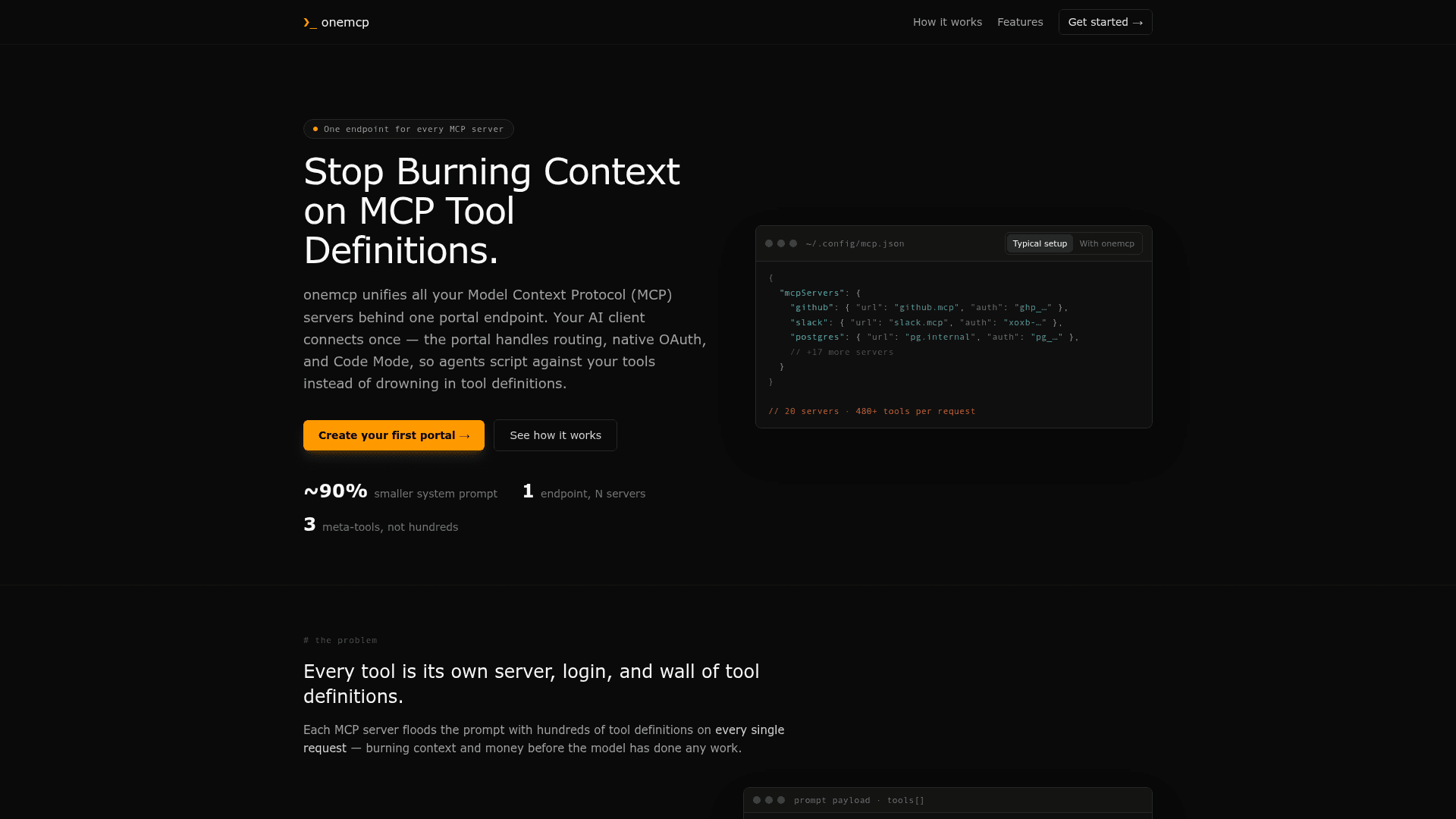
onemcp unifies all your MCP servers behind a single portal endpoint, reducing context usage by ~90% using three meta-tools instead of hundreds of tool definitions.
At a Glance
Create your first portal and connect MCP servers at no cost.
Engagement
Available On
Alternatives
Listed Aug 2026
About onemcp
onemcp is a developer tool that consolidates multiple Model Context Protocol (MCP) servers behind a single portal endpoint, dramatically reducing the token overhead that comes from exposing every tool definition on every request. Instead of flooding the AI client's context window with hundreds of tool schemas, onemcp exposes just three meta-tools — search, describe, and execute — and lets the model script against them on demand.
What It Is
onemcp is an MCP gateway and portal layer built around Cloudflare's "Code Mode" pattern, which the Cloudflare blog describes as "the better way to use MCP." The core insight is that LLMs are better at writing code to call MCP tools than at selecting from a massive flat list of tool definitions. By routing all upstream MCP servers through one portal, onemcp shrinks a typical ~15,000-token tool payload down to roughly ~500 tokens per request — a reduction the site claims is approximately 97%.
How the Three Meta-Tools Work
Rather than exposing every tool from every connected server, a portal exposes exactly three operations:
- search — finds the right tools across all connected servers for the task at hand, returning ranked results with relevance scores
- describe — fetches a tool's exact type signature on demand, only when needed
- execute — runs a script that calls those tools and returns just the result
This means the AI client discovers and uses tools dynamically rather than receiving the entire toolset upfront on every turn.
Architecture and Routing
The onemcp gateway sits between the AI client (Claude, Cursor, or any MCP-compatible agent) and the upstream MCP servers. The client connects once to the portal URL; the portal handles routing, native OAuth flows to upstream servers, and per-portal credential scoping. Key architectural properties include:
- Unified endpoint — one portal URL replaces N individual server configs in the client's
mcp.json - Native upstream OAuth — credentials stay host-side and are never scattered across clients
- Per-portal auth scoping — the same upstream server can carry different credentials in different portals
- Import/export — portals can be moved between environments or shared as a single portable config file
- Request logs — every client request flowing through a portal is visible for debugging
Deployment Model and Audience
onemcp targets developers building AI agents and workflows that rely on multiple MCP servers simultaneously. The tool is accessed via a web app at app.onemcp.dev, where users create and configure portals. No client-side installation is required beyond updating the MCP client config to point at the portal URL. The site notes that for enterprise-grade needs — access policies, allowlisting, DLP, and audit logs — Cloudflare's own MCP Server Portals product is the recommended path.
Current Status
onemcp is actively available as a web application. The project is independently operated and supported via a "Buy me a coffee" link, indicating it is a solo or small-team project rather than a venture-backed product. The site credits Cloudflare as the pioneer of the MCP portal pattern and positions onemcp as an accessible implementation of that pattern for individual developers and small teams.
Community Discussions
Be the first to start a conversation about onemcp
Share your experience with onemcp, ask questions, or help others learn from your insights.
Pricing
Free
Create your first portal and connect MCP servers at no cost.
- Single portal endpoint
- Three meta-tools (search, describe, execute)
- Native upstream OAuth
- Per-portal auth scoping
- Import/export portals
Capabilities
Key Features
- Single portal endpoint for all MCP servers
- ~90% smaller system prompt footprint
- Three meta-tools: search, describe, execute
- Native upstream OAuth authentication
- Per-portal credential scoping
- Import and export portal configurations
- Request logs for debugging agent calls
- Code Mode efficiency via Cloudflare pattern
- Add or swap upstream servers without touching client config