
OpenFolk
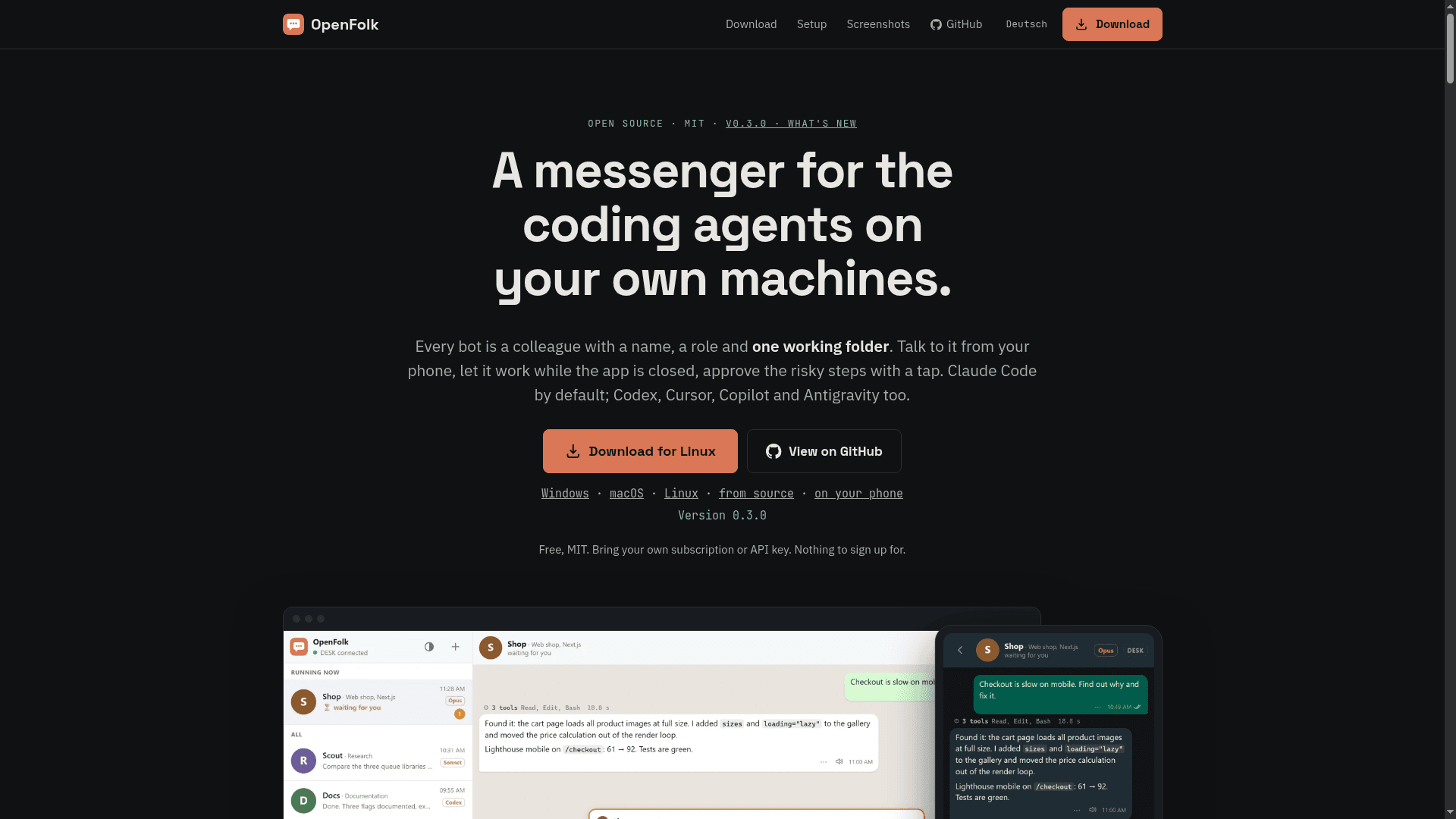
Messenger-style app for running AI coding agents such as Claude Code, Codex, Cursor and Copilot as a team of bots on your own machines.
At a Glance
About OpenFolk
OpenFolk is an open-source, MIT-licensed messenger-style web app from Flowdesk GmbH for running several AI coding agents on your own computers. Each bot has a name, role, tone and one working folder, and keeps working when the app is closed. Version 0.3.0 is the current release, with desktop apps for Windows, macOS and Linux.
What It Is
OpenFolk is a chat list in which every row is a bot, typically one per repository. You talk to a bot from your phone or desktop, and it reports when it is done or needs a decision. It is not an IDE and is not built on one; it carries the same agents onward when you are away from your machine and can hand a chat back to VS Code or a terminal.
Bots run on Claude Code (Claude Agent SDK) by default. A bot or a single conversation can instead use OpenAI Codex, or Cursor, GitHub Copilot, Google Antigravity and OpenCode through the Agent Client Protocol. You sign in with your own subscriptions or API keys.
Approvals and team workflow
Per bot you choose an approval level. Risky (default) asks before deleting, pushing, deploying, SSH or touching things outside its folder; write asks before every file change; never does not ask. Requests appear as chat cards with allow, always allow and deny, and unanswered ones are denied after 30 minutes.
Bots can be placed in group chats, hand jobs to one another, run scheduled routines that can wake a machine, and keep a memory of facts and searchable history. Push notifications tell you when an answer or decision is waiting.
Architecture and privacy model
Sessions, history, files and approvals stay on the machine running the backend. A relay only forwards frames, stores no messages and holds no model credentials. The backend connects outbound, and end-to-end encryption is on from first start. The relay can run inside the app or as a Docker container on your own server for phone access from anywhere.
Setup path
The desktop app bundles backend and relay: choose Start on this computer, sign in to Claude Code, and create a first bot. Alternatively run from source with Node 22.18 or newer using npm start. The phone uses the web app as a PWA, while native iOS and Android apps are built from the repository and are not in the stores yet. The Windows installer is unsigned, and the backend is developed and tested mainly on Windows 11.
Community Discussions
Be the first to start a conversation about OpenFolk
Share your experience with OpenFolk, ask questions, or help others learn from your insights.
Pricing
Open Source (MIT)
Free, MIT-licensed OpenFolk app and self-hosted relay/backend. Bring your own subscription or API key; no sign-up required.
- MIT license permits use, change and redistribution, commercial or not
- Bring your own subscription or API key (external cost, not sold by OpenFolk)
- Desktop apps for Windows, macOS and Linux; iOS and Android apps; browser/PWA
- Supports Claude Code, OpenAI Codex, Cursor, GitHub Copilot, Google Antigravity, OpenCode
- Nothing to sign up for
Capabilities
Key Features
- One bot per folder or repository, each with its own name, role, tone and model
- Approval cards in chat with allow, always allow and deny
- Configurable approval levels: risky, write, never
- Push notifications when bots finish or need a decision
- Group chats and bot-to-bot job handoff
- Scheduled routines that can wake a machine
- Bot memory and searchable chat history
- Voice messages transcribed locally with faster-whisper
- Multiple machines with one set of bots
- Open changes view with commit-and-push or pull per repo
- Hand a chat to VS Code or a terminal
- Multiple accounts on one relay
- End-to-end encrypted relay that stores no messages
- Desktop, PWA and mobile clients in English and German