
Plano
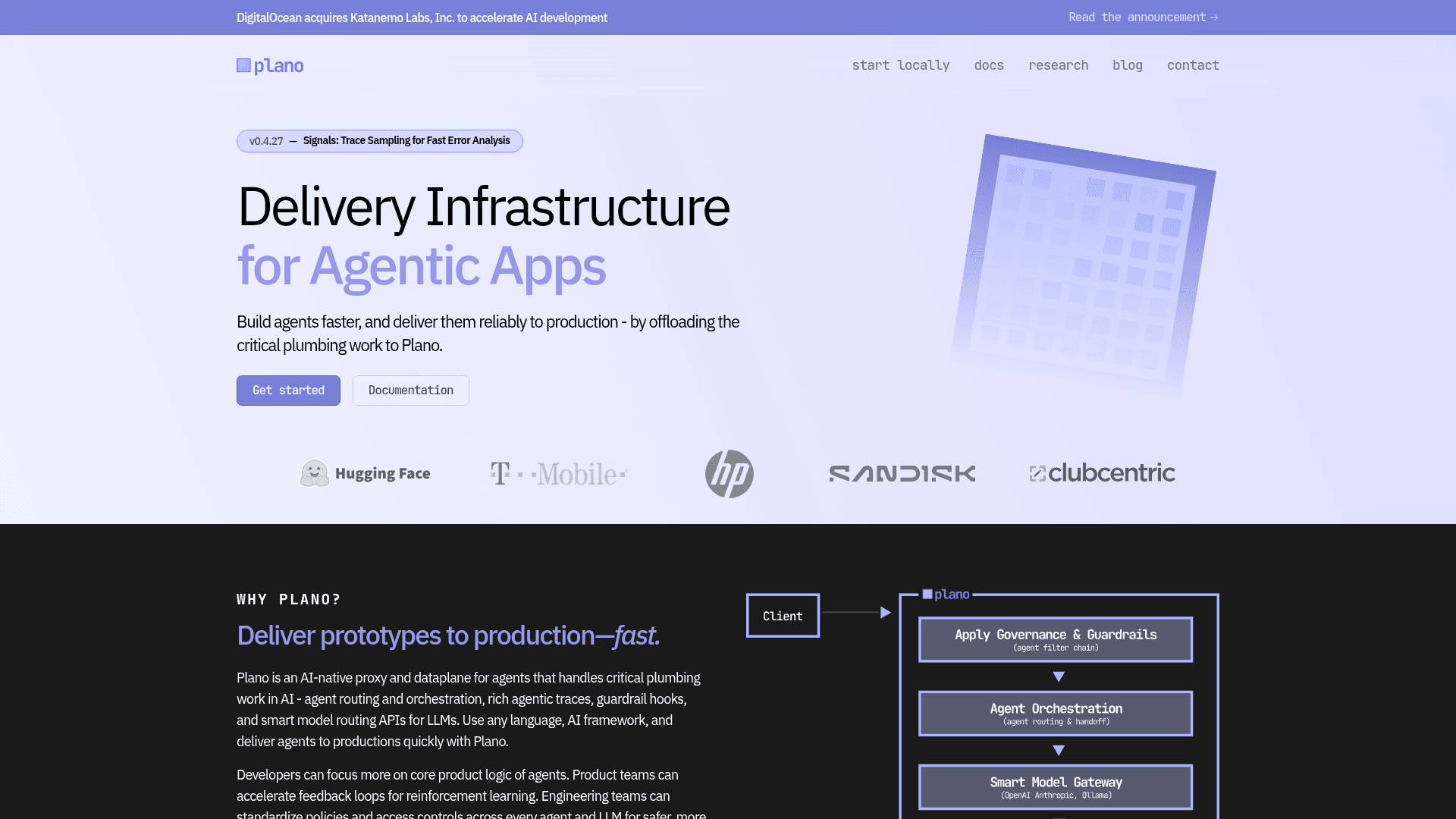
An AI-native proxy and data plane for agentic apps that handles orchestration, LLM routing, observability, and guardrails so developers can focus on core agent logic.
At a Glance
About Plano
Plano is an open-source, AI-native proxy server and data plane for agentic applications, built by Katanemo Labs (now a DigitalOcean company). Written primarily in Rust and built on Envoy by its core contributors, Plano moves the "hidden middleware" work — agent routing, observability, safety hooks, and model management — out of application code and into a unified, out-of-process dataplane.
What It Is
Plano sits between your agents and the outside world as a framework-friendly sidecar, handling the infrastructure concerns that slow teams down when shipping agentic apps to production. Rather than writing intent classifiers, routing logic, or tracing instrumentation by hand, developers declare agent descriptions and model preferences in a single YAML configuration file, and Plano takes care of the rest. It is language-agnostic and works with any AI framework.
Core Capabilities
Plano bundles four main building blocks that can be used independently or together:
- Agent Orchestration: Low-latency routing between multiple agents declared in YAML; adding a new agent requires only a config change, not code modifications.
- Smart LLM Routing: Route requests by model name, semantic alias, or automatic preference — with a unified OpenAI-compatible API across providers including OpenAI and Anthropic.
- Agentic Signals™: Zero-code capture of traces, metrics, and logs via OpenTelemetry across every agent interaction, plus a trace-sampling feature (introduced in v0.4.27) for fast error analysis.
- Filter Chains: Pluggable hooks for jailbreak protection, moderation policies, context engineering, and memory — applied consistently without bespoke per-agent code.
Architecture and Open-Source Foundation
Plano is built on Envoy, the battle-tested proxy used in large-scale production environments, by contributors who worked on Envoy's core. The project is licensed under Apache 2.0 and hosted at github.com/katanemo/plano. Its routing layer uses purpose-built, lightweight LLMs — including a 4B-parameter orchestrator model — rather than heavyweight general-purpose models, which the project claims reduces routing cost and latency compared to using GPT-4-class models for orchestration. The project also publishes models on Hugging Face under the katanemo organization.
Developer Workflow
Getting started requires a single configuration file and a planoai up config.yaml command. Agents are plain HTTP servers implementing the OpenAI-compatible chat completions endpoint, so any language or framework works. The config file declares:
- Agent IDs and URLs with natural-language descriptions
- Model providers and API keys
- Listener ports and router model selection
- Tracing sampling rates
Plano then handles intent classification, routing, provider API normalization, and end-to-end tracing automatically. On-premises deployment is supported for regulated environments requiring full data control.
Update: v0.4.27 — Signals and Trace Sampling
The latest release as of July 2026 is v0.4.27, published on July 9, 2026. The headline feature is Signals: Trace Sampling for Fast Error Analysis, which enables configurable random sampling of agentic traces to accelerate debugging and continuous improvement workflows. The repository shows active development with the last push on July 17, 2026, and the project has accumulated over 6,800 GitHub stars and 469 forks since its creation in July 2024.
Acquisition Context
DigitalOcean acquired Katanemo Labs, the company behind Plano, and announced the acquisition on the DigitalOcean blog. Plano continues to operate under the Katanemo Labs brand as a DigitalOcean company, with the open-source project remaining available on GitHub.
Community Discussions
Be the first to start a conversation about Plano
Share your experience with Plano, ask questions, or help others learn from your insights.
Pricing
Open Source
Free to use, modify, and distribute under the Apache License 2.0.
- Agent orchestration
- Smart LLM routing
- Agentic Signals and tracing
- Filter chains for guardrails
- OpenTelemetry observability
Capabilities
Key Features
- AI-native proxy and data plane for agentic apps
- Multi-agent orchestration via YAML configuration
- Smart LLM routing by model name, alias, or automatic preference
- Unified OpenAI-compatible API across multiple providers
- Agentic Signals™ for zero-code trace capture
- OpenTelemetry traces, metrics, and logs
- Trace sampling for fast error analysis
- Filter chains for guardrails, moderation, and memory hooks
- Jailbreak protection and safety policies
- Context engineering hooks
- On-premises deployment support
- Framework-agnostic and language-agnostic
- Built on Envoy proxy
- Purpose-built 4B-parameter orchestrator LLM
- Single configuration file orchestration
- Docker image support