
Polypore
Agentic desktop IDE with a modular dockable panel system, built-in MCP server, and support for Claude and Codex CLIs across Windows, macOS, and Linux.
At a Glance
Fully free and open-source under the MIT license. Download pre-built binaries or build from source.
Engagement
Available On
Alternatives
Listed Jun 2026
About Polypore
Polypore is an open-source, agentic desktop IDE built by Evan Klem and released under the MIT license. It is designed from the ground up around the agent as the primary actor, rather than bolting an AI panel onto a traditional code editor. The project is language-agnostic and OS-agnostic, with its first stable release (v0.1.0) published in June 2026.
What It Is
Polypore is a desktop IDE in the agentic coding category — a class of tools where AI agents drive the development loop rather than merely assisting it. Every surface in the IDE is a dockable panel that can be split, reordered, or closed. The layout engine, memory system, debug tooling, and MCP server are all designed around agent-first workflows. The stack is built on Tauri 2 (Rust shell), React 18, Dockview for panel management, Monaco for editing, and xterm.js for terminal emulation. It ships with no telemetry.
Built-In Panels
Eight panels are available from the + tab button, covering the full development loop:
- claude — Claude CLI terminal with slash-command quick-launch
- codex — Codex CLI terminal with slash-command quick-launch
- preview — Live runtime output: browser, CLI, or any dev server
- editor — Monaco editor with per-project diagnostics
- diff-stack — Side-by-side diff and scrubbable history feed
- terminal — Standalone pty terminal
- debug — Verify runs and diagnostics
- memory — Project knowledge base with
[[wikilinks]]and context inventory - agent — Formation canvas, skills, MCP management, and secrets
MCP Server and Agent Control
A Node MCP sidecar ships with Polypore and is picked up automatically by Claude Code via .mcp.json. It exposes 22+ tools across namespaces including polypore.debug.* (breakpoints, step, DOM/network capture), polypore.memory.* (knowledge base read/write), polypore.verify.* (verification suites), polypore.tasks.* (real-time task management), polypore.phase.* (workflow phase reporting), polypore.secrets.* (mediated HTTP requests without exposing secret values), polypore.skills.* (active skill library), and polypore.format.* (in-editor formatters). This gives agents direct, structured IDE control rather than relying on file-system access alone.
Secret Broker and Security Model
Polypore includes a built-in secret broker backed by the OS keyring. When the IDE spawns an agent, it strips every registered secret from the environment and replaces it with a POLYPORE_SECRET_HANDLE_<KEY> sentinel. Agents call polypore.secrets.use with an HTTP request; Polypore injects the real value and masks it on the way back. The model never sees plaintext credentials.
SDK and Plugin Architecture
Third-party panels are sandboxed iframes that use the same HostRpcServer contract as the built-in panels. A plugin can be written in any framework, dropped into .polypore/plugins/<id>/, and it appears in the panel strip. Agents can drive third-party plugins through the MCP server the same way they drive built-ins. Contracts are defined in JSON Schema and code-generated into the packages/sdk/ package.
Polyflow Skills
Polypore ships with 15 slash commands in packages/polyflow/ covering the full development loop: brainstorming, writing plans, executing plans, TDD, iteration, debugging, review, interface design, PRD, architecture improvement, QA, glossary, and compaction. These are available as quick-launch commands inside the claude and codex panels.
Update: v0.1.0
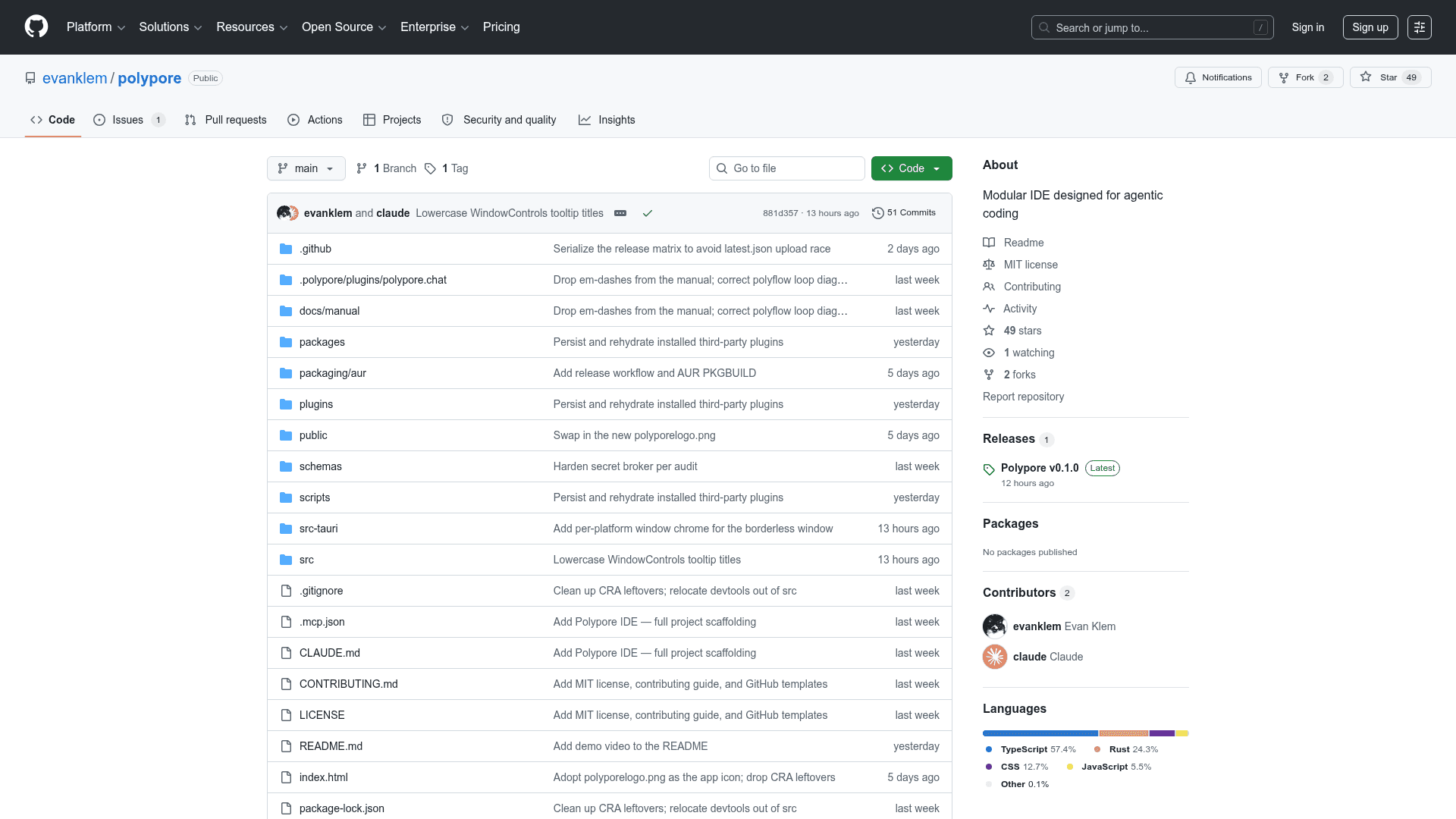
The first public release, Polypore v0.1.0, was published on June 17, 2026. The repository was created on June 6, 2026, making this a very early-stage project. Pre-built binaries are available for Linux (AppImage, .deb, .rpm), macOS (Apple Silicon and Intel .dmg), and Windows (.msi and setup .exe). The IDE self-updates after the first install.
Community Discussions
Be the first to start a conversation about Polypore
Share your experience with Polypore, ask questions, or help others learn from your insights.
Pricing
Open Source
Fully free and open-source under the MIT license. Download pre-built binaries or build from source.
- All built-in panels
- MCP sidecar with 22+ tools
- Secret broker
- Plugin SDK
- Polyflow skills
Capabilities
Key Features
- Dockable panel layout (split, reorder, close)
- Claude CLI panel with slash-command quick-launch
- Codex CLI panel with slash-command quick-launch
- Monaco editor with per-project diagnostics
- Live preview panel (browser, CLI, dev server)
- Side-by-side diff and scrubbable history feed
- Standalone pty terminal
- Debug panel with breakpoints and diagnostics
- Project knowledge base with wikilinks
- Agent formation canvas with skills and MCP management
- Built-in MCP sidecar with 22+ agent tools
- OS keyring secret broker (model never sees plaintext)
- Third-party plugin SDK (sandboxed iframes)
- 15 Polyflow slash commands for full dev loop
- Self-updating after first install
- No telemetry
- SQLite persistence
- File watching via notify