Voidleap Code
A local-first agentic coding environment that runs on your machine, supports multiple AI providers and local models, and gives developers full observability and control over AI agents.
At a Glance
About Voidleap Code
Voidleap Code is a full agentic coding environment built for developers who want deep control over how AI agents work on their codebase. It runs as a desktop app on Mac and Windows, routes inference directly to the provider or local model you choose, and keeps all application state on your machine. The product launched as version 1.0 on August 16, 2026, free for everyone.
What It Is
Voidleap Code is an agentic IDE — a harness and scaffolding layer around AI models, not a wrapper that hides what the models are doing. The core design principle is that every agent, skill, hook, slash command, security rule, and system prompt is visible, editable, and owned by the developer. It supports nine providers out of the box (Anthropic, OpenAI, Google Gemini, GitHub Copilot, Ollama, LMStudio, OpenRouter, Azure, Bedrock) and lets you switch models between turns without restarting a thread.
Local-First Architecture
Privacy is described by the Voidleap team as an architectural decision, not a setting. All application data lives in ~/.voidleap/ on the user's filesystem — threads, logs, memory, plugin cache, configuration, artifacts, worktrees, and checkpoints. The code index is a local SQLite database. When a cloud provider is used, prompts and credentials go directly to that provider; nothing routes through Voidleap's servers. Local model support covers Ollama with custom model registration, and tool-call parsing recognizes Harmony, Gemma, Qwen, and Hermes XML/JSON formats so open-source local models get full tool-call parity with hosted ones. An optional macOS Seatbelt sandbox adds kernel-level write restrictions for high-stakes work.
Observability and Control
The tool replaces what the team calls the "black box" with full observability. A live Control Center shows every running thread grouped by status (Running, Needs Input, Idle, Errored), with a real-time LLM call feed displaying actual prompts, responses, and tool calls as they stream. A statistics dashboard covers 30+ charts: cost trend, per-model cost, token volume, latency distribution, cache efficiency, tool success rate, RPM, and TPS — all live and exportable. Four execution modes (Default, Read-only, Careful, Yolo) let developers set how much the agent can do autonomously. AST-aware command parsing and sensitive-path defaults (.ssh, .env*, .aws, .gnupg) are on by default.
Multi-Agent Orchestration and Customization
Two primary agents ship as starting points — Build and Plan — along with a set of pre-defined subagents: Oracle (deep reasoning), Explorer (codebase search), Librarian (web research), Planner (architecture analysis), Looker (screenshots and PDFs), and several utility subagents. Developers can author custom agents with per-agent model and provider, effort and thinking budget, allowed and denied tools, context isolation mode, and provider-specific prompt variants (e.g., my-agent.anthropic.md). A three-scope inheritance system (Global, Workspace, Project) lets configuration be authored once and overridden at any level. A built-in marketplace with a security auditor (static analyzer plus optional AI deep review) handles community plugin installation.
Context Engineering
Voidleap Code provides a visual context management system that segments context by category (system, conversation, artifacts, files) against the model's actual token limit. Four slash commands handle cleanup: /trim removes paired tool calls, /prune is AI-assisted and clears stale rounds, /compact summarizes old history, and /clear resets context without destroying thread history. AI Prune Suggest mode shows proposed removals before applying them. The team reports Anthropic cache breakpoints push hit rates into the 85–95% range, with cache hit rate visible in the dashboard. A persistent symbol index (15 languages, BM25-ranked search, camelCase/snake_case fuzzy matching) lets agents query symbols instead of falling back to grep.
Update: Voidleap Code 1.0
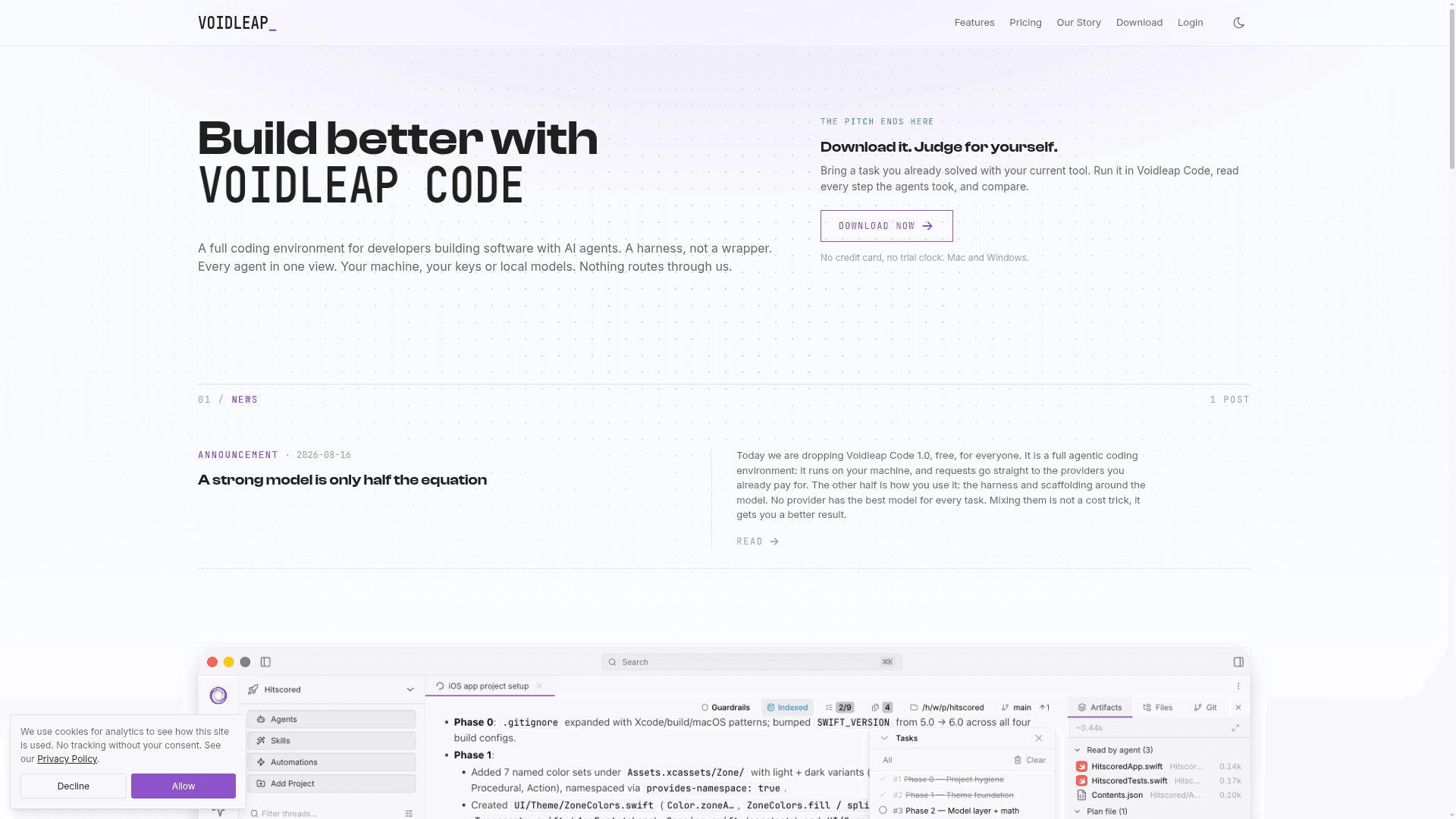
Voidleap Code 1.0 launched on August 16, 2026, as a free download for Mac and Windows with no credit card required and no trial clock. The announcement post frames the release around the idea that "a strong model is only half the equation" — the harness and scaffolding around the model determine result quality. The Free plan is described as the full product limited in scale rather than time. A Pro plan and Team plan are listed on the pricing page but noted as still in development at launch time, with Enterprise available via contact.
Community Discussions
Be the first to start a conversation about Voidleap Code
Share your experience with Voidleap Code, ask questions, or help others learn from your insights.
Pricing
Free
The full agentic IDE on your machine, free with no time limit. Limited in scale, not in time.
- 3 workspaces with 3 projects each
- 1 profile for token keys and credentials
- 7-day dashboard history and export
- Community support on Discord
- Full local IDE: scaffolding, code indexing, browser use, sandboxing, automations, hooks, unlimited threads, multi-repo support, plugin marketplace
Pro
Full functionality for the solo developer, with optional server hosting so agents keep running with the client closed.
- One server install on your own VPS (coming soon)
- Unlimited workspaces, projects, and profiles
- Workflows and experimental features
- Ticket support from the team
- OpenTelemetry export
- Unlimited dashboard history and export
- License banner can be hidden
Team
Built for working together. Shared servers and threads, real-time collaboration, up to 50 managed seats. Coming soon.
- Unlimited server installs on VPSs you control
- Invite users with workspace-level access
- Real-time thread collaboration and handover
- SSO with GitHub and Google
- Up to 50 managed seats
Enterprise
On-premises runtime, central policy, SAML/OIDC SSO, unlimited seats, and dedicated support.
- On-premises deployment behind your firewall
- Central policy, guardrails, and key pooling
- SAML/OIDC SSO and unlimited seats
- Invoicing and a dedicated contact
- Annual or quarterly invoicing with volume discounts
Capabilities
Key Features
- Local-first architecture with all data stored on-device
- Nine AI provider integrations: Anthropic, OpenAI, Gemini, GitHub Copilot, Ollama, LMStudio, OpenRouter, Azure, Bedrock
- Local model support via Ollama with full tool-call parity
- Multi-agent orchestration with Build and Plan primary agents
- Pre-defined subagents: Oracle, Explorer, Librarian, Planner, Looker, and more
- Custom agent authoring with per-agent model, provider, and tool configuration
- Three-scope configuration inheritance: Global, Workspace, Project
- Visual context management with per-round entry control
- AI Prune Suggest mode for context cleanup review
- 30+ analytics charts: cost, tokens, latency, cache hit rate
- Live Control Center with real-time LLM call feed across all threads
- Four execution modes: Default, Read-only, Careful, Yolo
- AST-aware command parsing with sensitive-path defaults
- Optional macOS Seatbelt sandbox
- Persistent symbol index for 15 languages with BM25-ranked search
- Git worktrees per thread with turn-level diffs and /undo
- Built-in browser with DOM automation and annotation tools
- Custom cron-based automations and event hooks
- Plugin marketplace with static and AI security auditing
- Dockable multi-panel IDE layout
- CodeMirror 6 editor with diff/merge view
- Custom virtualizer for smooth long-thread streaming
- OpenTelemetry export (Pro)
- Per-thread model switching without restarting