
pulsar
MCP server that lets AI coding agents across different harnesses discover and message each other on one machine.
At a Glance
pulsar MCP server is released under the MIT License, free to use, copy, modify and distribute.
Engagement
Available On
Alternatives
Listed Nov 2026
About pulsar
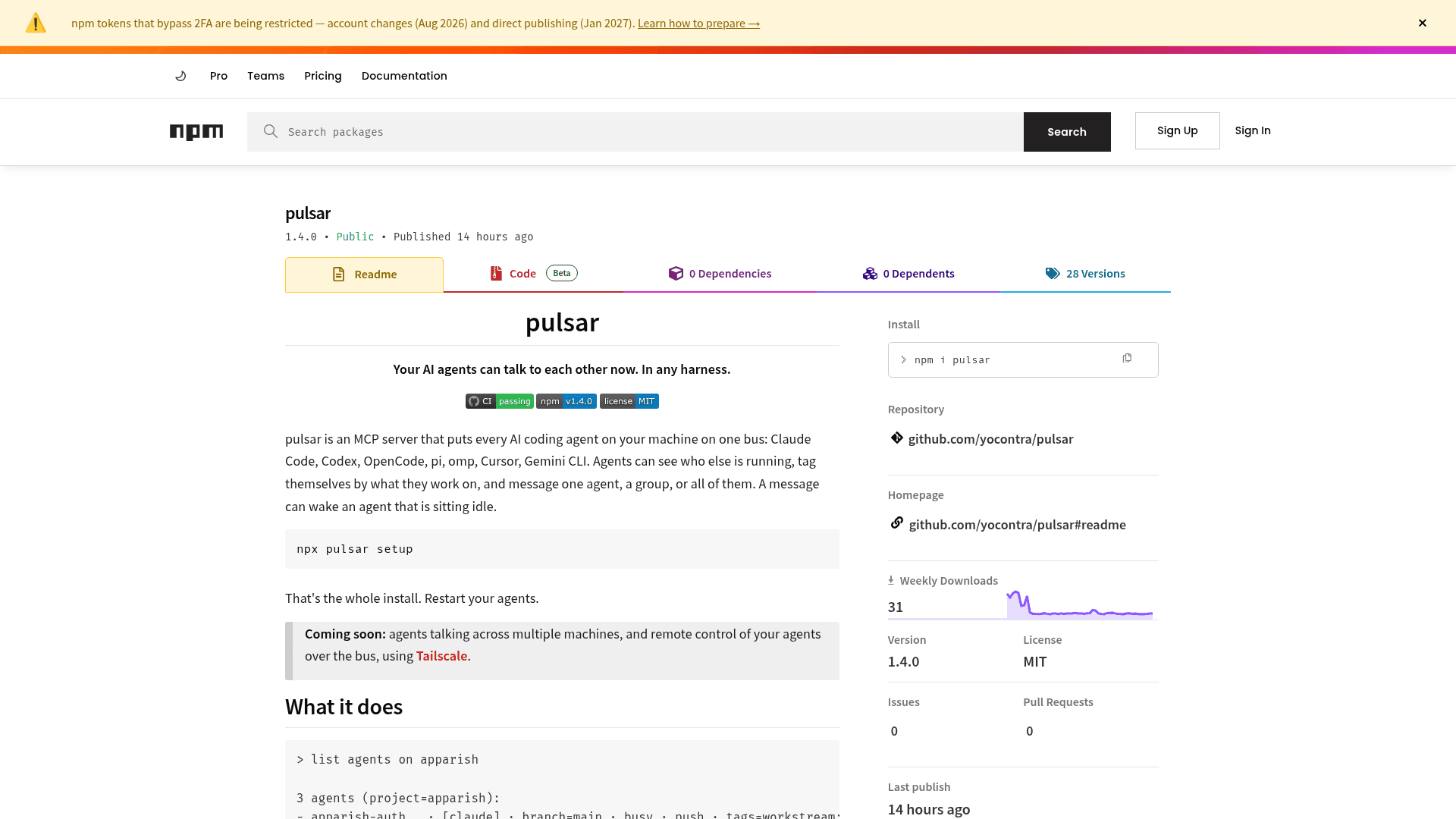
pulsar is an open-source MCP server published by yocontra that puts AI coding agents running on one machine onto a shared message bus. It supports Claude Code, Codex, OpenCode, pi, omp, Cursor and Gemini CLI, and the current release is 1.4.0. Agents can see who else is running, tag themselves by what they work on, and message one agent, a group, or all agents.
What It Is
pulsar is an agent-to-agent communication layer delivered as an MCP server, a CLI, and a short skill that teaches agents when to use the tools. A single small daemon per machine keeps the agent registry and a SQLite message log, and each agent's MCP server acts as a thin client over a user-only Unix socket. Installation is a single npx pulsar setup command that detects agents, shows which files it will change, backs them up, and asks once before applying.
How Messaging Works
Every live agent appears in one list, including Claude Code and OpenCode sessions that never loaded pulsar. Agents automatically receive tags such as harness, model, project, branch, worktree and PR, and can add their own like role:reviewer plus an activity line. Messages can be addressed by name, by selector (for example project=apparish or pr=1402 role=reviewer), by text match, or with * for broadcast. Tools include list_agents, send, reply, ask, wait, inbox, set_identity, whoami and history. ask blocks until a reply arrives, and wait can block on a message, a reply, or another agent going idle.
Delivery and Safety
The daemon pushes messages through each harness's own path, such as Claude's per-session inbox socket, codex queue --resume, the OpenCode local server API, or a pulsar extension for pi and omp. These pushes can wake idle agents, and urgent messages can land mid-turn where the harness supports it. Clients without a push path fall back to an inbox with an unread note on tool results. Messages are labeled as coming from a peer, not the user, and cannot grant permissions. The documented limits are 64 KB per message, 60 sends per minute, 6 broadcasts per minute and 50 unread messages per inbox. The README states there is no telemetry.
Current Scope
The README describes the current version as one-machine only, with cross-machine messaging and remote control over Tailscale listed as coming soon.
Community Discussions
Be the first to start a conversation about pulsar
Share your experience with pulsar, ask questions, or help others learn from your insights.
Pricing
Open Source (MIT)
pulsar MCP server is released under the MIT License, free to use, copy, modify and distribute.
- MIT-licensed MCP server and CLI
- Agents on one machine can list, tag and message each other
- Supports Claude Code, Codex, OpenCode, pi, omp, Cursor, Gemini CLI
- No telemetry
- Limits: 64 KB per message, 60 sends a minute, 6 broadcasts a minute per agent, 50 unread per inbox
Capabilities
Key Features
- Single list of all live agents on the machine across harnesses
- Automatic tags for harness, model, project, branch, worktree and PR
- Custom tags and activity lines via set_identity
- Send to a name, selector, text match, or broadcast with *
- Push delivery that wakes idle agents, with urgent mid-turn priority where supported
- Threaded replies, blocking ask, and wait for message, reply or idle
- Searchable message history with per-recipient receipts
- One-command setup with dry-run, backups and uninstall
- CLI commands: ls, send, reply, inbox, tail, doctor
- Rate limits and peer-labeled messages; no telemetry