
Raven
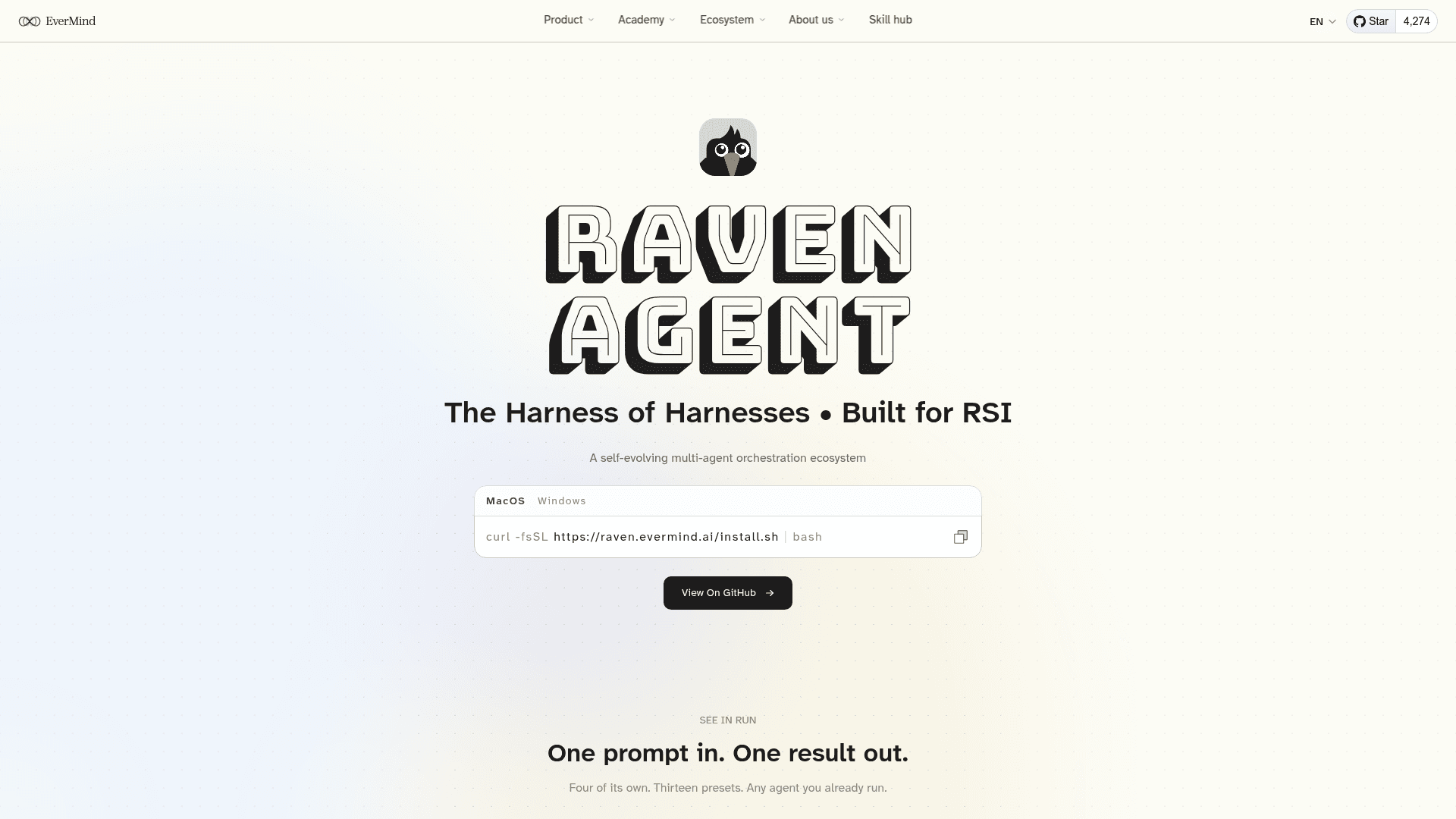
Raven is an open-source, self-evolving multi-agent orchestration harness built for recursive self-improvement, with four built-in specialized agents for research, coding, design, and workflow automation.
At a Glance
About Raven
Raven is EverMind's open-source "harness of harnesses," designed to orchestrate multiple specialized AI agents across complex, multi-step tasks. Released under the Apache 2.0 license and currently at pre-alpha (v0.2.3), it installs via a single shell command on macOS, Windows, and Linux, then launches a browser-based WebUI for managing agents, tasks, and memory. The project is built around recursive self-improvement (RSI) — the idea that the orchestration harness itself can be iteratively diagnosed, improved, and validated without human intervention.
What It Is
Raven is a Host Agent — a meta-layer that interprets a user's goal, decomposes it into a directed acyclic graph (DAG) of subtasks, assigns each node to the most appropriate specialist agent, and integrates all results into a single traceable deliverable. It ships with four built-in agents (Raven-Research, Raven-Code, Raven-Design, and Raven-Oncall) and supports 13 preset third-party agent integrations including Claude Code, GitHub Copilot, Codex, Qwen Code, Hermes Agent, and others. Connectivity to external agents is handled via ACP, CLI, or OpenAI-compatible APIs.
The Four Built-In Agents
Each built-in agent is purpose-built for a domain and benchmarked against public leaderboards:
- Raven-Research — Autonomous deep research delivering structured reports with traceable sources. The README reports 76.5% accuracy on the DeepResearch Mixed benchmark (BrowseComp + FRAMES + HLE + xBench-DeepSearch).
- Raven-Code — Agentic software development covering feature implementation, debugging, refactoring, and data analysis. The README reports top performance on DataAgentBench (0.8762 Pass@1 as of 2026-08-24 live leaderboard).
- Raven-Design — Visual design agent producing PowerPoint decks, brand assets, charts, diagrams, and web interfaces. The README reports top scores on PresentBench for slide generation and strong results on ArtifactsBench and GDPVal.
- Raven-Oncall — Unattended workflow automation for long-running experiments, optimization loops, and continuous monitoring, involving users only when human judgment is required.
Runtime Self-Evolution Architecture
Raven's agent loop is split into four decoupled strategy modules: Memory (what a turn gets to see), Planning (how the agent approaches work), Capability (which tools are exposed), and Action (what to do next and how to judge it before execution). A Curator component continuously rewrites these modules — adjusting prompts, tools, skills, and judgment code — and validates each change before installation. Failed checks send the Curator back for another round. The Curator ships with the repository rather than the installed package and is described as experimental.
The Raven Evolver is a separate tool that consumes Raven as a library, evaluates candidate harness changes against benchmarks, and retains only improvements that outperform the baseline in reproducible evaluations.
Core Systems and Ecosystem
Raven integrates several EverMind infrastructure components:
- EverOS Memory — A local-first, Markdown-native long-term memory runtime that preserves user context, agent experience, and world knowledge across sessions.
- SkillForge — Retrieves relevant skills from local libraries, EverOS memory, and the SkillHub catalog (the README lists 114,190 skills in the public SkillCorpus).
- Proactivity — Combines event monitoring and scheduled execution to anticipate user needs and initiate follow-up work autonomously.
The broader EverMind ecosystem includes EverOS, EverMe (CLI), SkillCorpus, EverAlgo, HyperMem, MSA, and evaluation frameworks like EverMemBench and EvoAgentBench.
Update: Raven v0.2.3
The latest release is v0.2.3, published on 2026-09-27. The GitHub repository was last pushed on 2026-09-29, indicating active development. The project self-describes as pre-alpha, with interfaces and configuration subject to rapid change. The repository has accumulated over 4,400 stars and 113 forks since its creation in May 2026, and a technical report is available for citation in research contexts.
Community Discussions
Be the first to start a conversation about Raven
Share your experience with Raven, ask questions, or help others learn from your insights.
Pricing
Open Source
Fully open-source under Apache 2.0. Free to use, modify, and distribute.
- Four built-in agents (Raven-Research, Raven-Code, Raven-Design, Raven-Oncall)
- Multi-agent orchestration with DAG task graphs
- 13 preset third-party agent integrations
- EverOS long-term memory
- SkillForge skill retrieval
Capabilities
Key Features
- Multi-agent orchestration via DAG task graphs
- Four built-in agents: Raven-Research, Raven-Code, Raven-Design, Raven-Oncall
- 13 preset third-party agent integrations (Claude Code, Codex, GitHub Copilot, Qwen Code, Hermes, etc.)
- Runtime self-evolution via Curator and Raven Evolver
- EverOS long-term memory across sessions
- SkillForge skill retrieval from local libraries and SkillHub catalog
- Browser-based WebUI for task management and agent monitoring
- Proactive event monitoring and scheduled execution
- ACP, CLI, and OpenAI-compatible API connectivity
- Docker-based deployment option
- Parallel and sequential task coordination
- Persona assembly from user description
- Harness self-improvement with validation before installation