RepoMaster
An open-source AI agent that autonomously discovers, understands, and executes tasks using GitHub repositories, turning 100M+ open-source repos into an intelligent toolbox.
At a Glance
About RepoMaster
RepoMaster is an open-source AI agent built by QuantaAlpha that transforms how developers solve complex coding tasks by automatically finding and leveraging GitHub repositories. Released in August 2025 and accepted as a NeurIPS 2025 Spotlight paper, it enables users to describe a task in natural language and watch as the agent discovers, configures, and orchestrates the right open-source tools to complete it autonomously.
What It Is
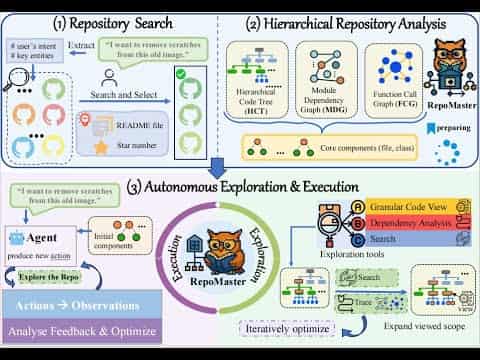
RepoMaster is a multi-agent system designed to make the 100M+ repositories on GitHub work as an intelligent, on-demand toolbox. Rather than writing code from scratch, users describe what they want and the agent handles repository discovery, environment setup, and execution end-to-end. The core pipeline follows a Discover → Understand → Execute loop: the agent analyzes the request, searches for relevant GitHub tools, auto-configures them, and delivers results.
How the Agent Works
RepoMaster uses hierarchical code trees, module-dependency views, and function-call graphs to understand large repositories with pruned context — reducing token usage while maintaining task accuracy. The system supports multiple specialized agent modes:
- Deep Search Agent: performs multi-step web and repository search to find the best tools for a task
- Repository Agent: focuses on understanding and executing within a specific codebase
- General Programming Assistant: handles broader coding questions and tasks
- Unified Mode: orchestrates all agents together for complex multi-step workflows
The web interface (built on Streamlit, accessible at localhost:8501) and CLI backend both expose these modes, making it accessible to beginners and power users alike.
Setup Path
Installation requires cloning the repository, installing Python dependencies via pip install -r requirements.txt, and configuring API keys in a .env file. Required keys include an OpenAI API key (with GPT-5 as the default model), a Serper key for Google search integration, and a Jina key for web content extraction. Optional support is available for Anthropic Claude, DeepSeek, and Google Gemini as alternative AI providers.
Update: NeurIPS 2025 Spotlight and Open-Source Release
The project was open-sourced on August 28, 2025. The accompanying paper, "RepoMaster: Autonomous Exploration and Understanding of GitHub Repositories for Complex Task Solving" (arXiv:2505.21577), was accepted to NeurIPS 2025 as a Spotlight paper — a distinction the team notes represents approximately 3.2% of submissions. A companion benchmark, GitTaskBench, was also open-sourced to evaluate repo-level code agents on real-world task delivery. The repository had accumulated 523 stars and 67 forks as of the last recorded update.
Ecosystem and Research Context
RepoMaster is part of a broader QuantaAlpha research ecosystem that includes SE-Agent (a self-evolution trajectory framework, NeurIPS 2025 Poster) and GitTaskBench (a repo-level benchmark). The project acknowledges foundational work from AutoGen, OpenHands, and SWE-Agent. QuantaAlpha was founded in April 2025 by researchers affiliated with Tsinghua University, Peking University, CAS, CMU, HKUST, and other institutions, with a stated focus on CodeAgent, DeepResearch, Agentic RL, and self-evolving multi-agent systems.
Community Discussions
Be the first to start a conversation about RepoMaster
Share your experience with RepoMaster, ask questions, or help others learn from your insights.
Pricing
Open Source
Fully free and open-source under MIT license. Clone, modify, and run locally with your own API keys.
- Full source code access on GitHub
- Web interface via Streamlit
- CLI backend with multiple agent modes
- Support for OpenAI, Claude, DeepSeek, Gemini
- Deep Search, Repository, and General Assistant agents
Capabilities
Key Features
- Natural language task description to autonomous execution
- Automatic GitHub repository discovery and selection
- Hierarchical code tree and module-dependency analysis
- Multi-agent orchestration (Deep Search, Repository, General Assistant, Unified modes)
- Web interface via Streamlit and CLI backend
- Support for OpenAI, Anthropic Claude, DeepSeek, and Google Gemini
- Pruned context for token-efficient repository understanding
- Auto-configuration and environment setup for discovered repos
- Neural style transfer and web scraping demo use cases
- GitTaskBench benchmark integration for evaluation
Integrations
Demo Video