
RocketRide
Open source AI Development Environment (AIDE) that turns your IDE into a visual AI pipeline builder with a high-performance C++ runtime, 100+ nodes, and support for 15+ LLM providers.
At a Glance
About RocketRide
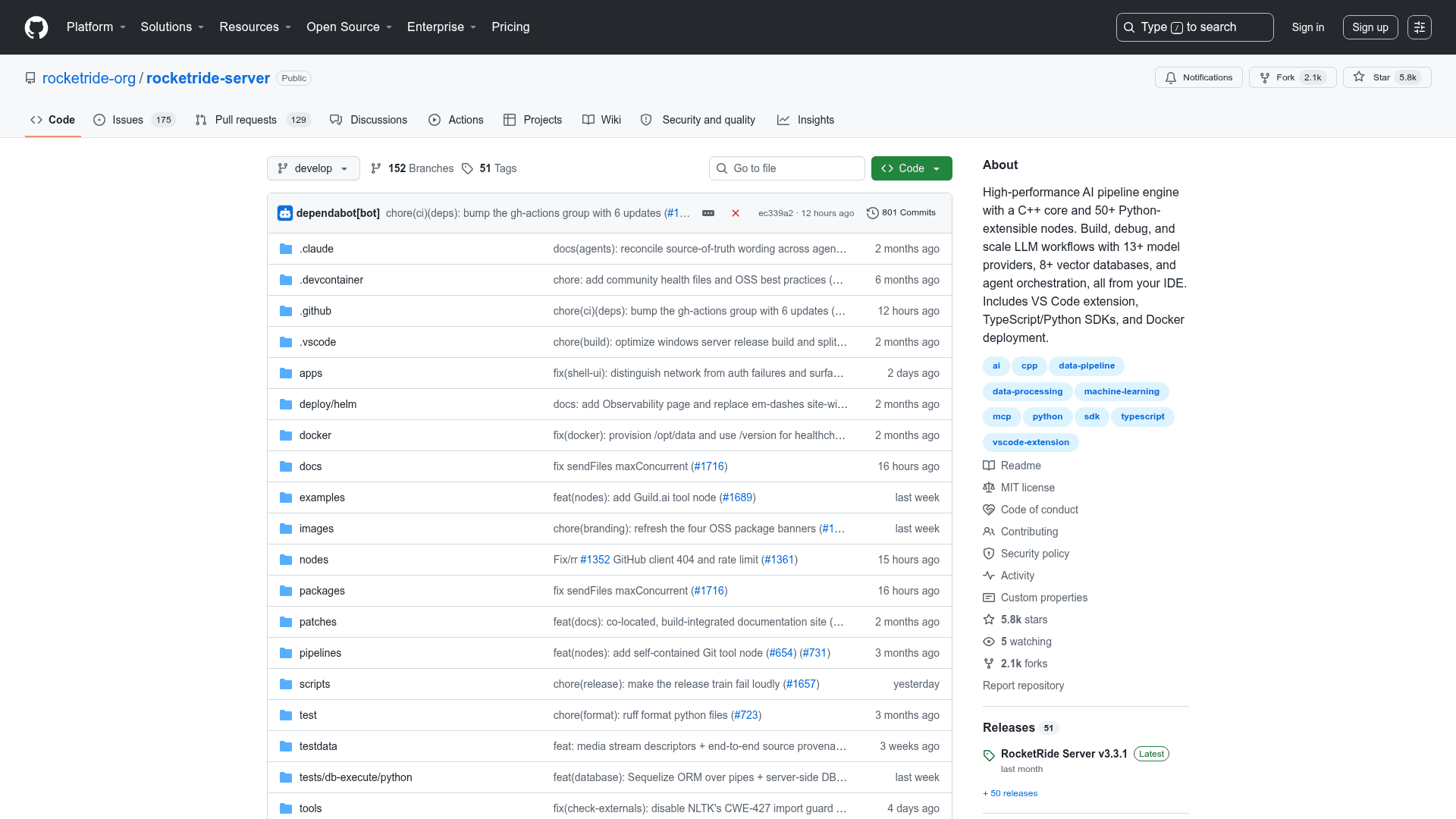
RocketRide is an open source AI pipeline engine and development environment built by Aparavi Software AG, licensed under MIT. It lets developers compose, debug, observe, and deploy AI workflows directly from their IDE or CLI, with no vendor lock-in and full data residency when self-hosted. The project reached its latest stable release (server-v3.3.1) in July 2026 and has accumulated over 5,700 GitHub stars.
What It Is
RocketRide positions itself as an AI Development Environment (AIDE) — a layer on top of the classic IDE that handles the full stack beneath AI applications, not just the agents. At its core is a multithreaded C++ runtime purpose-built for the throughput demands of AI and ML workloads. Pipelines are defined as portable JSON (.pipe files), built visually on a canvas inside VS Code, and executed by that same C++ engine whether running locally, on Docker, on-premises, or on RocketRide Cloud.
Architecture and Node Ecosystem
The engine ships with 100+ pipeline nodes covering a wide range of AI and data tasks:
- LLM providers: 15+ supported (OpenAI, Anthropic, and others)
- Vector databases: 9 supported
- Data processing: OCR, NER, PII anonymization, chunking strategies, embedding models
- Agent frameworks: Built-in CrewAI and LangChain support for multi-agent workflows with shared memory
- Extensibility: All nodes are Python-extensible; developers can build and publish custom nodes
Pipelines are version-controllable, shareable, and portable across deployment targets without modification.
Deployment Model: Cloud and On-Prem
RocketRide offers two deployment paths that use the identical runtime and pipeline format:
- RocketRide Cloud (now live): A managed hosting option where the team operates the engine. Connecting requires only two environment variables (
ROCKETRIDE_URIandROCKETRIDE_AUTH). The vendor claims a patent-pending model server runs workloads more efficiently than standard hosting. - On-Prem / Self-Hosted (free, MIT): Run via Docker (
ghcr.io/rocketride-org/rocketride-engine), bare metal, local process in the IDE, or a Kubernetes cluster via Helm chart. Data and model calls never leave the user's infrastructure.
IDE Integration and SDK Surface
The primary entry point is a VS Code extension (also available on Open VSX) that renders the visual pipeline canvas, manages connections, and handles local server deployment with no manual setup. The extension auto-detects coding agents such as Claude and Cursor, enabling pipeline creation and modification through natural language.
Beyond the IDE, RocketRide exposes three SDK surfaces:
- Python SDK (available on PyPI as
rocketride) - TypeScript/Node SDK (available on npm as
rocketride) - MCP Server (available on PyPI as
rocketride-mcp) for exposing pipelines as callable tools for AI assistants
Update: Server v3.3.1
The latest release, RocketRide Server v3.3.1, was published on July 7, 2026. The repository is actively maintained under the develop branch, with the last push recorded in August 2026. The project has 302 open issues and 2,000+ forks, indicating an active contributor community. GitHub topics include ai, cpp, data-pipeline, mcp, vscode-extension, and sdk, reflecting the breadth of the platform's scope.
Observability and Debugging
The VS Code extension includes in-depth pipeline analytics: trace call trees, token usage, memory consumption, LLM call counts, and latency — all visible while pipelines are running. This observability layer is designed to help developers optimize pipelines before scaling, making it possible to compare models, agents, and tools against real workload data.
Community Discussions
Be the first to start a conversation about RocketRide
Share your experience with RocketRide, ask questions, or help others learn from your insights.
Pricing
On-Prem / Self-Hosted
Run the full MIT-licensed C++ engine yourself on Docker, bare metal, or local. Full control and data residency, no lock-in.
- Full MIT-licensed open source engine
- Docker and on-premises deployment
- Helm chart for Kubernetes
- All 100+ pipeline nodes
- VS Code extension
RocketRide Cloud
Managed hosting where RocketRide operates the engine. No servers, no ops, automatic scaling.
- Managed infrastructure (no ops)
- Same portable .pipe pipeline format
- Automatic scalability
- Team collaboration on shared pipelines
- Higher throughput on C++ engine
- Patent-pending model server efficiency
Capabilities
Key Features
- Visual pipeline builder canvas in VS Code
- High-performance multithreaded C++ runtime
- 100+ pipeline nodes (OCR, NER, PII anonymization, chunking, embeddings)
- 15+ LLM provider integrations
- 9 vector database integrations
- Multi-agent workflows with CrewAI and LangChain support
- Shared memory across pipeline runs
- Coding agent auto-detection (Claude, Cursor)
- Portable JSON pipeline format (.pipe files)
- Python-extensible custom nodes
- Real-time observability: token usage, LLM calls, latency, memory
- Python SDK (PyPI: rocketride)
- TypeScript/Node SDK (npm: rocketride)
- MCP Server (PyPI: rocketride-mcp)
- Docker deployment support
- Helm chart for Kubernetes cluster scaling
- One-click local deployment inside IDE
- RocketRide Cloud managed hosting
- On-premises / self-hosted deployment
- Zero vendor lock-in, MIT licensed