
Self-hosted, open-source agent orchestrator that runs coding agents in secure sandboxes, triggered by alerts, chat, forge comments or schedules, and delivers fixes as pull requests.
At a Glance
Self-hosted Ryph core released under the MIT License; runs on your own infrastructure.
Engagement
Available On
Listed Nov 2026
About Ryph
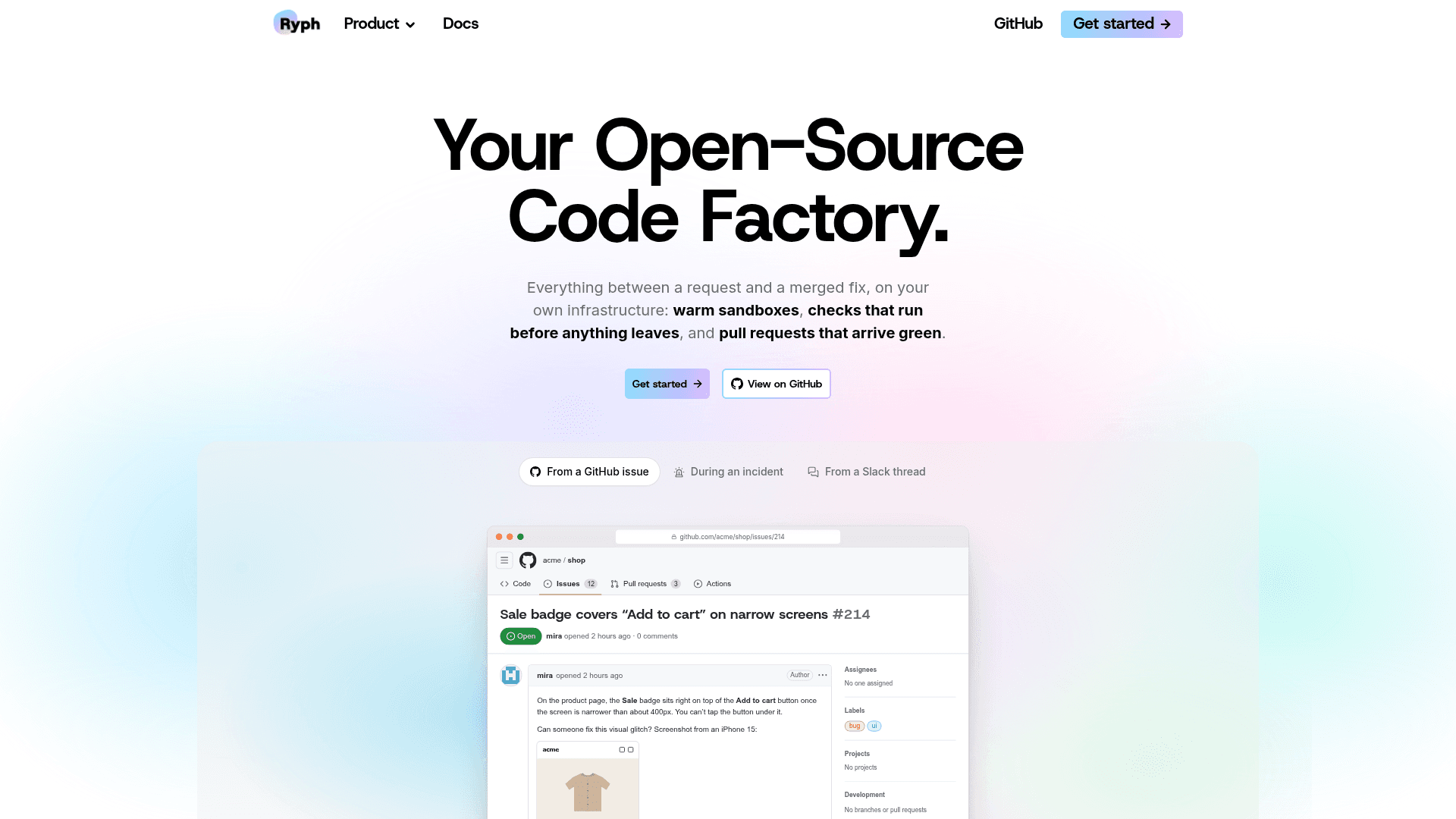
Ryph is an open-source, self-hosted platform from Ryph that runs coding agents in secure containers for engineering teams. Agents can be started by an alert, a task in the UI, a /ryph comment on a pull request or issue, a chat mention, or a schedule. Their work leaves as a pull request, with every step on record. The latest listed release is v0.1.4, and the README notes breaking changes are possible before v1.
What It Is
Ryph is an agent orchestrator that handles everything between a request and a merged fix on your own infrastructure. Each run gets a sandbox built from an image for the repo, with dependencies installed and a warm build. Checks declared in the repo run before anything leaves, so pull requests arrive with CI already green, according to the project.
Incident Response and Chat
When an alert fires from a webhook-capable incident tool (Grafana, Alertmanager, PagerDuty, Sentry, incident.io, Datadog, Opsgenie or a custom mapping), an automation starts an agent that joins the team's incident chat. It reads telemetry through a tool proxy, reports findings, takes direction from people mentioning it, and submits a fix pull request. Chat integrations include Slack, Zulip, Telegram and Discord. Agents can also publish reports as artifacts that teammates open as pages.
Forges, Automations and Memory
Commenting /ryph on a GitHub or GitLab issue or pull request, or on a Radicle issue or patch, starts an agent that reads the thread and opens or updates a pull request. Automations pair a saved recipe with cron schedules or webhooks. Memory consolidates what runs learn into a shared store, merges duplicates, settles contradictions and flags memories the code has moved past.
Security Model
Ryph assumes an agent can be manipulated. Real model, tool and forge credentials stay behind gateways, and the sandbox holds only run-scoped keys. Tools are allowlisted per agent, internet access goes through an egress proxy with a host allowlist, and Git changes leave as patches through a forge gateway. The site documents limits, such as web fetch tools not going through the proxy.
Deployment
Ryph runs as a single binary on a laptop (ryph up, with embedded Postgres and Docker runs), via Docker Compose, or with a Helm chart on Kubernetes 1.29 or later. It supports Anthropic, OpenAI or any OpenAI-compatible endpoint, plus hosted or remote MCP servers.
Community Discussions
Be the first to start a conversation about Ryph
Share your experience with Ryph, ask questions, or help others learn from your insights.
Pricing
Open Source (Self-hosted)
Self-hosted Ryph core released under the MIT License; runs on your own infrastructure.
- MIT License
- Self-hosted: one binary on a laptop, Docker Compose, or Kubernetes (Helm chart)
- Bring your own Anthropic, OpenAI, or OpenAI-compatible model access (external cost)
- Incident response, automations, forge and chat integrations, artifacts, memory, agentic CI
Capabilities
Key Features
- Incident response agents that join incident chat
- Webhook and cron automations
- /ryph commands on GitHub, GitLab and Radicle issues and PRs
- Shared agent memory with consolidation and staleness flagging
- Agentic CI checks declared in .ryph/checks.yml
- Credential gateways, egress allowlist and patch-only Git delivery
- Per-repo environment images and service containers (Postgres, Redis)
- Artifacts published as shareable pages
- Agent blueprints and per-agent tool policies
- Hosted MCP servers
- Submission policies for automatic or approved PRs
- Usage and cost tracking
- Kill switches for provider keys and MCP servers
- Single binary, Docker Compose and Helm deployment