Semantica
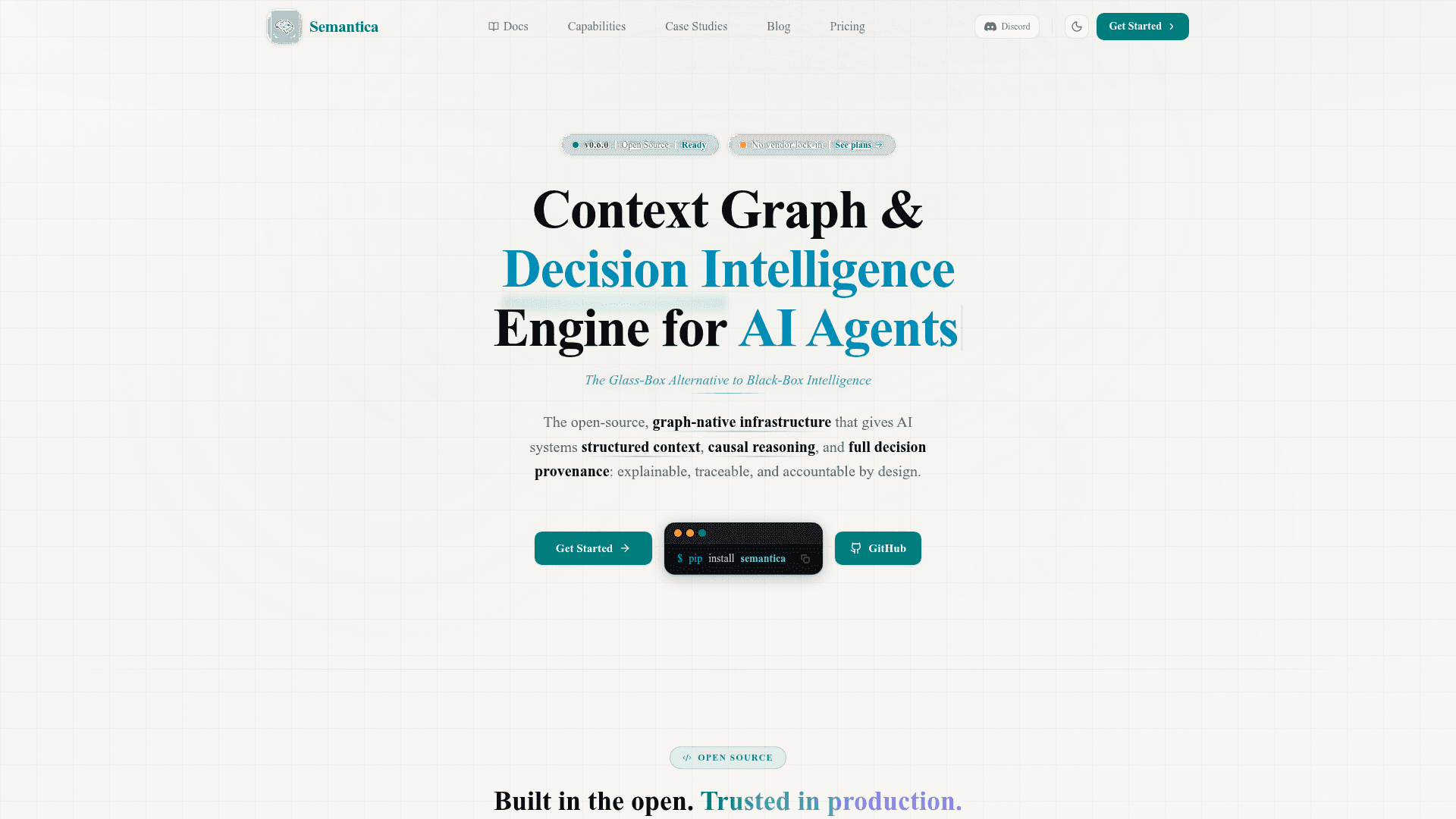
Open-source, graph-native infrastructure that gives AI agents structured context, causal reasoning, and full decision provenance for explainable, traceable, and auditable AI systems.
At a Glance
MIT-licensed context graph engine for developers, startups, and researchers building agentic AI systems.
Engagement
Available On
Listed Aug 2026
About Semantica
Semantica is an open-source Python library (MIT licensed) that sits underneath LLMs, vector stores, and agent frameworks as a deterministic infrastructure layer for context graphs, decision intelligence, and full provenance tracking. It is installable via pip install semantica and is currently at v0.6.0, published July 2026. The project describes itself as "the glass-box alternative to black-box intelligence" and is positioned for high-stakes, regulated domains where AI outputs must be explainable and auditable.
What It Is
Semantica is a graph-native AI infrastructure library that builds a structured, queryable context graph from enterprise data sources and records every AI decision as a first-class, auditable object. Unlike vector stores that retrieve similar text without understanding relationships, Semantica constructs a live knowledge graph of entities, relationships, and decisions with W3C PROV-O compliant lineage on every fact. It is fully self-hostable with zero vendor lock-in, supporting swappable backends for graph databases (Neo4j, FalkorDB, Apache AGE, AWS Neptune), RDF triple stores (Blazegraph, Apache Jena, Eclipse RDF4J), and vector stores (FAISS, Pinecone, Weaviate, Qdrant, Milvus, PgVector).
Core Architecture and Modules
Semantica ships 13+ independently importable production modules spanning the full pipeline from ingestion to export:
- Context Graphs — Typed nodes and edges with temporal validity windows, SPARQL/Cypher queries, and point-in-time snapshots
- Decision Intelligence —
record_decision(),trace_decision_chain(),find_similar_decisions(),analyze_decision_impact(), andcheck_decision_rules()turn every AI choice into a permanent, queryable graph node - Reasoning Engines — Forward chaining, Rete network, Datalog, abductive reasoning, and SPARQL with fully explainable inference paths
- Semantic Extraction — Named entity recognition, relation extraction, event detection, and triplet generation from raw text
- Provenance & Auditability — W3C PROV-O lineage on every fact, exportable to JSON, CSV, RDF, and Parquet for regulator submission
- Ontology Management — Auto-generate OWL ontologies, validate with SHACL/HermiT/Pellet, manage SKOS vocabularies
- Temporal Intelligence — Allen Interval Algebra (13 relations), bi-temporal provenance, point-in-time graph snapshots, and
TemporalNormalizer - Pipeline DSL — Declarative, parallel stage chaining with validation gates and configurable retry policies
Integration Ecosystem
Semantica connects to virtually every major AI tool category through native plugin bundles, an MCP server, and a REST API:
- Native plugin bundles for Claude Code, Cursor, and Codex CLI
- MCP server + plugin for Windsurf, Cline, Continue, VS Code, and OpenClaw
- REST API for GitHub Copilot, Roo Code, Goose, Aider, Amazon Q, and Zed
- Agentic frameworks — First-class Agno integration; LangChain, LangGraph, CrewAI, LlamaIndex, AutoGen, OpenAI Agents, and Google ADK supported via REST/MCP today, with dedicated native SDKs planned
- Enterprise data platforms — Native
DatabricksIngestor(Unity Catalog + Delta Lake) andSnowflakeIngestorconnectors - LLM providers — All major providers via
semantica.llmsand LiteLLM: OpenAI, Anthropic, Gemini, Mistral, Llama, Groq, Cohere, Azure OpenAI, AWS Bedrock, Ollama, DeepSeek, and more
Target Audience and Regulated Domains
The README explicitly targets AI/ML platform teams shipping consequential agents, data platform teams on Databricks or Snowflake, compliance and audit teams, and regulated enterprises in finance, healthcare, legal, government, and defense. The homepage lists vendor-published case studies including a marine natural capital finance deployment (Nereus) quantifying $1.62B in natural capital across Indo-Pacific sites, and an energy regulation deployment (Ausgrid) indexing 10 years of AER regulatory history with full provenance. The project states compliance alignment with GDPR, EU AI Act, HIPAA, and W3C PROV-O standards.
Update: v0.6.0
Released July 21, 2026, v0.6.0 adds four notable capabilities: named-graph support for JenaStore completing cross-backend named-graph parity across Blazegraph, RDF4J, and Jena; parameterized SPARQL CONSTRUCT query templates extended to RDF4J and Jena with pipeline integration; a new DatabricksIngestor for Unity Catalog + Delta Lake ingestion with PAT/OAuth M2M auth; and a SQLiteVecStore disk-backed local vector store on sqlite-vec's vec0 virtual tables. The repository reports 3,100+ GitHub stars and 370+ forks as of the data snapshot.
Community Discussions
Be the first to start a conversation about Semantica
Share your experience with Semantica, ask questions, or help others learn from your insights.
Pricing
Open Source
MIT-licensed context graph engine for developers, startups, and researchers building agentic AI systems.
- Full context graph engine
- Decision tracking & causal chains
- All reasoning engines
- Semantic extraction pipeline
- Knowledge Explorer UI
Self-Hosted
Production-ready deployment inside your own VPC, with collaboration features, analytics, and priority support.
- Everything in Open Source
- Runs entirely in your VPC
- Team collaboration
- Analytics dashboard
- Custom ontology templates
- SSO / SAML authentication
- Audit logs
- Priority support
- No vendor lock-in
Custom Enterprise Deployment
End-to-end domain-specific AI systems for organizations requiring dedicated infrastructure, advanced customization, and enterprise support.
- Everything in Self-Hosted
- Dedicated infrastructure
- On-premise deployment
- Domain-specific customization
- Custom integrations & APIs
- Compliance support
- Dedicated success manager
- 24/7 priority support
- Custom SLA agreements
- White-glove onboarding
Capabilities
Key Features
- Context Graphs with typed nodes, edges, and temporal validity windows
- Decision Intelligence with record_decision(), trace_decision_chain(), find_similar_decisions()
- W3C PROV-O compliant provenance on every fact
- Forward chaining, Rete network, Datalog, and SPARQL reasoning engines with explainable paths
- Named entity recognition, relation extraction, event detection, and triplet generation
- OWL ontology generation, SHACL validation, and SKOS vocabulary management
- Temporal intelligence with Allen Interval Algebra, bi-temporal provenance, and point-in-time snapshots
- Polyglot graph storage: Neo4j, FalkorDB, Apache AGE, AWS Neptune, Blazegraph, Apache Jena, Eclipse RDF4J
- Vector store integrations: FAISS, Pinecone, Weaviate, Qdrant, Milvus, PgVector, SQLite
- Hybrid search combining vector similarity with graph traversal
- GraphRAG-native entity-aware, relation-aware, and ontology-aware document chunking
- Conflict detection and resolution across multiple data sources
- Entity resolution and semantic deduplication at scale
- Declarative parallel pipeline DSL with validation gates and retry policies
- Export to RDF, OWL, Parquet, Cypher, JSON-LD, and CSV
- Interactive Knowledge Explorer UI built on React 19 and Sigma.js
- MCP server for Claude Desktop, Windsurf, Cline, Continue, VS Code, and OpenClaw
- Native plugin bundles for Claude Code, Cursor, and Codex CLI
- REST API with endpoints for graph, decisions, reasoning, provenance, ontology, and export
- Databricks Unity Catalog + Delta Lake ingestion with PAT/OAuth M2M auth
- Snowflake ingestion with warehouse/database/schema and key-pair/OAuth auth
- Multi-agent shared context via first-class Agno integration
- CLI with 20+ command groups including ingest, reason, decision, provenance, and export
- Graph analytics: PageRank, betweenness centrality, Louvain community detection, Node2Vec, link prediction
- Audit trail export in W3C PROV-O format for GDPR, EU AI Act, and HIPAA compliance
Integrations
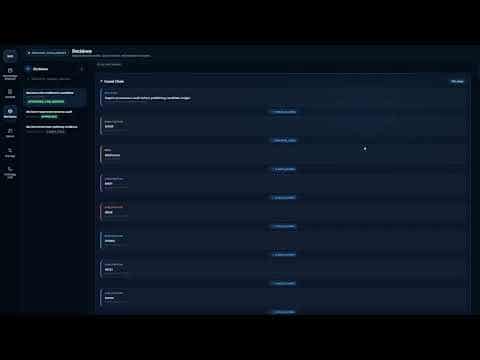
Demo Video