
Busabase
Open-source database and workspace for AI agents where agent-written data, docs, skills, and apps are stored and reviewed by humans.
At a Glance
MIT-licensed Busabase engine, free forever when self-hosted; no seat count, no expiry.
Engagement
Available On
Alternatives
Listed Oct 2026
About Busabase
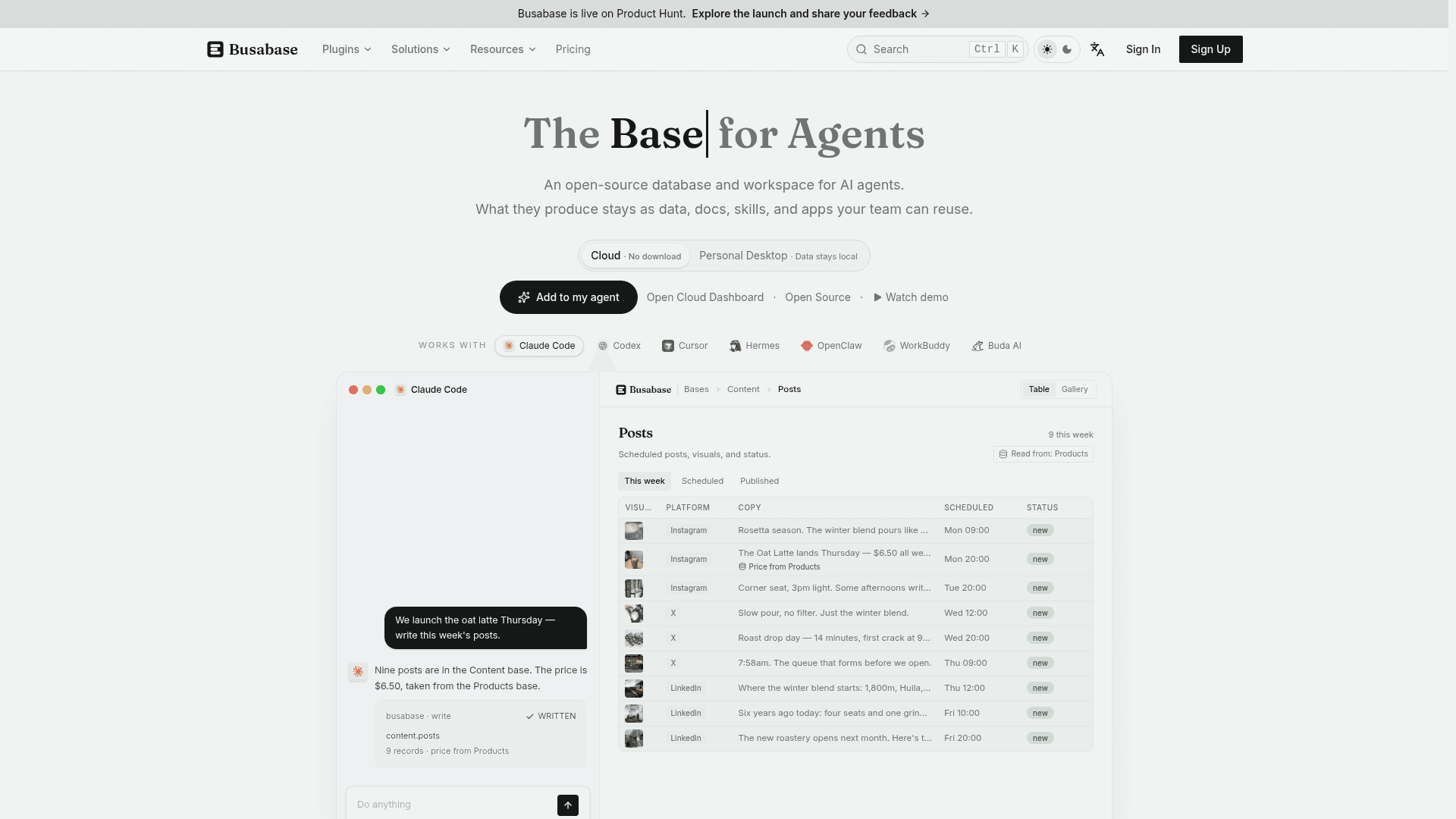
Busabase is an open-source database and workspace for AI agents. Agents connect to it and write their output as structured data, docs, skills, and apps; people review and approve changes before they become canonical records. It can run in Busabase Cloud, in Busabase Desktop with local data, or self-hosted with Docker.
What It Is
Busabase describes itself as a headless review database for AI-generated content, combining flexible table storage with a git-shaped review workflow. In the docs, a base is a content type, a record is the approved row, and a change request is an in-flight edit that is opened, reviewed, approved, and merged. Every AI edit is stored as a commit, which gives a diffable history of who changed what.
The workspace is organized into Data bases (typed tables), Knowledge bases (checked, sourced docs), Apps bases (AirApps built on the same data), Skills bases (saved workflows any agent can run), and Playbooks that agents consult before tasks.
How Agents Connect
Agents such as Claude Code, Codex, Cursor, Hermes, OpenClaw, n8n, or custom agents connect through Agent Skills, MCP, OpenAPI, or the CLI. Busabase has no built-in model; the docs describe bringing your own agent over ACP and typing @AI in a comment to get a revised commit. Approved records can be served downstream over a token-authenticated REST API. Plugins exist for Codex, Claude Code, and DeepSeek Harness, and community adapters include Drizzle, Kysely, and an n8n node.
Review and Ownership Model
Agents propose and humans merge: each write carries its author, change, and history, and rejected work never enters canonical data. The About page states that Busabase will not put AI inside the product and will not train on user data. Use cases listed include customer support, marketing, content, team memory, operations, research, product catalog, and compliance.
Deployment Options
The homepage states the engine is MIT-licensed open source. Desktop keeps data in a local folder and works offline, Docker supports self-hosting inside a company network, and Cloud requires no installation.
Community Discussions
Be the first to start a conversation about Busabase
Share your experience with Busabase, ask questions, or help others learn from your insights.
Pricing
Open Source (Self-hosted)
MIT-licensed Busabase engine, free forever when self-hosted; no seat count, no expiry.
- MIT-licensed engine
- No seat limit
- Data never leaves your machine
- Run via npx busabase server or Docker
Free
Busabase Cloud: for one person keeping what their agents produce.
- 1 space you own
- 3 seats per space
- 5,000 records per space
- 20 nodes per space
- 1 GB attachment storage
Plus
For a small team building on the same agent-written data.
- 3 spaces you own
- 10 seats per space
- 50,000 records per space
- 200 nodes per space
- 20 GB attachment storage
- 3 self-hosted connections online
- Whiteboards, skills and workflows
- OpenAPI, webhooks and MCP
- Flat per-seat price — no metered overage
Pro
For growing workspaces that need room to scale and open APIs everywhere.
- Everything in Plus
- Unlimited spaces you own
- Unlimited seats
- Unlimited records
- Unlimited nodes
- 100 GB attachment storage
- Unlimited self-hosted connections
- AirApps and HTML pages
- Priority support (WhatsApp / WeChat / Email)
Enterprise
Managed cloud or a commercial self-host license, with security review and an SLA.
- Everything in Pro
- Attachment storage sized to your contract
- Multi-stage review workflows
- SSO and SAML
- Audit log export
- Self-host commercial license and support
- SLA and a dedicated account manager
Capabilities
Key Features
- Human review queue (Inbox) for agent submissions
- Change requests with commits, diffs, approve/reject/merge
- Typed Data bases
- Knowledge base with sources and review history
- AirApps built on the same data
- Reusable agent Skills
- Playbooks agents follow before tasks
- @AI comments for revisions over ACP
- REST API with token authentication, OpenAPI and webhooks
- MCP, Agent Skills, and CLI connectivity
- Full audit history of every change
- Templates for common workspaces
- Local desktop, self-hosted Docker, and Cloud deployment