
Sepo
A GitHub-native AI agent that turns any repository into a self-evolving codebase by responding to @mentions in issues, PRs, and discussions to implement, review, and maintain code via GitHub Actions.
At a Glance
Fully free and open-source under the MIT License. Self-host via GitHub Actions with your own model-provider API keys.
Engagement
Available On
Listed May 2026
About Sepo
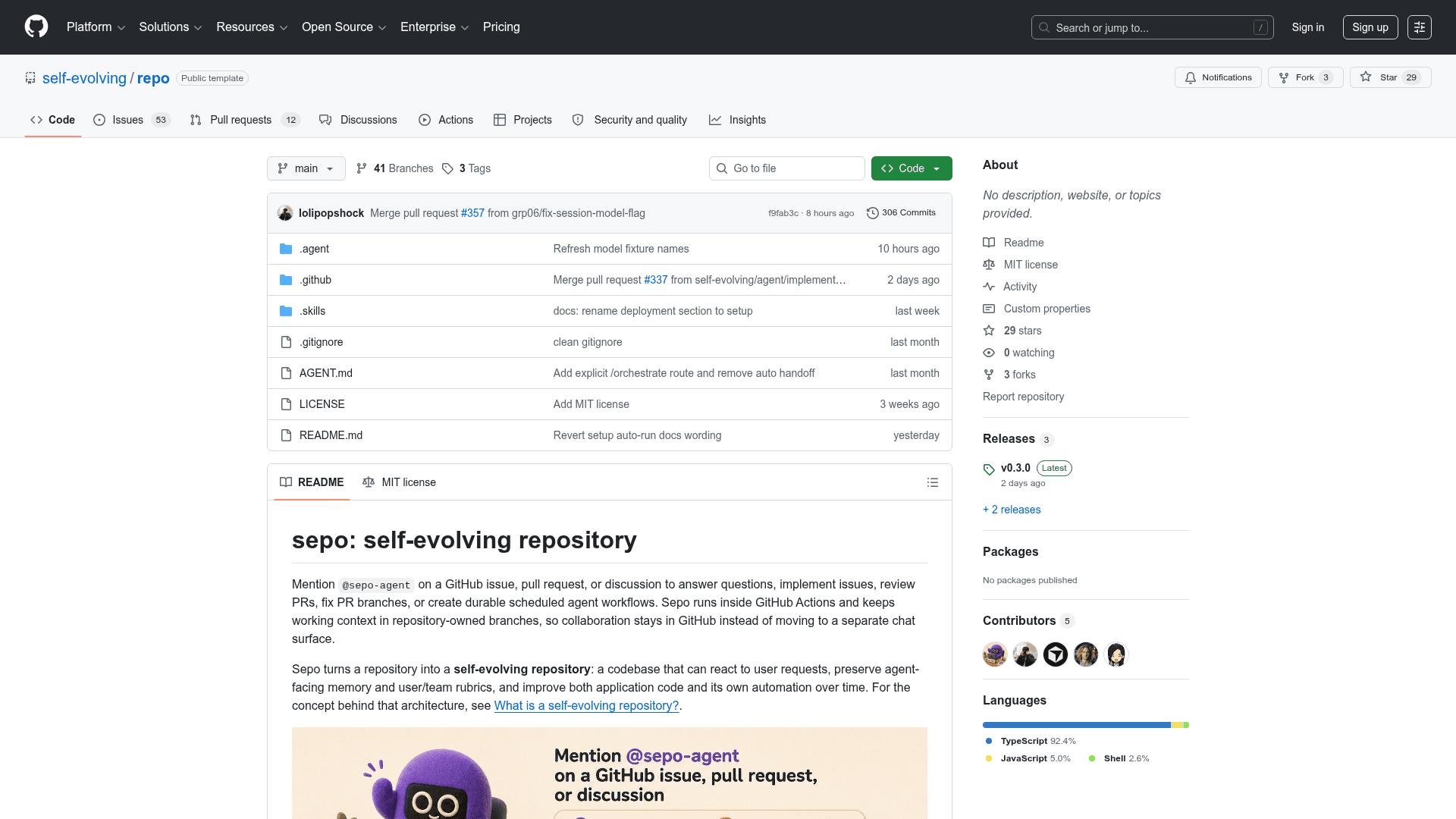
Sepo is an open-source GitHub App and Actions-based agent that runs entirely inside a repository's own infrastructure. Built by the self-evolving organization and licensed under MIT, it lets teams trigger AI-powered workflows directly from GitHub issues, pull requests, and discussions by mentioning @sepo-agent. The latest release is v0.3.0, published in May 2026.
What It Is
Sepo introduces the concept of a self-evolving repository: a codebase that can react to user requests, preserve agent-facing memory and team rubrics, and improve both application code and its own automation over time. Rather than routing collaboration to a separate chat surface, Sepo keeps all agent interaction inside GitHub — where the code, issues, and pull requests already live. It supports OpenAI Codex-backed runs (via OPENAI_API_KEY) and Claude-backed runs (via CLAUDE_CODE_OAUTH_TOKEN or ANTHROPIC_API_KEY), configured as repository secrets in GitHub Actions.
How the Workflow Works
Every trigger — a mention, a label, or a scheduled cron — converges on agent-router.yml, which extracts GitHub context, applies an access policy, optionally triages free-form requests with a model, and dispatches to a specialized route. The supported built-in routes include:
/implement— implements a GitHub issue into code/review— reviews an open pull request/fix-pr— fixes a failing or flagged PR branch/orchestrate— checks current target state and chains the right built-in actions through bounded follow-up handoffs/skill <name>— invokes arbitrary repository-defined skills/install— installs Sepo into another repository
Labels like agent/review or agent/implement can trigger the same routes without a text mention.
Durable Memory and Rubrics Architecture
Sepo persists long-lived context across runs using two repository-owned branches:
agent/memory— mirrors GitHub Actions artifacts and stores curated project context so later runs can resume from prior stateagent/rubrics— stores user and team preferences that guide implementation style and review behavior
This architecture means agent sessions survive across workflow runs without requiring an external database or third-party service.
Scheduled and Autonomous Jobs
Beyond on-demand mentions, Sepo supports scheduled GitHub Actions workflows for recurring tasks. The packaged agent-daily-summary.yml can publish a daily repository activity summary discussion when enabled (disabled by default, manual dispatch available). The agent-update.yml workflow checks near-biweekly for Sepo infrastructure updates from the latest stable release tag, updating an existing PR rather than opening duplicates. The AGENT_AUTO_UPDATE=false variable disables the scheduled update check; AGENT_ENABLED=false pauses all Sepo agent workflows entirely.
Update: v0.3.0
The latest release, v0.3.0, was published on May 24, 2026. The repository was created in April 2026 and has seen active development, with the last push recorded on May 26, 2026. The project currently has 26 stars and 3 forks on GitHub, with 65 open issues reflecting active community engagement. The project direction signals continued investment in the self-evolving repository concept, with documentation covering architecture, customization, skills, memory, and rubrics as distinct subsystems.
Setup Path
Sepo can be started from a template repository or installed into an existing repository. The quick-start path involves creating a repo from the template, installing the Sepo GitHub App, configuring at least one model-provider credential as a repository secret, and running the Agent / Onboarding / Check Setup workflow to create trigger labels and validate configuration. For existing repositories, a guided install issue form is available for public repos; private repos require a local agent session using the .skills/install-agent skill to keep private access in a trusted environment.
Community Discussions
Be the first to start a conversation about Sepo
Share your experience with Sepo, ask questions, or help others learn from your insights.
Pricing
Open Source
Fully free and open-source under the MIT License. Self-host via GitHub Actions with your own model-provider API keys.
- Full source code available under MIT License
- Runs inside GitHub Actions — no external service required
- Supports OpenAI Codex and Anthropic Claude backends
- All built-in routes: implement, review, fix-pr, orchestrate, skill, install
- Durable memory and rubrics via repository-owned branches
Capabilities
Key Features
- Mention @sepo-agent in issues, PRs, or discussions to trigger AI workflows
- Implements GitHub issues into code automatically
- Reviews pull requests on demand or via label trigger
- Fixes failing PR branches
- Task orchestration with bounded follow-up handoffs
- Durable agent memory via agent/memory repository branch
- Team rubrics stored in agent/rubrics branch
- Scheduled cron jobs for recurring maintenance and triage
- Near-biweekly self-update workflow
- Configurable access policy for authorized users
- Supports OpenAI Codex and Anthropic Claude backends
- Arbitrary repository-defined skills via /skill route
- Install Sepo into other repositories via /install route
- Runs entirely inside GitHub Actions — no external service required
- Label-based triggers (agent/review, agent/implement, etc.)