
Slnmap
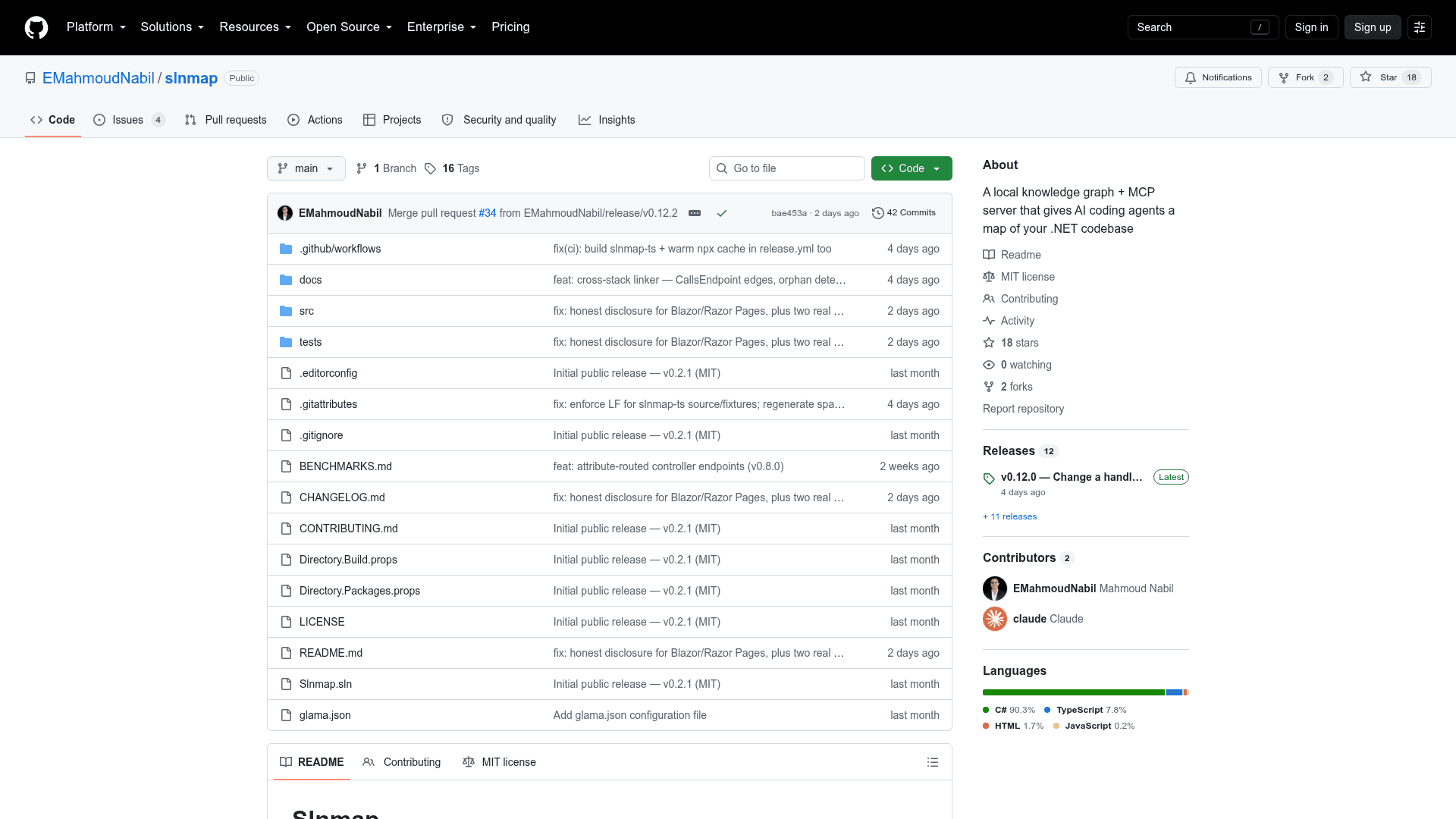
A local semantic code graph and MCP server that gives AI coding agents a compiler-accurate map of your entire .NET solution for precise refactoring and impact analysis.
At a Glance
Fully free and open source under the MIT license. Install via dotnet tool install --global Slnmap.
Engagement
Available On
Listed Aug 2026
About Slnmap
Slnmap (sln-map) is an open-source CLI tool and MCP server built by Mahmoud Nabil that gives AI coding agents a precise, compiler-accurate map of .NET solutions. It uses the Roslyn compiler platform to build a semantic graph of every type, member, and relationship in a solution, stores it locally as a SQLite database, and serves it to agents or editors over the Model Context Protocol (MCP). The project is MIT-licensed and available on GitHub.
What It Is
Slnmap solves a concrete problem: AI agents refactoring .NET code can only see files already in their context window, so they miss callers in other projects, misidentify dependencies, and hallucinate breaking changes. Slnmap builds a whole-solution graph — every caller, every implementation, every inheritance edge — and exposes it through fifteen read-only MCP tools so an agent can answer architecture questions correctly across every project in the solution. It runs entirely locally with no telemetry and no cloud service.
How the Graph Is Built
Slnmap uses MSBuildWorkspace (Roslyn) to perform design-time builds of each project, extracting:
- Symbols: types, members, interfaces, events, endpoints
- Relationships: Calls, Implements, Inherits, References edges
- HTTP endpoints: ASP.NET Core Minimal APIs and attribute-routed controllers, resolved statically including
MapGroupprefixes,constpatterns, class-level[Route], and controller base classes from packages like Ardalis.ApiEndpoints - Frontend call sites (via
analyze-ts): TypeScript/React HTTP calls resolved through const-through-barrel re-exports and template literals, linked to C# endpoints viaslnmap link
The graph is stored in a local slnmap.db SQLite file. Updates are incremental and crash-safe — an interrupted run never corrupts the existing graph. The slnmap watch command (added in v0.10.0) keeps a warm Roslyn workspace in memory and re-analyzes on file save, bringing a one-file semantic change down to roughly one second end-to-end on a representative solution.
MCP Tool Surface
The MCP server exposes fifteen read-only tools covering the most common agent architecture queries:
find_symbol,get_symbol_source— locate and read any symbol by FQNimpact_analysis— every symbol that transitively depends on a given one, depth 5, counts-firstfind_usages,find_implementations,get_type_hierarchy— reference and inheritance traversalget_architecture_overview,get_project_dependencies,find_circular_dependencies— solution-level structurelist_endpoints,find_endpoint— HTTP endpoint discovery across Minimal APIs and controllersfind_orphan_calls,list_frontend_callsites— cross-stack frontend→backend linking (afterslnmap link)find_tests_for_symbol— test members that transitively exercise a symbol
Malformed calls return a structured JSON payload (status/code/message/hint) rather than opaque errors, so agents can self-correct without human intervention.
Update: v0.12.0 — Cross-Stack Impact Analysis
The latest release (v0.12.0, published August 2026) is titled "Change a handler, see the React call sites that break." It completes the cross-stack linking feature: after running slnmap analyze, slnmap analyze-ts, and slnmap link, impact_analysis and find_usages on a C# handler continue straight through to its frontend callers — surfacing the exact React call sites that break when a backend handler changes, with no separate query. Earlier notable releases include v0.10.0 (slnmap watch for warm-workspace incremental analysis) and v0.8.0 (attribute-routed controller endpoint support).
Privacy and Deployment Model
Slnmap is fully local by design. The README states that analyze, watch, serve, viz, status, and doctor make no network calls at all — analysis works fully offline. The one documented exception is analyze-ts, which fetches the slnmap-ts npm extractor via npx on first use; no source code is ever sent anywhere. Because the CLI and MCP server are open source, the no-telemetry claim is auditable from the source code. The tool runs on Windows, macOS, and Linux and requires the .NET 9 SDK; analyze-ts additionally requires Node.js 18+.
Community Discussions
Be the first to start a conversation about Slnmap
Share your experience with Slnmap, ask questions, or help others learn from your insights.
Pricing
Open Source
Fully free and open source under the MIT license. Install via dotnet tool install --global Slnmap.
- Full CLI and MCP server
- 15 read-only MCP tools
- Roslyn semantic graph analysis
- HTTP endpoint discovery
- TypeScript/React frontend analysis
Capabilities
Key Features
- Roslyn-powered semantic code graph of entire .NET solutions
- 15 read-only MCP tools for architecture queries
- Impact analysis across all projects and callers
- HTTP endpoint discovery for Minimal APIs and attribute-routed controllers
- TypeScript/React frontend call site analysis via analyze-ts
- Cross-stack frontend-to-backend linking via slnmap link
- Incremental and crash-safe graph updates
- Warm-workspace watch mode for ~1s re-analysis on file save
- Interactive HTML graph visualization export
- Fully local with no telemetry or cloud service
- Structured error payloads for agent self-correction
- Circular dependency detection
- Test-to-symbol traceability
- SQLite-backed local graph storage
- Works with any MCP client including Claude Code