
SoduWork
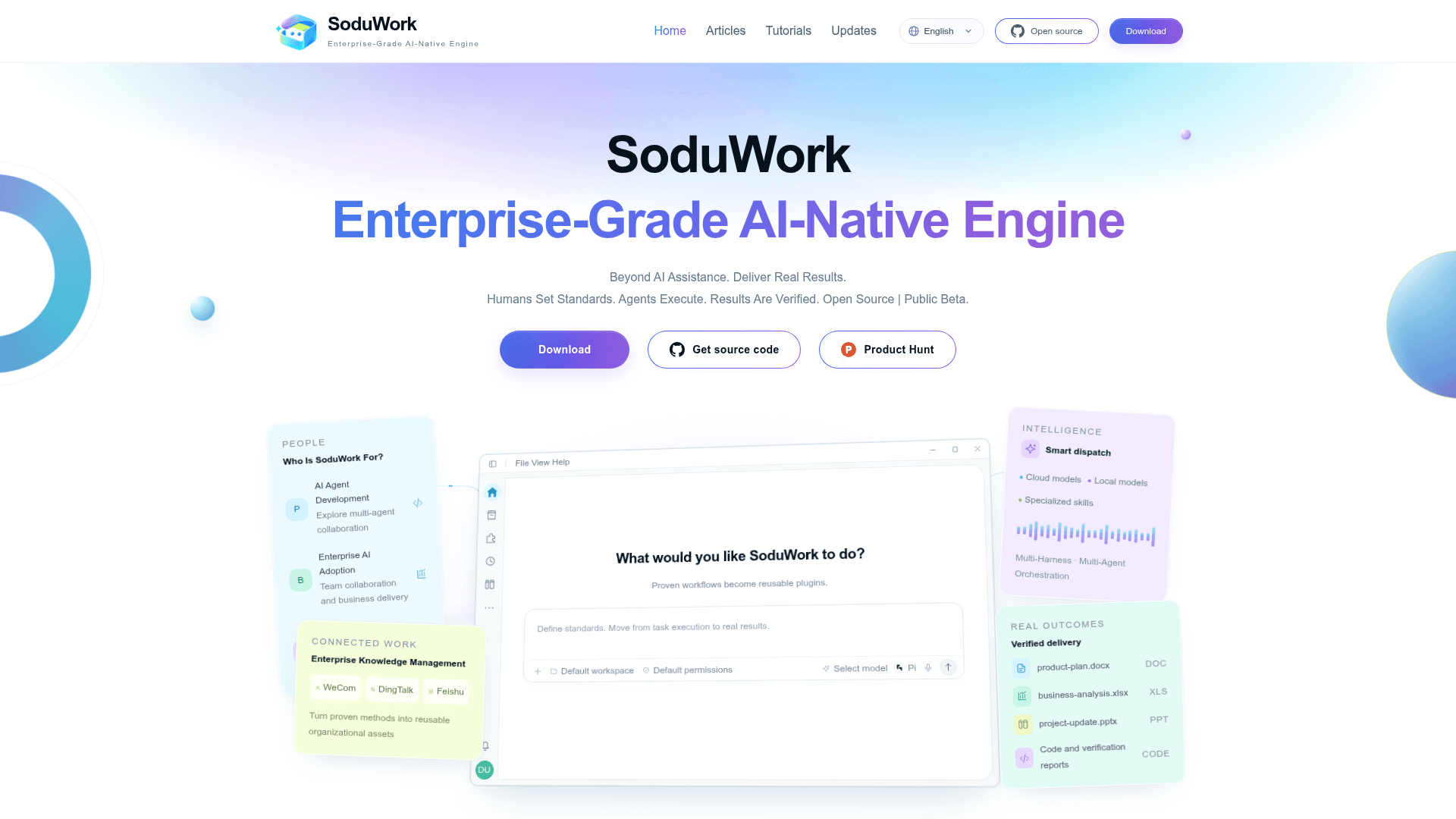
Open-source, self-hosted AI-native engine that orchestrates multiple agent harnesses with acceptance criteria, AI review, and reusable team plugins.
At a Glance
SoduWork's own code is released under the MIT License; self-hosted multi-harness, multi-agent engine, currently in public beta.
Engagement
Available On
Alternatives
Listed Nov 2026
About SoduWork
SoduWork is an open-source, self-hosted engine from MDiRi (Material Digital Intelligence Research Institute) for teams and their AI agents. A request is filed with acceptance criteria, executed by an agent on a chosen harness, reviewed by a separate AI, and signed off by the requester. It is in public beta, and the project advises evaluating it before production use.
What It Is
SoduWork is a multi-harness, multi-agent workbench. A harness is the agent runtime that does the work, and SoduWork connects harnesses through one adapter interface so issues, plugins and review do not depend on any single one. Documented harnesses include Pi (built in), OpenCode, DeepSeek Harness, Qwen Code, Kimi Code, Codex Harness and Codex. Programs that support the Agent Client Protocol can be added with a catalog declaration.
How the Delivery Workflow Works
Requests, execution, review and reuse happen in a shared issue pool. A person raises a request, AI refines it and adds acceptance criteria, and it is assigned to the requester, a colleague or an agent. The agent runs it, often with a team plugin, a separate AI review checks each criterion, and the requester makes the final sign-off. Who asked, who did the work, which plugin ran and who approved it is recorded.
Plugins and Organizational Assets
When a task goes well, the chat can be saved as a versioned plugin containing method, inputs, acceptance criteria and workflow. Plugins can be kept private or submitted for review and published to a team catalog, with grants and revocation. Plugin apps add their own UI and an AI chat panel. The website lists built-in capabilities such as document, presentation and spreadsheet workshops, deep research, PDF tools, code delivery workflows, and WeCom, DingTalk and Feishu integrations.
Deployment and Data Handling
SoduWork can run from source on macOS, Linux or Windows, via desktop installers, or be deployed for a team with Docker, which starts the Hub, admin console and PostgreSQL. When self-hosted, issues, plugins and chat history stay in your own Hub. The README documents limits: cloud handoff moves context rather than running processes, and runners are not a general-purpose sandbox.
Community Discussions
Be the first to start a conversation about SoduWork
Share your experience with SoduWork, ask questions, or help others learn from your insights.
Pricing
Open Source (Self-hosted)
SoduWork's own code is released under the MIT License; self-hosted multi-harness, multi-agent engine, currently in public beta.
- MIT-licensed core code (third-party code, fonts, graphics and bundled tools keep their own licenses)
- SoduWork name and logo are trademarks of MDiRi and not licensed under MIT
- Self-hosted Hub deployable with Docker
- Multi-harness, multi-agent orchestration
- Built-in governance: plugin review, roles, usage, cost and audit log
Capabilities
Key Features
- Multi-harness integration with mid-conversation harness switching
- Multi-agent collaboration with separate AI review
- Acceptance criteria on every request with human sign-off
- Reusable versioned plugins and plugin apps
- Plugin review, scoped grants and revocation
- Roles, usage, cost tracking and audit log
- Cloud runner support for long tasks
- Self-hosted deployment with Docker
- Desktop client and admin console
- ACP-based harness extensibility