
StepSecurity
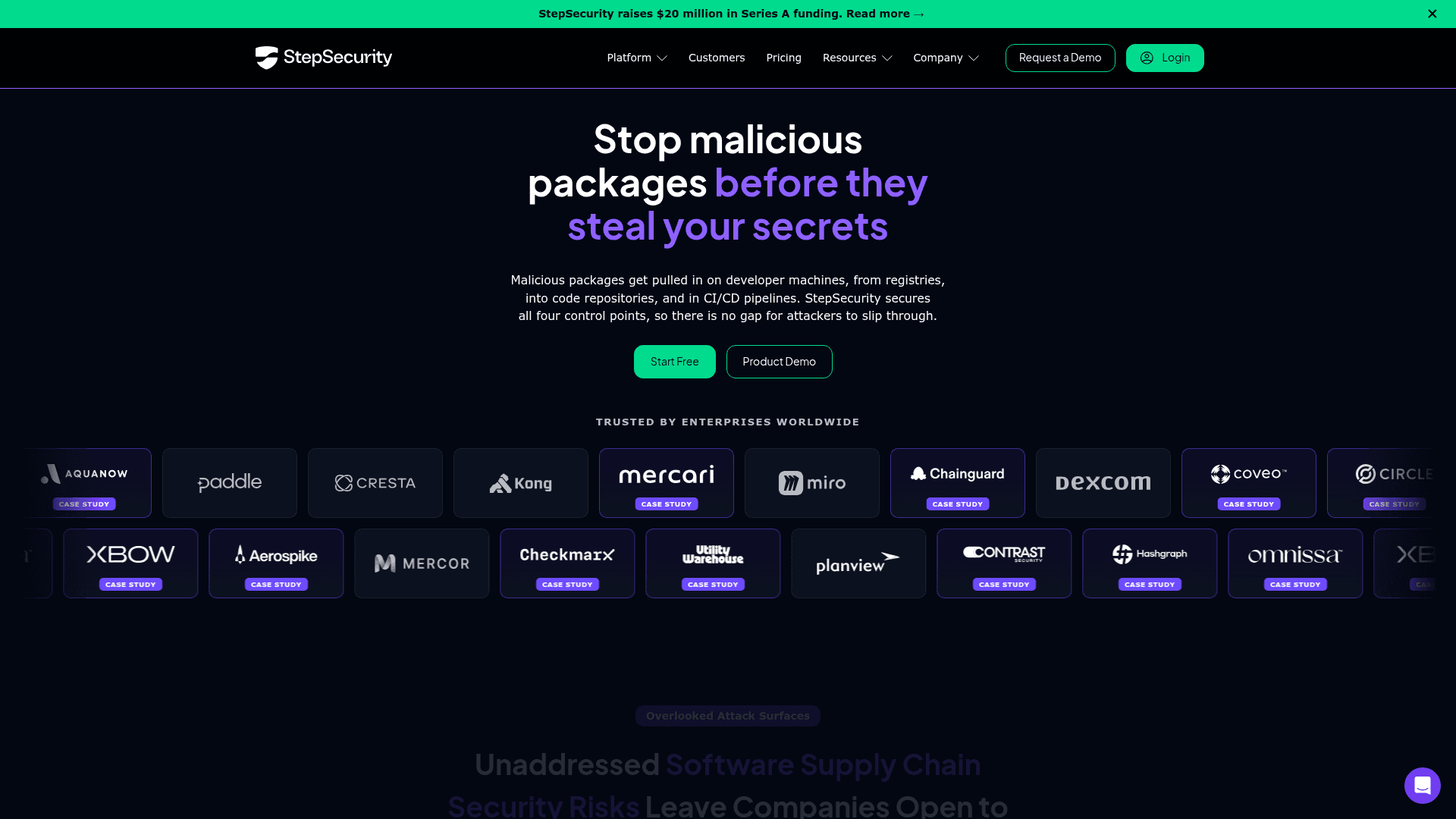
Software supply chain security platform that protects developer machines, package registries, code repositories, and CI/CD pipelines from malicious packages.
At a Glance
Best for open source repositories; unlimited public repositories.
14-day free trial of Enterprise or Dev Machine Guard; private repositories included.
Engagement
Available On
Listed Nov 2026
About StepSecurity
StepSecurity, founded in 2021 by Varun Sharma and Ashish Kurmi, is a software supply chain security platform. It places controls at four points where malicious code can enter software delivery: developer machines, package registries, code repositories, and CI/CD pipelines. Its open-source Dev Machine Guard agent is published under the Apache 2.0 license.
What It Is
StepSecurity detects and blocks software supply chain attacks where software gets built. The platform has four products: CI/CD Security (built around Harden Runner), Dev Machine Guard, Secure Registry, and Code Repo Security. A threat intelligence team publishes advisories with affected versions, IOCs, and remediation steps, and the company says these detections feed rules enforced by its products.
Controls at Each Layer
- Developer machines: Dev Machine Guard inventories AI coding agents, MCP servers, IDE extensions, browser extensions, and local packages, and audits package-manager configuration such as effective registry, cooldown policy, and authentication surface.
- Registry: Secure Registry applies cooldown periods, compromised-package blocking, and typosquat protection to installs from laptops and CI.
- Code repos: GitHub Checks screen pull requests, and Orchestrate Security opens policy-driven pull requests to harden repositories.
- CI/CD: Harden Runner monitors network calls, file writes, and processes on runners, with egress policies and workflow run policies.
Dev Machine Guard
Dev Machine Guard is a single Go binary for macOS, Windows, and Linux. It outputs pretty terminal text, JSON, or a self-contained HTML report. It also flags suspicious files, such as a malicious binding.gyp, using StepSecurity-maintained rules. In community mode, all data stays on the machine. Enterprise mode uploads scan data to the StepSecurity dashboard and adds scheduled scans via launchd, systemd, or schtasks, plus policy enforcement and alerting. The README says it complements EDR and MDM tools rather than replacing them.
Deployment Model
The homepage says deployment takes one line of YAML for CI, one config line for the registry, and one MDM push for laptops. Dev Machine Guard can be deployed through MDM tools such as Jamf, Kandji, and Intune.
Community Discussions
Be the first to start a conversation about StepSecurity
Share your experience with StepSecurity, ask questions, or help others learn from your insights.
Pricing
Community
Best for open source repositories; unlimited public repositories.
- Harden-Runner network and runtime security
- GitHub-hosted runners on GitHub Cloud
- StepSecurity Maintained Actions
- Orchestrated security remediation PRs
- Community support
Free trial
14-day free trial of Enterprise or Dev Machine Guard; private repositories included.
- Private repositories included
Enterprise
Every product, for the people who build your software. Per contributing developer; includes Dev Machine Guard and Secure Registry.
- CI/CD Security: Harden-Runner on hosted and self-hosted runners, GitLab CI, Azure DevOps
- Code Repo Security: PR checks, posture controls, hardening across all repos
- Secure Registry: one package policy for laptops and CI
- Dev Machine Guard for every licensed developer
- Centralized Threat Center and threat intelligence
- Priority support with support SLAs
- Volume discounts available for teams with more than 100 developers
Dev Machine Guard
For employees who use development tools but do not contribute code. Per device; includes Secure Registry.
- AI coding agent, MCP server, and IDE extension inventory
- Compromised package detection on endpoints
- Device Policy enforced through your MDM
- Secure Registry: cooldowns, blocklists, typosquat protection
- Threat Center and threat intelligence
Capabilities
Key Features
- Dev Machine Guard inventory of AI agents, MCP servers, IDE extensions, and browser extensions
- Package-manager config auditing for registry, cooldown, and authentication
- Suspicious file and IOC detection
- Harden Runner runtime monitoring and egress policy for CI/CD
- Secure Registry cooldown and compromised-package blocking
- GitHub Checks screening of pull requests
- Orchestrate Security policy-driven hardening PRs
- Maintained Actions as replacements for risky third-party GitHub Actions
- Threat intelligence advisories with IOCs and remediation steps
- Pretty, JSON, and HTML scan output