
SubjectiveZero
An open-source, native macOS agentic node editor for creative coding and realtime VFX, where AI coding agents turn prompt nodes into live, hot-reloading Metal code.
At a Glance
About SubjectiveZero
SubjectiveZero (SubZ) is a native macOS application built by SXP Studio that lets creative coders describe visual ideas as prompt nodes in a graph, then dispatches AI coding agents to implement each node as real, editable Swift and Metal code. It is currently in beta at v0.2.1, distributed as a signed and notarized DMG outside the App Store, and licensed under AGPL-3.0.
What It Is
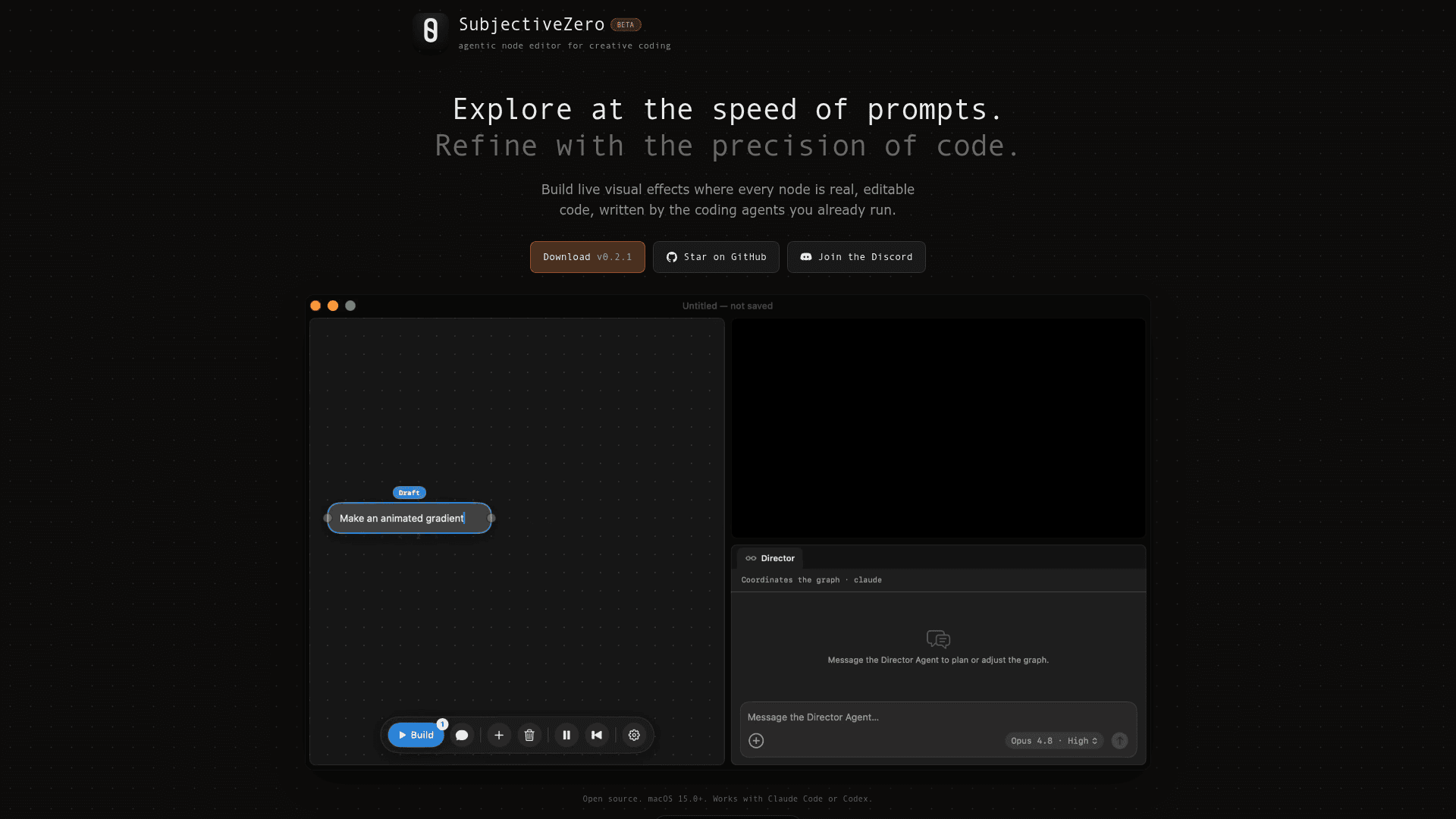
SubjectiveZero is an agentic creative-coding and realtime-VFX harness for macOS. Rather than picking operators from a fixed library like TouchDesigner or vvvv, you describe what you want in natural language. A Director Agent reads your prompt, splits it into typed nodes, wires them together, and dispatches a separate coding agent to each node simultaneously. Each node becomes an isolated, inspectable Swift file with a node-contract.json describing its typed inputs and outputs. The result compiles, hot-reloads on save (polling roughly every 300 milliseconds), and renders in a live Metal viewport — all without a WebView or Electron layer.
The Core Agentic Loop
The workflow follows four stages the product page describes as describe, iterate, combine, and own:
- Describe: A Director Agent reads your prompt, plans the graph, and dispatches one coding agent per node in parallel. Each node's UI — title, icon, typed inputs and outputs — drafts itself before a line of code exists.
- Iterate: Every node has a chat tab that works the way Claude Code and Codex already do. You can attach files by dropping or pasting, @mention any node or the whole project, and ask for a control; the node builds its own interface alongside the code.
- Combine: Prompt nodes (nodes that don't exist yet) can be wired into already-rendering nodes. Compile isolation means a node that fails to build never takes the rest of the graph down.
- Own: Every node is editable source. Change a constant, save, and it hot-reloads. The agent and your manual edits operate on the same files.
Architecture and Native Stack
SubZ is built entirely in Swift with SwiftUI for the interface and Metal for the renderer — no Electron, no WebView. The codebase is split into independent Swift packages: SZApp (the app bundle), SZCore (shared state and JSON serialization), SZAI (provider wrapping and orchestration), SZRuntime (Metal rendering engine), and SZUI (SwiftUI/AppKit panels). State is stored as JSON for portability. An embedded MCP server lets agents interact with the app — notifying status, reading state, requesting UI updates, and querying the built-in node library — with a 1:1 mapping to key UI interactions.
Agent Providers and No-Subscription Model
SubjectiveZero ships no model and resells no tokens. It drives the coding agent CLI you already have installed and authenticated: Claude Code (claude CLI) and Codex (codex CLI) are supported today, with OpenCode and Pi listed as coming soon. The app surfaces available models and thinking levels from a static capability manifest per provider. Because SubZ uses your own account and rate limits, there is no additional subscription required beyond what you already pay your AI provider.
Media, Audio, and Graph Capabilities
Beyond VFX shaders, the graph supports:
- Live microphone input feeding an audio-FFT node with ten band outputs that can drive any parameter
- Camera input wired into the graph
- Drag-and-drop images or video onto the canvas, arriving as source nodes
- Split and merge: ask for one node to become two, or two to fold into one; agents work out where the seam goes
Update: v0.2.1 Beta
The latest release is v0.2.1, published on 2026-07-10, distributed as a DMG with in-app updates via Sparkle. The GitHub repository was created on 2026-07-10 and last updated on 2026-07-11, indicating this is a very early and actively moving project. The README notes that interfaces, project formats, and the node ABI can still change between versions. Planned features include behavior-tree orchestration for agents, video export, and standalone app export from effects. Cross-platform support (Windows, Linux) is deferred and described as dependent on community interest.
Community Discussions
Be the first to start a conversation about SubjectiveZero
Share your experience with SubjectiveZero, ask questions, or help others learn from your insights.
Pricing
Open Source
Free and open source under AGPL-3.0. Download the signed DMG, build from source, or fork it. No subscription required beyond your own AI provider (Claude Code or Codex).
- Full agentic node editor
- Director Agent and per-node coding agents
- Live Metal viewport with hot-reload
- Claude Code and Codex integration
- Audio and camera input nodes
Capabilities
Key Features
- Agentic node editor with Director Agent and per-node coding agents
- Live Metal viewport with hot-reload on save (~300ms polling)
- Prompt nodes: describe an effect in natural language, agents implement it
- Per-node chat tab compatible with Claude Code and Codex workflows
- Compile isolation: a failing node never takes the rest of the graph down
- Audio input: microphone → FFT → 10-band outputs drive any parameter
- Camera input wired as a source node
- Drag-and-drop images and video onto the canvas as source nodes
- Split and merge nodes: agents work out the seam
- Built-in node library with 3-tier token-efficient access (index, cards, full source)
- MCP server for agent-to-app communication and automated testing
- Native SwiftUI + Metal stack, no Electron or WebView
- In-app updates via Sparkle
- AGPL-3.0 open source; your created work is explicitly yours