
system-design-skills
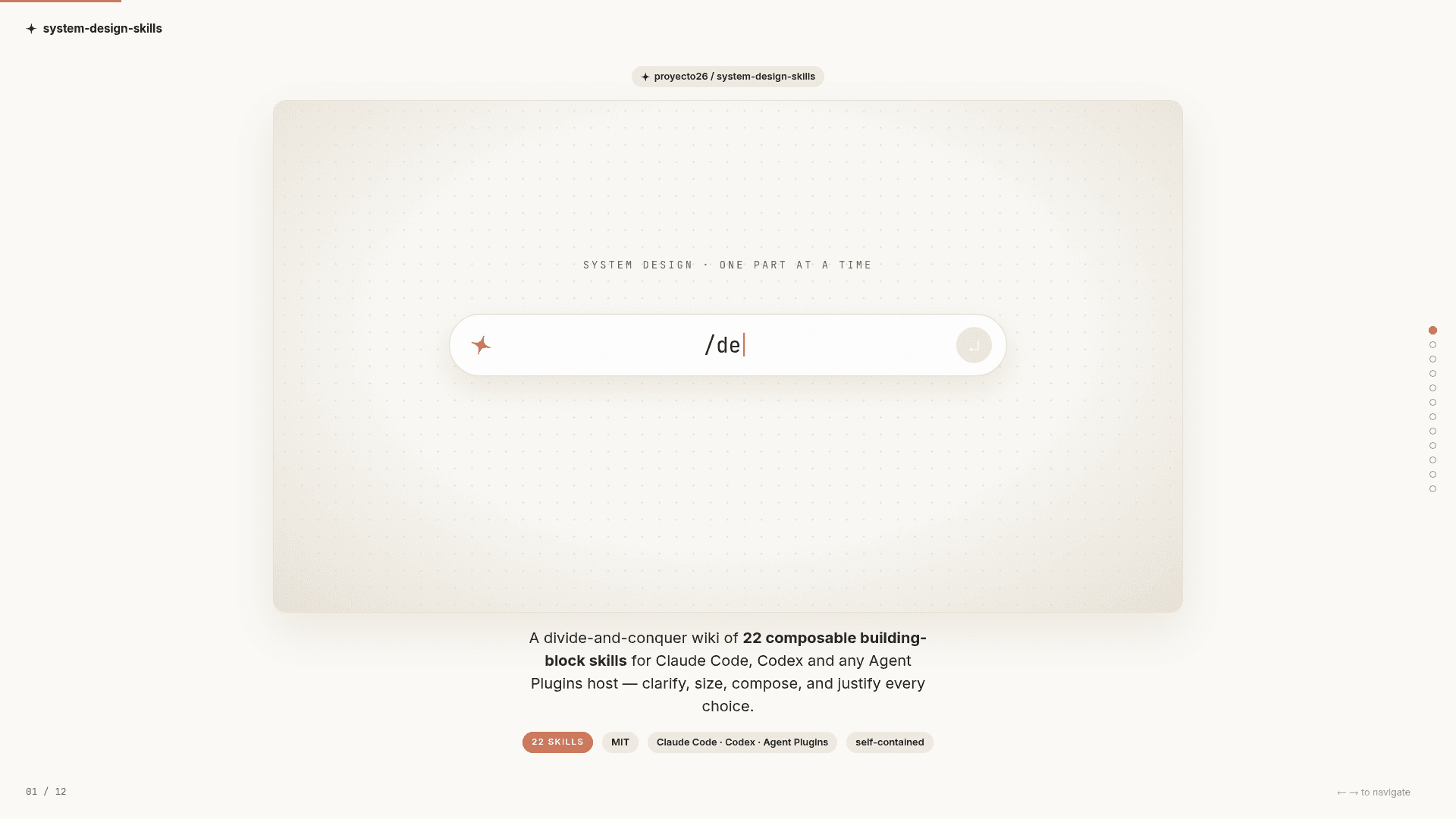
A set of 22 composable system-design skills for Claude Code, Codex and Agent Plugins hosts that guide reasoning-based architecture design.
At a Glance
About system-design-skills
system-design-skills is an open-source skill collection from Proyecto 26 that helps engineers design scalable systems by reasoning through requirements, numbers and trade-offs rather than recalling memorized diagrams. It ships 22 skills for Claude Code, OpenAI Codex and other Agent Plugins hosts, released under the MIT license.
What It Is
The project is a divide-and-conquer wiki of agent skills: one orchestrator, one diagram engine and 20 building-block skills, each covering one part of a system. Every block follows a shared contract covering when to use it, what to clarify first, options, trade-offs, behavior under stress, numbers that matter and cloud-provider variants (AWS, Azure, GCP, plus Temporal for durable execution). It needs no runtime, server or API keys; the only scripted component is a stdlib Python calculator for back-of-the-envelope estimates.
How the reasoning loop works
A design runs through clarify, estimate, design, trade-offs, failure modes and iterate. When a constraint changes, the loop re-enters at the affected phase and redesigns only that part. The /design <system> command or the orchestrator agent invokes the relevant building-block skills, renders a self-contained HTML+SVG architecture diagram, and writes a scored design document to docs/design/.
The building-block catalog
Blocks are arranged bottom-up in layers L0 to L7: frame (requirements-scoping, back-of-the-envelope), edge (dns, load-balancing, content-delivery), services (api-design, service-decomposition), state (data-storage, caching, blob-store, sequencer, sharded-counters, distributed-search), async (messaging-streaming, task-scheduling), correctness (consistency-coordination), ops (resilience-failure, observability, distributed-logging) and growth (scaling-evolution). Each layer depends only on those beneath it.
Ways to use it
Users can run the full /design workflow, start a conversational design through the system-design skill, or trigger a single block such as a caching or SQL-vs-NoSQL question. Install via npx skills add proyecto26/system-design-skills or as a Claude Code plugin; Codex loads the skills, while the /design command and orchestrator agent are Claude Code components. The README reports an eval of 30/30 with skills versus 20/30 baseline on a WhatsApp design exercise.
Known limitations
The README notes that the reasoning is judgment-based rather than deterministic, provider quotas may drift and should be verified against current docs, and the optional PNG/PDF diagram export relies on two CDN scripts.
Community Discussions
Be the first to start a conversation about system-design-skills
Share your experience with system-design-skills, ask questions, or help others learn from your insights.
Pricing
Open Source (MIT)
MIT-licensed set of 22 composable system-design skills for Claude Code, Codex and Agent Plugins hosts; free and open source.
- 22 composable building-block skills
- Works with Claude Code, Codex and Agent Plugins hosts
- No runtime, server, or API keys required
- MIT License
Capabilities
Key Features
- 22 composable skills: orchestrator, diagram engine and 20 building blocks
- /design command and system-design-orchestrator agent
- Clarify, estimate, design, trade-offs, failure modes, iterate loop
- Back-of-the-envelope calculator script
- Self-contained HTML+SVG architecture diagrams with optional PNG/PDF export
- Scored design docs saved to docs/design/
- Cloud provider variants for AWS, Azure, GCP and Temporal
- Eval harness and interview study path
- No runtime, server or API keys required