TADA
Open-source speech-language model from Hume AI that synchronizes text and acoustic tokens one-to-one for fast, reliable text-to-speech generation.
At a Glance
Self-hosted TADA code under the MIT License; model weights are under the separate Llama 3.2 Community License, which has restrictions.
Engagement
Available On
Alternatives
Listed Nov 2026
About TADA
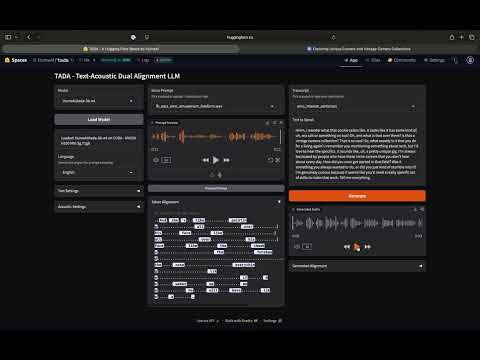
TADA (Text-Acoustic Dual Alignment) is an open-source speech-language model from Hume AI that generates speech by aligning one continuous acoustic vector to each text token. The release includes 1B (English) and 3B (multilingual) Llama-based models, an audio tokenizer and decoder, and a Python package for inference. Hume announced it on March 10, 2026.
What It Is
TADA is a text-to-speech and speech-continuation framework. Instead of compressing audio into fixed-rate discrete frames, its tokenizer produces a single synchronized stream in which each autoregressive step covers one text token and dynamically determines that token's duration and prosody. For output, the LLM's final hidden state conditions a flow-matching head that generates acoustic features, which are decoded into audio.
How the Workflow Runs
Users encode a short reference audio clip together with its transcript into a prompt, then call the model to generate speech for new text. Encoded prompts can be saved and reloaded so the encoder is not needed on later runs. Multilingual generation uses language-specific aligners, with documented codes for ar, ch, de, es, fr, it, ja, pl and pt. For non-English prompts, a transcript must be supplied because the built-in ASR is English-only. Passing extra steps produces text-speech continuation, and bf16 inference and torch.compile are supported.
Reported Performance and Limits
Hume reports a real-time factor of 0.09, zero hallucinations across 1000+ LibriTTSR samples using a character-error-rate threshold, and human-evaluation scores of 4.18/5 speaker similarity and 3.78/5 naturalness on the EARS dataset. Hume lists documented limitations: occasional speaker drift in long generations, reduced language quality when generating text alongside speech, pre-training only on speech continuation (fine-tuning is needed for assistant scenarios), and limited language coverage.
Licensing and Setup
The code is MIT-licensed, while the model weights fall under the Llama 3.2 Community License, and access to the Llama models must be requested first. Installation is via pip install hume-tada or from source.
Community Discussions
Be the first to start a conversation about TADA
Share your experience with TADA, ask questions, or help others learn from your insights.
Pricing
Open Source (self-hosted)
Self-hosted TADA code under the MIT License; model weights are under the separate Llama 3.2 Community License, which has restrictions.
- Code licensed under the MIT License
- Model weights (TADA-1B, TADA-3B-ML) under the Llama 3.2 Community License Agreement, not an OSI license
- Weights require accepting the Meta Llama 3.2 license on Hugging Face
- Llama license requires a 'Built with Llama' attribution and acceptable-use compliance
- Llama license requires a Meta license if the licensee has more than 700 million monthly active users
Capabilities
Key Features
- 1:1 text-to-acoustic token alignment
- Dynamic duration and prosody synthesis per text token
- Dual-stream generation of text and speech
- Voice prompting from reference audio with transcript
- Multilingual generation via language-specific aligners
- Speech continuation via extra steps
- Prompt caching with EncoderOutput save/load
- bf16 inference and torch.compile support
- 1B English and 3B multilingual models
Integrations
Demo Video