
Talgent Workbench
Self-hosted managed agent platform that gives every person an AI agent running each Work in an isolated sandbox or on their own machine.
At a Glance
Talgent Workbench core platform released under Apache-2.0, self-hosted on your own Kubernetes cluster. Model provider costs are external.
Engagement
Available On
Alternatives
Listed Nov 2026
About Talgent Workbench
Talgent Workbench is an Apache-2.0 licensed managed agent platform from Talgent that gives each person, and each registered program, an AI Agent of their own. Users start a Work, hand it files, follow its progress live and collect the results. The platform runs Claude Code natively and is deployed in your own Kubernetes cluster, with the latest listed release being v0.4.2.
What It Is
Workbench is a self-hosted environment for running AI agents on real tasks. Each Work gets its own sandbox, sessions resume where they stopped, and credentials are kept out of the agent's reach. The control plane, conversations, files and telemetry all live in the operator's cluster, not only the sandboxes.
How a Work Runs
Each time a Work starts, the user picks where it runs. In the cloud option, it runs in a fresh VM-isolated sandbox on the Workbench's Kubernetes cluster, cut off from the private network, with credentials and model keys kept out of the sandbox. With a Managed Computer, it runs on the user's own Mac, Linux or Windows machine through Talgent Computer, installed from npm as @talgent/computer, and can be confined to the operating system sandbox on macOS and Linux.
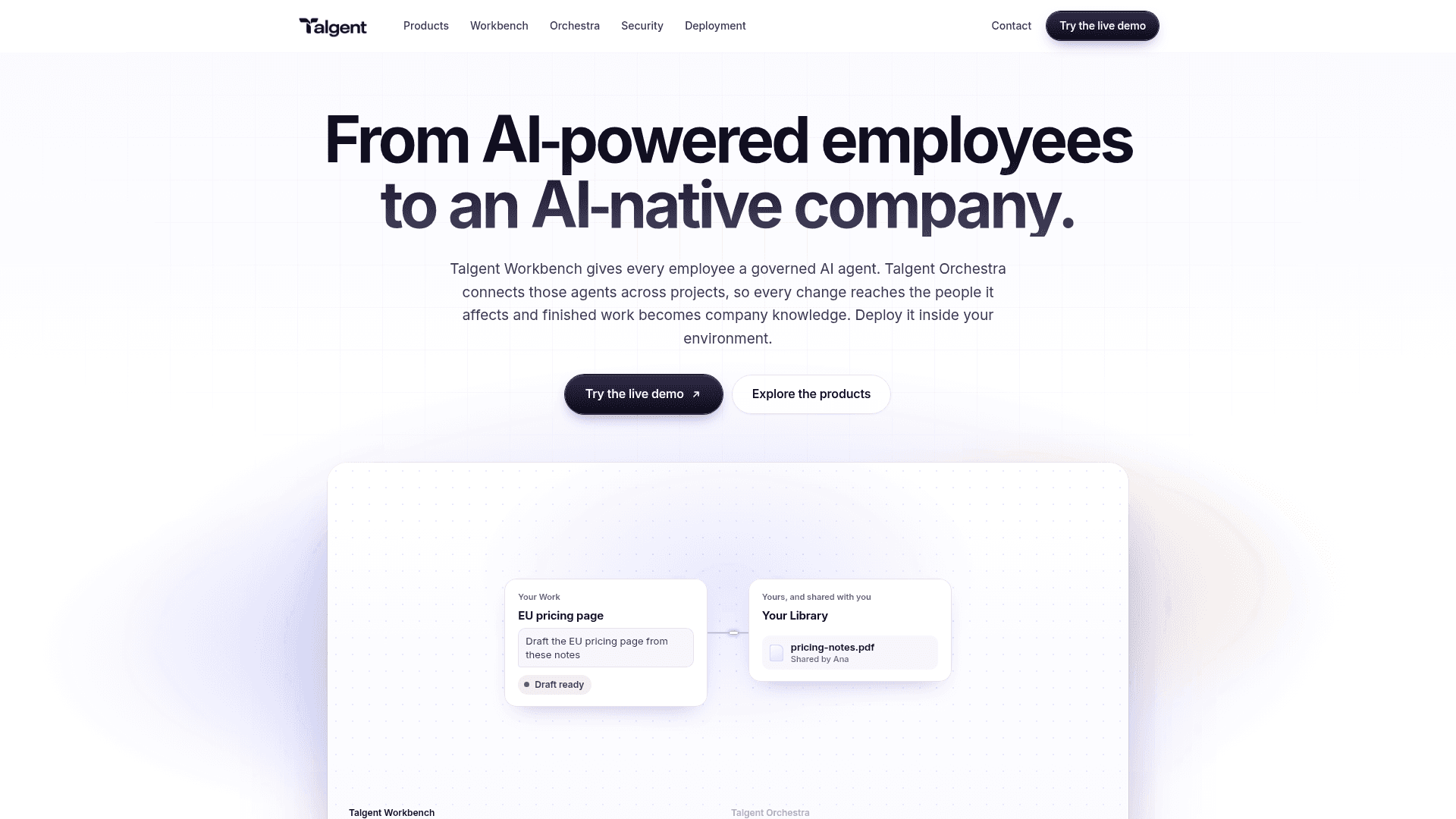
Users describe the task, attach files, pick a repository, a model and Plugins, and can steer or stop the Work and resume it later. The conversation streams the agent's thinking, tool calls, plan and progress. Colleagues can follow a Work read-only until access is revoked.
Models, Plugins and Library
Operators can offer Claude, DeepSeek, Qwen, Kimi, GLM, MiniMax or any vendor with an Anthropic-compatible API, each with its own key, and users choose a model per Work. Plugins come from standard Claude Code plugin catalogs, so existing Skills and Agents work unchanged, and the Marketplace also offers Connectors. Reports, pages, spreadsheets and decks land in a Library, with in-browser previews of Office documents, PDFs and images plus Share Links. A Usage view shows token use by person, Work, model and Application.
Applications and Orchestra
Registered Applications drive agents through the same public APIs as the web app, using OAuth 2.0 client credentials, with their own Agent, Plugins and authorizations, Work Labels for usage attribution, and optional per-Work MCP tools. Talgent Orchestra, built on Workbench, adds projects, goals with owners, a project coordinator that routes changes to affected owners, a traceable decision timeline, and project knowledge built from finished work.
Community Discussions
Be the first to start a conversation about Talgent Workbench
Share your experience with Talgent Workbench, ask questions, or help others learn from your insights.
Pricing
Open Source (Self-Hosted)
Talgent Workbench core platform released under Apache-2.0, self-hosted on your own Kubernetes cluster. Model provider costs are external.
- Apache License 2.0
- Self-hosted on your Kubernetes cluster
- Sandbox per Work or run on your own machine via Talgent Computer
- Any Anthropic-compatible model with your own keys
- Library, Plugins, sharing and token usage tracking
Enterprise license
Enterprise license for private deployment of Talgent products, sold via sales.
- Private deployment inside your environment
- Scope, Deploy, Connect, Accept process
Capabilities
Key Features
- Isolated VM sandbox per Work
- Run Works on your own Mac, Linux or Windows machine via Talgent Computer
- Choose model per Work (Claude, DeepSeek, Qwen, Kimi, GLM, MiniMax, Anthropic-compatible)
- Live streaming of agent thinking, tool calls and progress
- Resumable sessions
- Library of agent-produced artifacts with previews and Share Links
- Read-only sharing of Works
- Marketplace of Plugins and Connectors
- Token usage tracking by person, Work, model and Application
- Public APIs with OAuth 2.0 client credentials for Applications
- Per-Work MCP tools
- Self-hosting on Kubernetes