
TaskHandoff
Open-source, self-hostable control plane for managing AI coding sessions, Docker instances and servers across machines from desktop, mobile or browser.
At a Glance
Free, open-source, self-hostable control plane for AI remote work and server operations, licensed under Apache-2.0.
Engagement
Available On
Listed Nov 2026
About TaskHandoff
TaskHandoff is an open-source, self-hostable control plane for AI remote work and server operations, published under the Apache-2.0 license by the edgestorage GitHub owner. It connects Codex and OpenCode sessions across machines, workspaces and chat platforms, so work can be checked and continued from desktop, browser, mobile or chat. The project is labeled Beta in its README, with breaking changes possible between releases.
What It Is
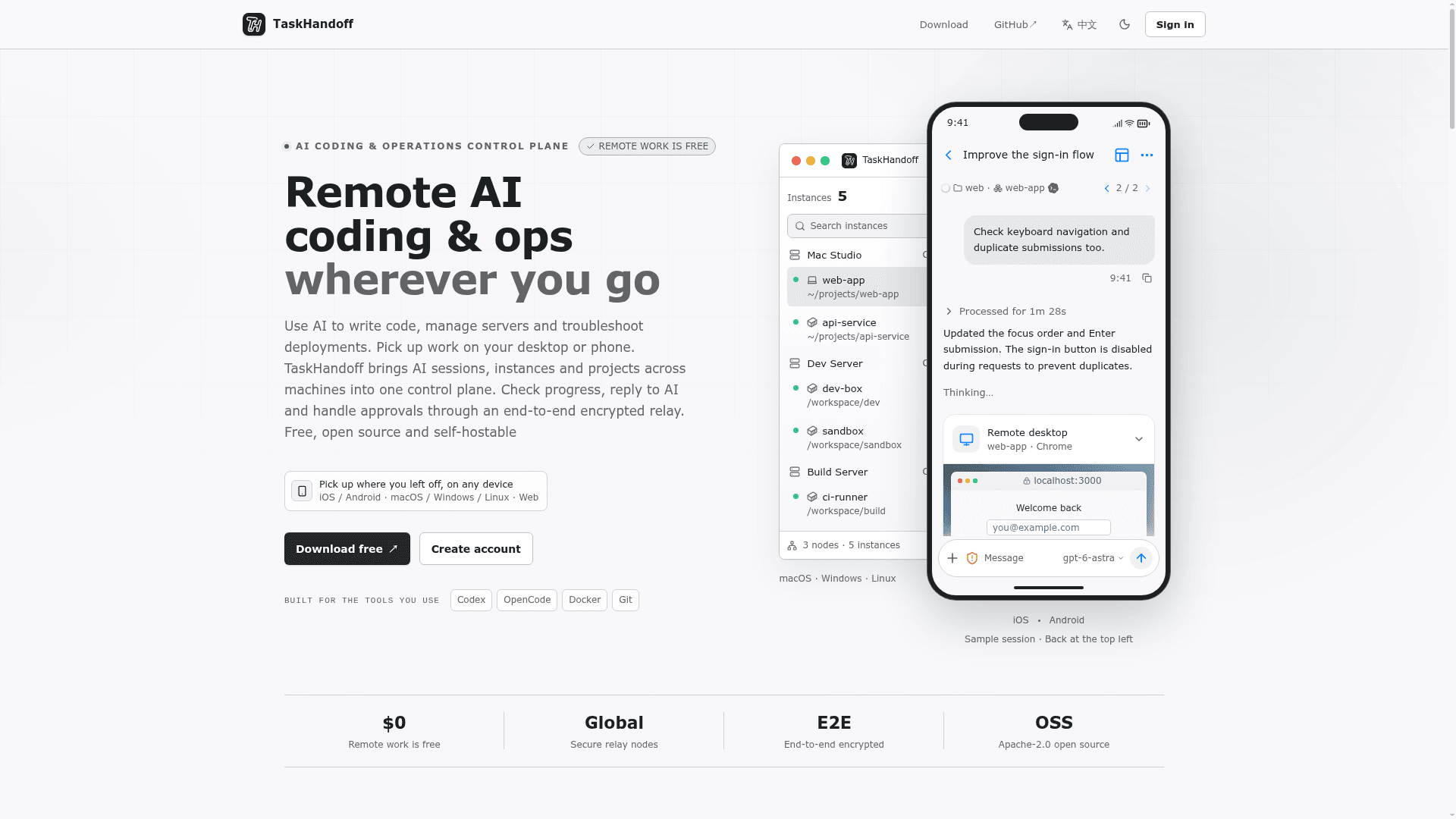
TaskHandoff brings devices, workspaces and AI sessions into one place. A Control Plane provides the web/API management surface, a Node Agent runs on each managed machine, and Controlled Instances host workspaces, applications and AI sessions. Users can review progress, reply to the AI and handle approvals without being at the original machine.
Instances and Environments
Docker container instances are the primary isolated runtime, allowing several instances on one node, each with managed volumes. A built-in Local Runtime is available on Windows, macOS and Linux, and a WSL2 runtime is documented for Windows nodes. Installed tools can be saved as a node-local environment template, which excludes workspaces, volumes and running state. Kubernetes support is still in development and is not a supported deployment target.
Remote Access and Security
TaskHandoff Cloud adds official accounts and an end-to-end encrypted relay with nodes in China and globally. The vendor states the relay forwards only ciphertext and routing/metering identifiers, and that access requires a pinned fingerprint, a device private-key signature and local approval. Remote Desktop supports viewing and controlling a single window, an application, the full desktop or a custom region. Chat routing is available for Telegram, DingTalk, WeChat and Feishu/Lark.
Setup Path
Users can download desktop and mobile clients, or deploy servers on Debian/Ubuntu with a one-line installer that sets up systemd services for the Control Plane and Node Agent. Remote machines join by installing the Node Agent with a one-time join token. An agent skill lets a coding agent learn to drive TaskHandoff through its CLI.
Community Discussions
Be the first to start a conversation about TaskHandoff
Share your experience with TaskHandoff, ask questions, or help others learn from your insights.
Pricing
Open Source (Self-hosted)
Free, open-source, self-hostable control plane for AI remote work and server operations, licensed under Apache-2.0.
- Apache-2.0 licensed core
- Self-hostable Control Plane and Node Agent
- Docker container instances
- Codex and OpenCode agent kernels
- Desktop, browser, mobile and chat access
TaskHandoff Cloud (Remote Work)
Official accounts and end-to-end encrypted secure relay; remote work is free, with traffic allowances to prevent abuse that can be raised free of charge for reasonable use.
- Official accounts (Email, OAuth, TOTP)
- End-to-end encrypted relay
- China and global relay nodes
- Traffic allowances raised free of charge for reasonable use
Capabilities
Key Features
- Multi-node management of local and remote machines
- Docker-backed isolated instances per task
- Environment templates saved from existing instances
- AI session center with real-time state
- Remote Desktop for window, application, full desktop or custom region
- End-to-end encrypted relay with China and global nodes
- Chat integrations for Telegram, DingTalk, WeChat and Feishu/Lark
- Image market and custom images
- Managed Git credentials and repository workflows
- Application management through a built-in catalog
- iOS and Android mobile client
- Agent skill for driving TaskHandoff
- English and Chinese UI
- Self-hostable server deployment via systemd