
Twinbraid
A desktop app that pairs any two coding agents in one shared workspace so they can message each other and edit the same project folder.
At a Glance
MIT-licensed desktop app (Windows and macOS) for pairing two coding agents in one workspace; free to use, modify and distribute under the MIT License.
Engagement
Available On
Listed Nov 2026
About Twinbraid
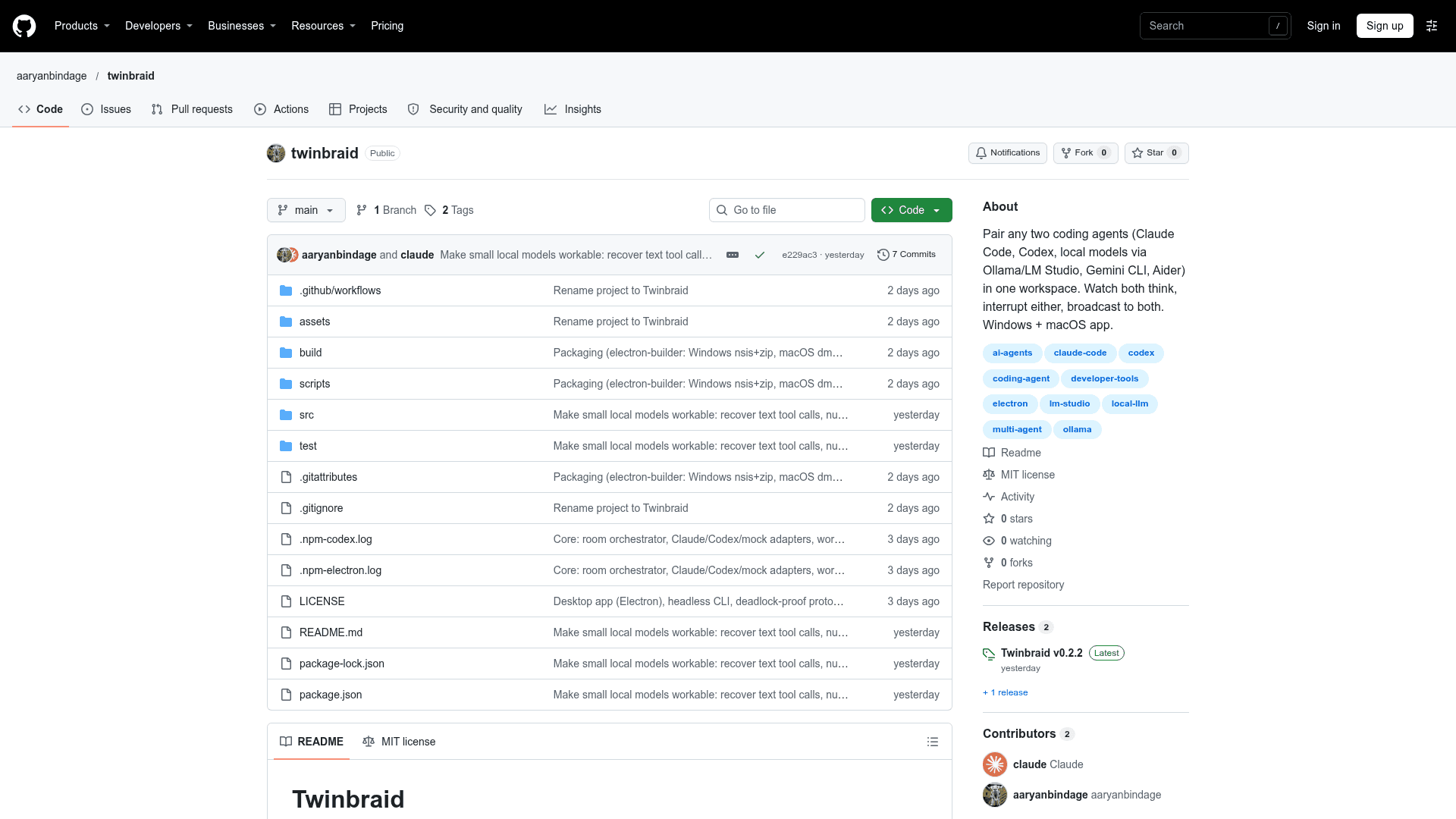
Twinbraid is an MIT-licensed desktop app for Windows and macOS, published by GitHub user aaryanbindage, that runs two coding agents side by side in one project directory. It supports Claude Code, Codex, local models via Ollama, LM Studio and llama.cpp, Gemini CLI, Aider, and OpenAI-compatible APIs. The latest release listed is v0.2.2.
What It Is
Twinbraid is a multi-agent coordination workspace for coding agents. Both agents work in the same directory, so one agent's files are already available to the other. Handoffs are short messages naming file ownership rather than pasted code. Each agent keeps its own resumable session across turns.
The app shows each agent's live status, thinking stream, and tool-call activity feed, plus a shared chat with agent-to-agent messages, user messages, interrupts, conflicts, and questions that need a human. Users can message both agents or one, interrupt either, resume, or stop all.
How the agents collaborate
Each agent runs as a headless process or API session, one turn at a time. The final message of a turn goes to the peer's inbox, and is delivered when the peer finishes if it is mid-turn. Agents use tags such as silent, done, and ask-user. The lead splits work by file, and Twinbraid warns the earlier owner if both touch a file. A cap on unattended agent-to-agent messages (default 14) limits runaway chatter.
Stats include tokens, lines added and removed (measured by diffing the filesystem after each tool call), files touched, tool calls, turns, and active time. Cost is shown for Claude only.
Local models and permissions
For Ollama, LM Studio and similar endpoints, Twinbraid runs its own tool loop (Read, Write, Edit, LS, Glob, Grep, Bash) over streaming chat completions. The model must support tool calling. Permission presets (Workspace, Careful, Full auto) decide up front what each agent may do, since headless agents cannot answer prompts.
Setup path
Install from the project's releases (Windows installer or portable zip, macOS arm64 or x64 dmg) or run from source with npm. The macOS build is unsigned. A headless CLI runner and simulators for testing without accounts are included. Sessions are logged under the user's home directory as JSONL.
Current Status
The README says it is verified against real Claude Code sessions and a local Ollama model paired with Claude Haiku. The Codex adapter has only been run against a simulator; Gemini, Aider and OpenCode presets, LM Studio and llama.cpp have not been tested live; macOS has not been hands-on tested.
Community Discussions
Be the first to start a conversation about Twinbraid
Share your experience with Twinbraid, ask questions, or help others learn from your insights.
Pricing
Open Source
MIT-licensed desktop app (Windows and macOS) for pairing two coding agents in one workspace; free to use, modify and distribute under the MIT License.
- MIT License
- Pair any two coding agents: Claude Code, Codex, local models, Gemini CLI, Aider, OpenAI-compatible APIs
- Desktop app for Windows and macOS
- Headless CLI runner
- Shared workspace with agent-to-agent messaging
Capabilities
Key Features
- Pair any two coding agents in one shared project directory
- Agent-to-agent messaging with short handoffs
- Resumable per-agent sessions
- Live per-agent panel with thinking stream and activity feed
- Stats for tokens, lines added/removed, files touched, tool calls and turns
- Interrupt either agent, broadcast to both, or stop all
- Built-in tool loop for local models
- File conflict warnings
- Permission presets: Workspace, Careful, Full auto
- Headless terminal runner
- Simulators for testing without accounts
- Session logging to JSONL