
Vibeyard
An open-source desktop IDE for managing multiple AI coding agent sessions across Claude Code, Codex CLI, and Gemini CLI.
At a Glance
Vibeyard desktop app, the IDE for AI coding agents, released under the MIT License. Requires at least one supported CLI installed and authenticated (external cost).
Engagement
Available On
Listed Nov 2026
About Vibeyard
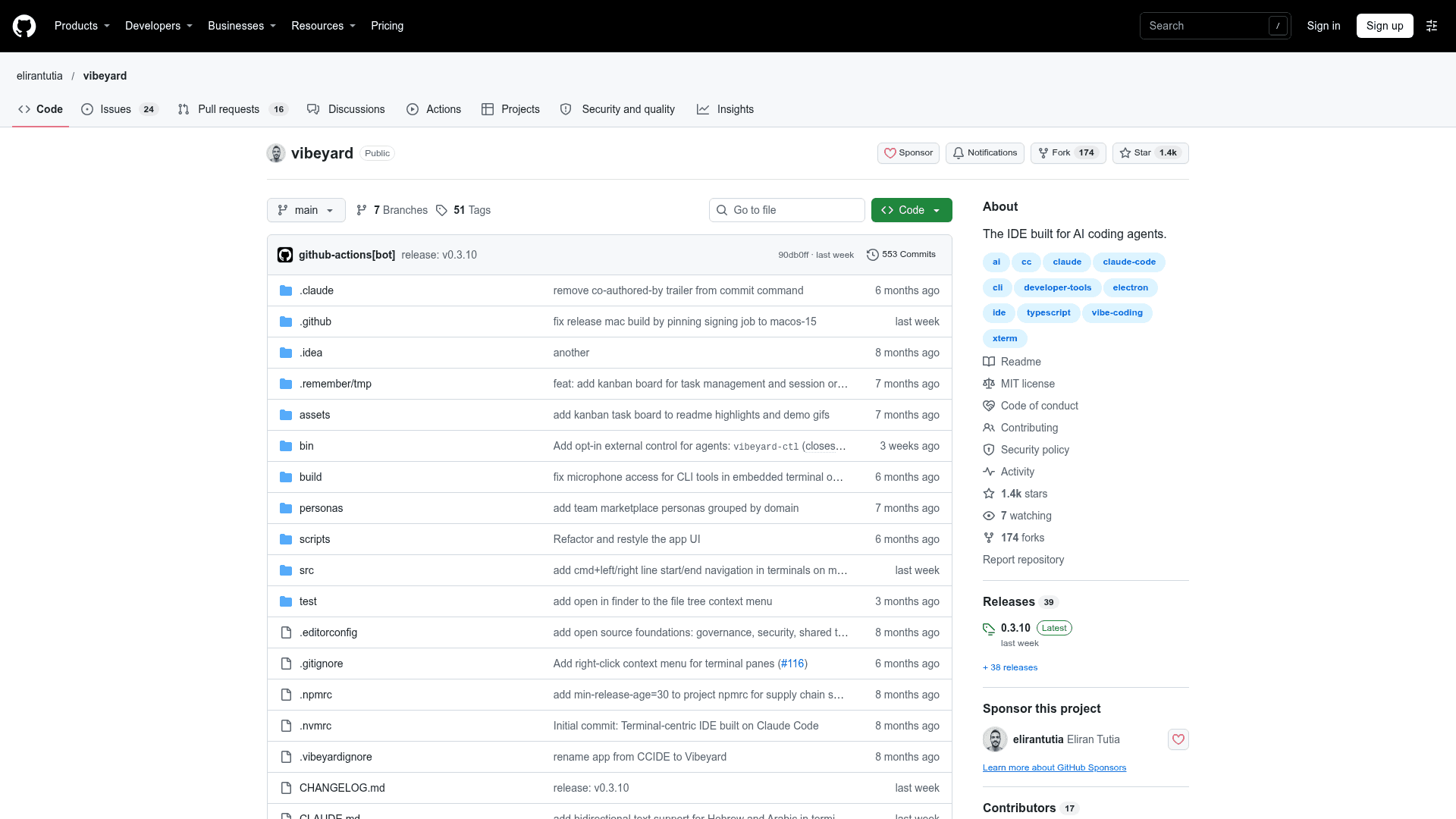
Vibeyard is an open-source desktop workspace for running AI coding agents, published on GitHub by elirantutia under the MIT license. It wraps Claude Code, OpenAI Codex CLI, and Gemini CLI sessions in a project dashboard with a kanban board, split panes, cost tracking, and session resume. The latest release listed is v0.3.10.
What It Is
Vibeyard is an Electron-based IDE built around terminal-based AI coding agents. Instead of juggling bare terminals, users run several agent sessions per project, each in its own PTY, and view them together in a swarm-mode grid. It requires at least one supported CLI to be installed and authenticated.
Session and Task Management
A per-project kanban board lets users plan work with drag-and-drop, search, and tag filtering. Each card can spawn or resume a CLI session, and tasks move to Done when the session completes. Color-coded status indicators show whether a session is working, waiting, needs input, or has completed, with optional desktop notifications. Sessions can be resumed after restarting the app, and multiple isolated Claude profiles can run side by side.
Monitoring and Collaboration
The app tracks spend, token usage, and context window use per session. A session inspector shows a timeline, cost breakdown, and tool usage stats. An AI Readiness Score rates how prepared a project is for AI-assisted coding, with one-click fixes. Live terminal sessions can be shared with teammates over encrypted peer-to-peer WebRTC connections in read-only or read-write mode with PIN authentication.
Browser Tab and Agent Control
An embedded browser tab opens URLs such as localhost:3000, lets users inspect DOM elements, and sends AI editing instructions that include the selector, text content, and page URL. When enabled in Preferences, agents inside a tab can spawn, rename, close, and list tabs through the vibeyard-ctl command.
Setup Path
Installers are available from GitHub Releases for macOS (.dmg), Linux (.deb and .AppImage), and Windows (NSIS and portable .exe). It can also be installed with npm (npm i -g vibeyard) or built from source with Node v24+. The project states it is independent and not affiliated with Anthropic.
Community Discussions
Be the first to start a conversation about Vibeyard
Share your experience with Vibeyard, ask questions, or help others learn from your insights.
Pricing
Open Source (MIT)
Vibeyard desktop app, the IDE for AI coding agents, released under the MIT License. Requires at least one supported CLI installed and authenticated (external cost).
- MIT-licensed open source core
- Multi-session management and swarm mode
- Kanban task board
- Cost & context tracking
- P2P session sharing
Capabilities
Key Features
- Customizable drag-and-drop project dashboard
- Kanban task board that spawns or resumes CLI sessions
- Multi-session management with swarm mode grid view
- Multiple isolated Claude profiles
- Real-time cost, token, and context window tracking
- Session inspector with timeline and tool usage stats
- AI Readiness Score with one-click fixes
- Session resume after app restart
- P2P session sharing over WebRTC with PIN authentication
- Embedded browser tab with DOM element inspection
- Session status indicators and desktop notifications
- Smart alerts for missing tools and context bloat
- vibeyard-ctl tab control for agents
- Light and dark themes
- Keyboard shortcuts