
Waku
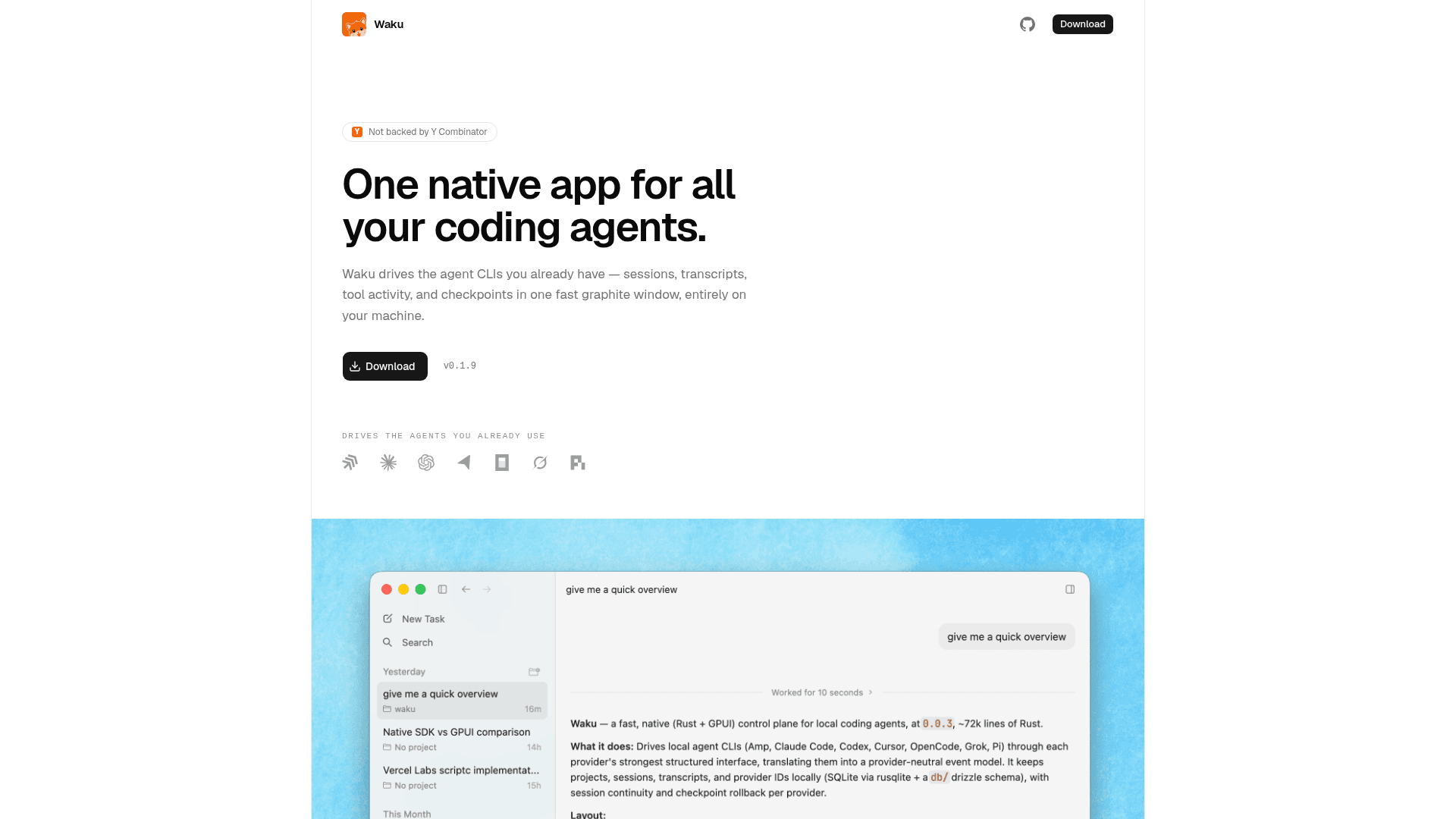
A fast, native desktop app built in Rust that unifies multiple coding agent CLIs (Claude Code, Codex, Cursor, Amp, and more) into one GPU-accelerated window with sessions, transcripts, and Git-backed checkpoints.
At a Glance
Fully free and open source under GPL-3.0. Download and use at no cost.
Engagement
Available On
Alternatives
Listed Aug 2026
About Waku
Waku is a native desktop application built in Rust using GPUI — the same GPU-accelerated UI framework that powers the Zed editor — designed to drive multiple coding agent CLIs from a single, fast graphite window. It runs entirely on your machine with no account, no telemetry, and no cloud service between you and your agents. The project is open source under the GNU General Public License v3.0 and is developed by egoist on GitHub.
What It Is
Waku sits in the category of agent harness / coding agent frontends. Rather than replacing coding agents, it acts as a unified native interface that connects to the agent CLIs you already have installed — normalizing their output into one provider-neutral model. It handles sessions, transcripts, tool activity, and Git-backed checkpoints across agents like Amp, Claude Code, Codex CLI, Cursor CLI, Grok Build, OpenCode, and Pi.
Architecture and Local-First Design
Waku's architecture separates concerns cleanly between a native desktop RPC client and a standalone waku-daemon process:
- Provider sessions run in
waku-core, behind an authenticated, versioned WebSocket contract defined inwaku-protocol. - The daemon owns task SQLite data, uploaded attachments, provider-native session forks, and all workspace filesystem and Git operations.
- The desktop retains only presentation state and a disposable preview cache.
- A browser client lives at
apps/weband uses a generated browser transport inpackages/waku-client, with types generated directly from the Rust protocol. - Projects, sessions, transcripts, and provider IDs live on disk — no Waku cloud, no remote service required.
How the Agent Interface Works
Each supported agent is connected over its strongest native interface — stream-json, JSON-RPC, or live events — and normalized into a single provider-neutral model. Waku detects available CLIs automatically. Key interaction patterns include:
- ⌘N starts a new session; ⏎ queues a follow-up while the agent works; ⌘⏎ steers mid-turn; Escape stops.
- Models, reasoning effort, and access modes are switchable from a shared interface.
- Every prompt checkpoints the working tree under a hidden git ref, enabling rewind of both code and the provider conversation together — not just the chat log.
Platform Support and Installation
Waku supports macOS, Linux, and Windows:
- macOS: Signed and notarized
.dmg, auto-updated with binary deltas via Sparkle. - Linux: Install script (
curl -fsSL https://waku.sh/install.sh | sh) installs into~/.localwithout root; supports both Wayland and X11. - Windows: Per-user installer
.exewith a portable.zipoption; requires the MSVC toolchain.
The embedded browser and experimental computer-use integration are currently macOS-only. Agent sessions, projects, transcripts, skills, usage, diffs, file editing, and the terminal run natively on Linux and Windows.
Update: v0.1.9
The latest release is v0.1.9, published on August 18, 2026. The repository was created on July 31, 2026, and has seen rapid iteration — reaching over 1,000 GitHub stars and 100 forks within weeks of creation. Development is active, with the main branch receiving pushes as recently as August 18, 2026. The project is supported via GitHub Sponsors.
Community Discussions
Be the first to start a conversation about Waku
Share your experience with Waku, ask questions, or help others learn from your insights.
Pricing
Open Source
Fully free and open source under GPL-3.0. Download and use at no cost.
- All agent integrations (Amp, Claude Code, Codex, Cursor, Grok Build, OpenCode, Pi)
- Native desktop app for macOS, Linux, and Windows
- Git-backed checkpoints and rewind
- Local-only storage with no account required
- Auto-updates
Capabilities
Key Features
- Unified interface for multiple coding agent CLIs
- Native Rust + GPUI (GPU-accelerated) desktop app
- Git-backed conversation checkpoints with rewind
- Session and transcript management
- Keyboard-first controls
- Auto-detection of installed agent CLIs
- Provider-neutral session model
- Local-only storage — no account or telemetry
- Auto-updates via Sparkle (macOS) and built-in updater (Windows)
- Queue or steer follow-up messages while agent is working
- Switch models and reasoning effort from shared interface
- Daemon architecture with WebSocket RPC protocol
- Browser client with generated Rust-protocol types