
Woolly
Local project memory for coding agents that flags facts as stale when the code they cite changes.
At a Glance
Local-first, MIT-licensed Woolly core; no account, no cloud, no telemetry.
Engagement
Available On
Alternatives
Listed Nov 2026
About Woolly
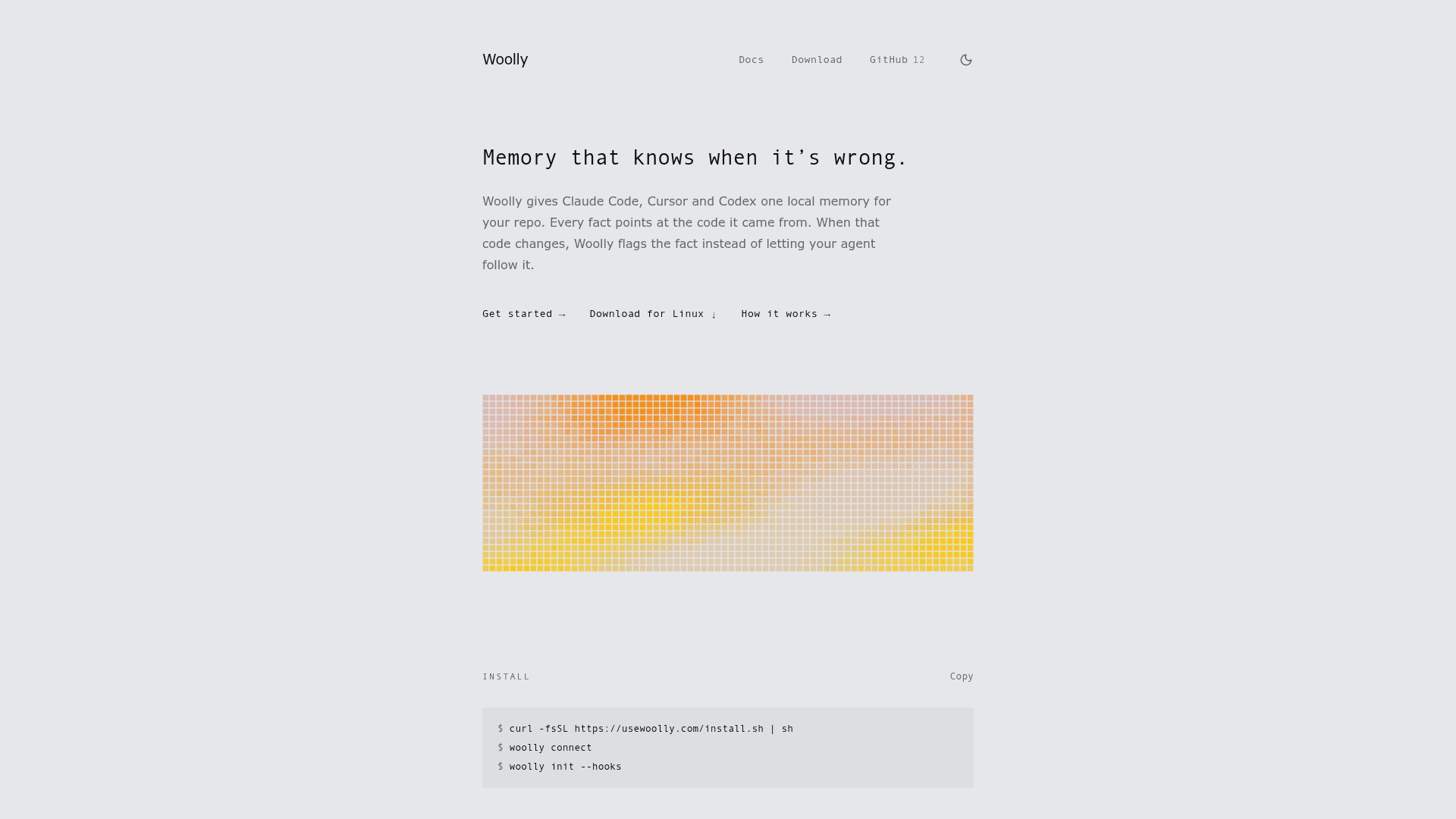
Woolly is a local memory tool for coding agents such as Claude Code, Cursor and Codex. Every saved fact cites the file, function or lines it came from, and Woolly flags the fact as stale when that code changes. It is MIT licensed and runs on the user's machine, with no account, cloud or telemetry according to its docs.
What It Is
Woolly gives all of a developer's coding agents one shared memory for a repo. Agents that would otherwise start from zero each session read and update the same notes, covering things like the stack, conventions, decisions, gotchas and commands. Each fact records its source, the commit it was saved at and the session it came from.
Memories are plain Markdown files that can be read, searched, edited by hand and kept in git. Nothing is deleted. Replaced or stale facts stay on disk with the date they stopped being true.
How stale detection works
On every commit and on woolly check, Woolly compares each fact with the code it points at. If a function is renamed, a file is deleted or a value changes, the dependent fact is flagged along with the commit that broke it. woolly review lets the user confirm, fix or retire flagged facts. Stale detection never needs a model. Each new session opens with a short brief of current facts and where the user left off, and stale facts are kept out of it.
Project memory in git
woolly init creates .woolly/woolly.md in a repo, with one fact per line under Overview, Stack, Conventions, Decisions, Gotchas and Commands. Teammates' agents get the notes through git, and facts about the individual user stay out of the repo. At session end Woolly saves decisions, the reasoning and what was ruled out.
Other capabilities
The same engine offers personal memory across AI apps and a memory API shaped like mem0's, with Python and JavaScript packages. woolly proxy adds memory to Ollama, OpenAI and Anthropic apps. It can also import ChatGPT or Claude history and sync machines over the user's own network. Ollama is optional: with it, Woolly searches by meaning and extracts decisions, and without it Woolly uses keyword search. The project's benchmark page reports 83.2% top-20 answer recall on a LOCOMO sample and 100% precision on 50 scripted code changes for stale detection.
Community Discussions
Be the first to start a conversation about Woolly
Share your experience with Woolly, ask questions, or help others learn from your insights.
Pricing
Open Source
Local-first, MIT-licensed Woolly core; no account, no cloud, no telemetry.
- MIT license
- Runs fully local: no cloud, no account, no telemetry
- One shared memory for Claude Code, Cursor and Codex
- Stale fact detection on every commit
- Memory stored as plain Markdown files
Capabilities
Key Features
- Stale fact detection against code on every commit
- Facts cite file, function or lines, commit and session
- One shared memory for Claude Code, Cursor and Codex
- Project memory stored in git via .woolly/woolly.md
- Session start briefs with current facts
- Decision capture including ruled-out options
- Memory kept as readable Markdown with history preserved
- Fully local with no account or telemetry
- mem0-shaped memory API with Python and JavaScript packages
- woolly proxy for Ollama, OpenAI and Anthropic apps
- Import of ChatGPT and Claude history
- Machine sync over own network