
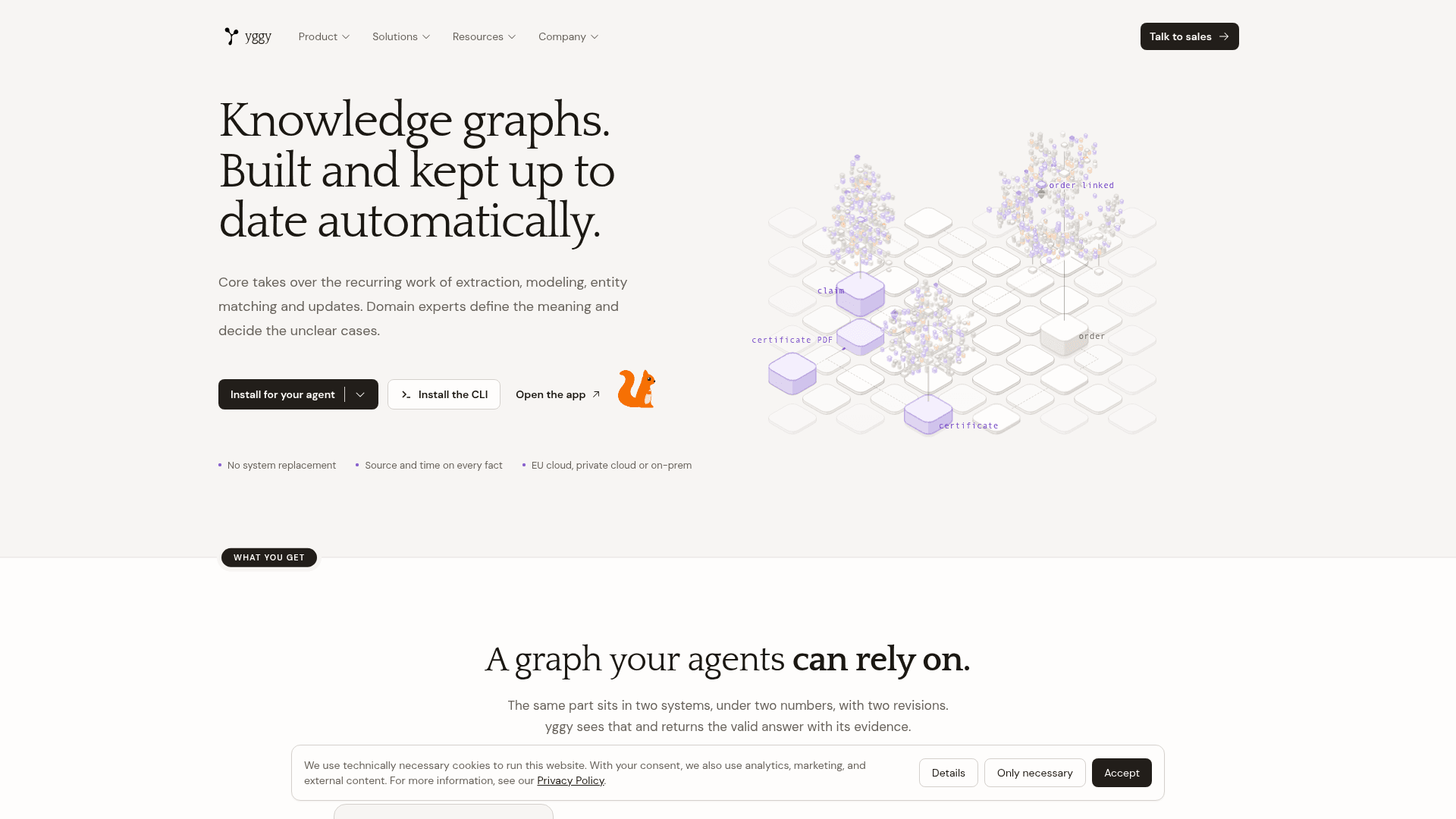
yggy automatically builds and updates sourced knowledge graphs from documents, ERP exports and other systems for people and AI agents.
At a Glance
Try yggy on your own documents. Stops at the included amount.
Engagement
Available On
Listed Oct 2026
About yggy
yggy, made by Yggdrasil UG in Germany, builds knowledge graphs from existing documents, tables and systems and keeps them current as sources change. Every fact in the graph carries its source document and time, so answers made by people or AI agents can be checked. It is reachable through a web app, a CLI, an API and MCP, and can be hosted in the EU cloud, a private cloud or on-prem.
What It Is
yggy is a knowledge-graph-as-a-service platform. It reads sources such as mail, ERP exports, QMS records, PIM data, PDFs, SharePoint, OneDrive and Google Drive, extracts facts, and matches them to the entities they belong to. Matching entities from different systems, such as a part listed under two numbers and revisions, resolves into one record with the valid answer and its evidence. Unclear cases are routed to domain experts for a decision. It runs on top of existing systems rather than replacing them.
How the Graph Is Built
Extraction is guided by a versioned, RDF-based base ontology exported as OWL 2 RL, and facts that break the ontology's contract are rejected. Structured files are handled through schema-guided mappings that are applied to every row. Each fact stores its source text, valid-from and valid-to dates and a confidence value, and conflicting values on single-valued relations can be flagged for review. Facts can be exported as JSON-LD or N-Quads and the ontology as OWL, SKOS and SHACL shapes.
Developer and Agent Access
Agents such as Claude Code, Codex and Cursor connect over a remote MCP server, and the same URL works in the Claude app as a custom connector. Agents call tools such as search_entities and get_entity_context and receive facts with their sources. The CLI and API offer other ways in.
Product Lines and Use Cases
The vendor offers yggy core for developers, yggy quality for complaints and traceability, and yggy notes for personal knowledge capture. Listed use cases include customer complaints and traceability, spec changes and product compliance, fitment and master data, product knowledge, contract obligations and research data integration.
Community Discussions
Be the first to start a conversation about yggy
Share your experience with yggy, ask questions, or help others learn from your insights.
Pricing
Free
Try yggy on your own documents. Stops at the included amount.
- Up to 10 members
- 100 credits (about 5,000 facts) and 1 GB stored a month, Standard reading
- 100 agent calls a day
- Care not included
- EU-hosted product
Pro
For teams whose agents work on company knowledge. Price per member; agents never take a seat.
- 1,000 credits per workspace (about 50,000 facts) and 5 GB stored per member each month, all reading levels
- Unlimited agent reads, 1,000 agent answers per member
- Care, paid per result, capped by a monthly Care budget
- SSO, custom domain, audit log, spend controls
- Overage rates: Credit €0.03; Storage €0.60 per GB-month; Agent answer above 1,000 per member €0.01
- Care results: Conflict resolved €0.10; Duplicate entity merged €0.03; Graph scans included; Reverted within 14 days €0
- Prices exclude VAT
Enterprise
A managed knowledge base with agreed outcomes, under a separate agreement.
- Freshness and precision SLAs on your knowledge base
- Per-case pricing for investigations and quality cases
- Managed EU, private cloud or on-premises, self-hosted models
- Priority support
Capabilities
Key Features
- Automatic extraction of entities and relationships from documents, tables and systems
- Entity matching across systems into one record
- Source and time on every fact
- Confidence value per fact
- Continuous updates with earlier states kept as history
- Expert review of unclear cases
- Ontology-guided and schema-guided structured extraction
- Export as JSON-LD, N-Quads, OWL, SKOS and SHACL
- MCP server and CLI for agents
- EU cloud, private cloud or on-prem deployment