
Command Code
A terminal-based AI coding agent that continuously learns your coding style and preferences to ship, fix, test, and refactor code in your taste.
At a Glance
About Command Code
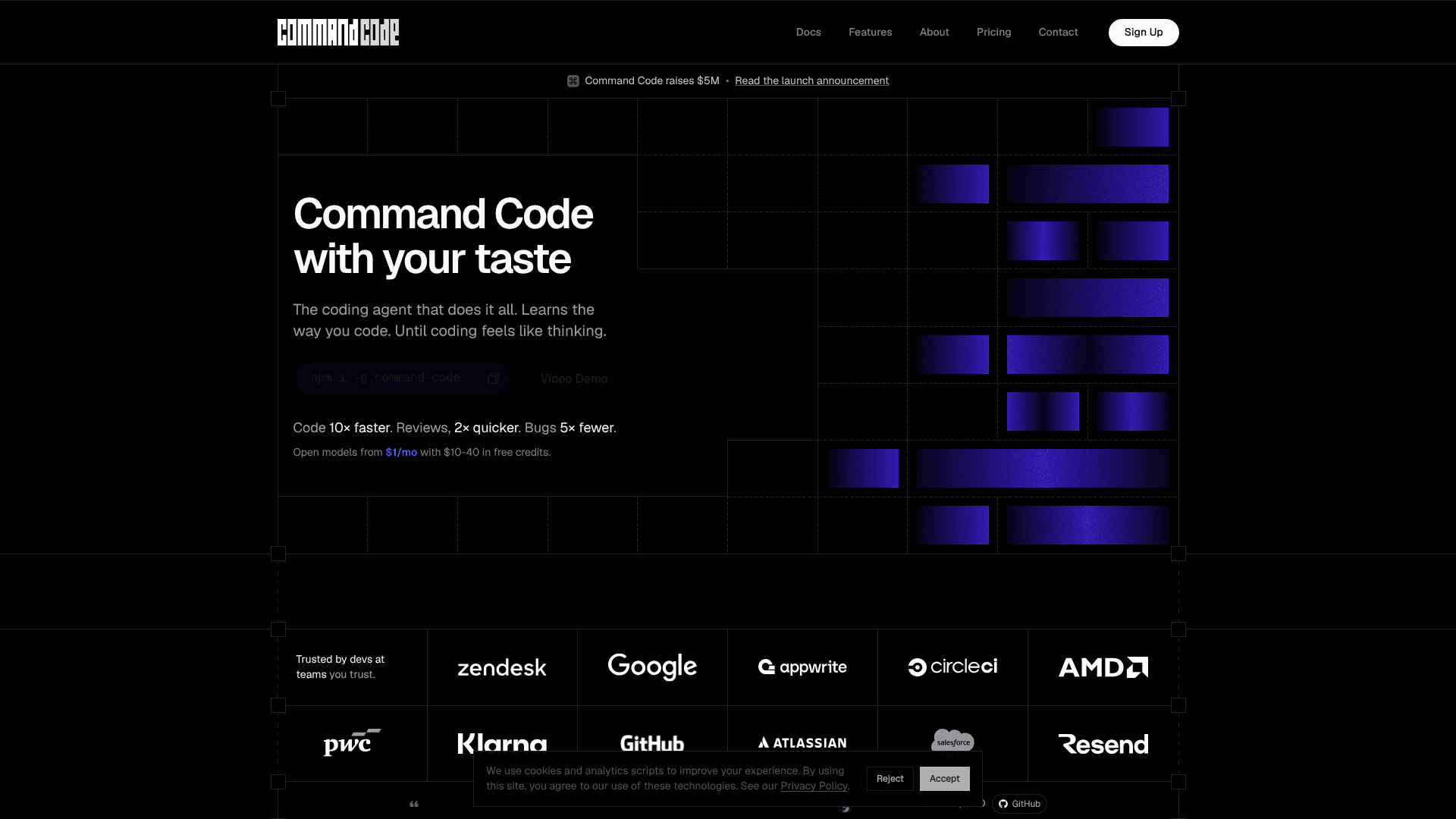
Command Code is a frontier AI coding agent that lives in your terminal and continuously learns your coding taste through a proprietary system called taste-1. Founded by Ahmad Awais and backed by $5M in funding, the tool installs via npm (npm i -g command-code) and works across any project without requiring IDE changes. The homepage states the company has shipped 252 releases, with the current version at v0.30.0.
What It Is
Command Code is a CLI-first coding agent in the same category as Claude Code and GitHub Copilot, but differentiated by its continuous reinforcement learning system. Every accept, reject, and edit a developer makes becomes a signal that the agent distills into project-level /skills and personal /memory. The result is an agent that adapts to individual coding conventions — naming patterns, toolchain preferences, test frameworks — rather than generating generic output. The underlying system is described by the company as "taste-1," a meta neuro-symbolic AI model that pairs LLMs with learned developer preferences.
How the Taste System Works
The taste-1 system operates through three mechanisms:
- Continuous learning: Every interaction (accept, reject, edit) is recorded and auto-generates project-level skills stored in
.commandcode/taste/ - Portable taste packages: Developers can run
npx taste pushto publish a skill andnpx taste pullto install one, enabling team-wide taste sharing - Onboarding from other agents: The tool can import existing preferences from Claude Code, Cursor, or other agents with a single command, and can also distill taste from any local path or GitHub repo
Taste data is stored locally on the developer's machine. The company states it never trains on user code.
Modes and Agentic Tools
Command Code supports multiple operating modes to fit different workflows:
- Interactive mode: Real-time conversational interface for chat-driven development
- Headless mode (
-p,--yolo): Non-interactive single-query mode for CI/CD pipelines and scripts - Plan mode: Read-only analysis without executing changes
- Auto-accept mode: Skip confirmation prompts, toggled with shift+tab
- Background sandbox: Fire-and-forget isolated tasks that run to completion and report back
Built-in tools include file operations, shell execution, extended thinking, agentic /review for PRs, web search and fetch, todo tracking, MCP server integration, custom slash commands, sub-agents, and checkpoints with rewind capability.
Model Access and Provider Flexibility
The agent supports a broad range of frontier and open-source models out of the box, including Anthropic (Claude Opus 4.8, Sonnet 4.6, Haiku 4.5), OpenAI (GPT-5.5, GPT-5.4, Codex), DeepSeek (V4 Pro, V4 Flash), Kimi (K2.6, K2.5), GLM (GLM-5.1, GLM-5), Qwen, and MiniMax. BYOK (bring your own key) is supported for any provider. The company positions open-source model support as a core differentiator, with the harness designed to enable reliable tool-calling on open models.
Update: v0.30.0 and 252 Releases
The changelog shows v0.30.0 as the current release, with 252 total releases shipped. Recent changes listed on the homepage include: repair of read_file/edit_file/glob aliases, a two-step /model picker for model and reasoning effort selection, a new /effort command to set reasoning effort per model, and a fix preventing "Thinking…" indicators from getting stuck. The pace of releases signals active, daily development consistent with the company's stated "Ship. Daily." value.
Team and Backing
The About page lists the founding team led by Ahmad Awais (Founder & CEO), with backgrounds spanning Google, NASA, GitHub, Microsoft, Cloudflare, and the Linux Foundation. Investors listed on the About page include Preston-Werner Ventures, Firestreak Ventures, Mento VC, Alumni Ventures, and AltaIR Capital, alongside individual angels including Tom Preston-Werner (GitHub co-founder), Amjad Masad (Replit CEO), Luca Maestri (Apple CFO), and Guy Podjarny (Snyk/Tessl CEO). The company is headquartered at 2261 Market St, San Francisco, CA.
Community Discussions
Be the first to start a conversation about Command Code
Share your experience with Command Code, ask questions, or help others learn from your insights.
Pricing
Go
Entry-level plan with open-source model access and $10 in monthly credits.
- ~15K requests
- taste-1 model access
- ~$40 on DeepSeek V4 Pro
- ~$20 on Qwen 3.7 Max
- Up to 99% off MiMo V2.5
- Limited usage analytics
- Discord community support
Pro
For side projects and individual developers with $30 in monthly credits.
- ~25K requests
- taste-1 model access
- Open-source + premium models
- ~$120 on DeepSeek V4 Pro
- ~$60 on Qwen 3.7 Max
- Up to 99% off MiMo V2.5
- Usage analytics
- Discord community support
Max
For daily shipping with $150 in monthly credits and higher rate limits.
- ~110K requests
- taste-1 model access
- Open-source + premium models
- ~$600 on DeepSeek V4 Pro
- ~$300 on Qwen 3.7 Max
- Up to 99% off MiMo V2.5
- Usage analytics
- Higher rate limits
- Priority support
Ultra
All models, highest rate limits, and $300 in monthly credits.
- ~200K requests
- taste-1 model access
- Open-source + premium models
- ~$1200 on DeepSeek V4 Pro
- ~$600 on Qwen 3.7 Max
- Up to 99% off MiMo V2.5
- Usage analytics
- Highest rate limits
- Priority support
Teams
Pooled credits and shared billing for teams.
- ~35K requests
- taste-1 model access
- Open-source + premium models
- Team collaboration & management
- Shared billing & central admin
- Priority support
Enterprise
Custom credits, unlimited seats, dedicated support, SLA guarantees, and custom onboarding.
- Custom credits & seats
- Unlimited team seats
- Dedicated support engineer
- SLA guarantees & uptime
- Priority infrastructure
- Custom training & onboarding
Capabilities
Key Features
- Continuous taste learning from accepts, rejects, and edits
- taste-1 neuro-symbolic AI model
- Interactive CLI mode
- Headless mode for CI/CD pipelines
- Plan mode (read-only analysis)
- Auto-accept mode
- Background sandbox for isolated tasks
- File operations (read, write, edit, glob, grep)
- Shell execution with real-time output streaming
- Extended thinking for complex decisions
- Agentic /review for PRs
- Web search and fetch
- Todo tracking for long tasks
- MCP server integration (HTTP and stdio)
- Custom slash commands
- Agent skills (reusable instruction sets)
- Sub-agents for parallel exploration
- AGENTS.md project memory
- Checkpoints and rewind
- Session resume and compact
- npx taste push/pull for team sharing
- Taste onboarding from other agents (Claude Code, Cursor)
- Multi-directory workspace support
- VSCode extension for IDE integration
- BYOK (bring your own key) support
- Studio dashboard for usage and billing
- No training on user code
- Local-only taste storage
- Self-updating via cmd update
- Keyboard shortcuts (Esc, shift+tab, alt+p, ctrl+t, ctrl+o)