
Conductor from Microsoft
A CLI tool for defining and running deterministic multi-agent workflows from YAML files using the GitHub Copilot SDK, Anthropic Claude, and other providers.
At a Glance
About Conductor from Microsoft
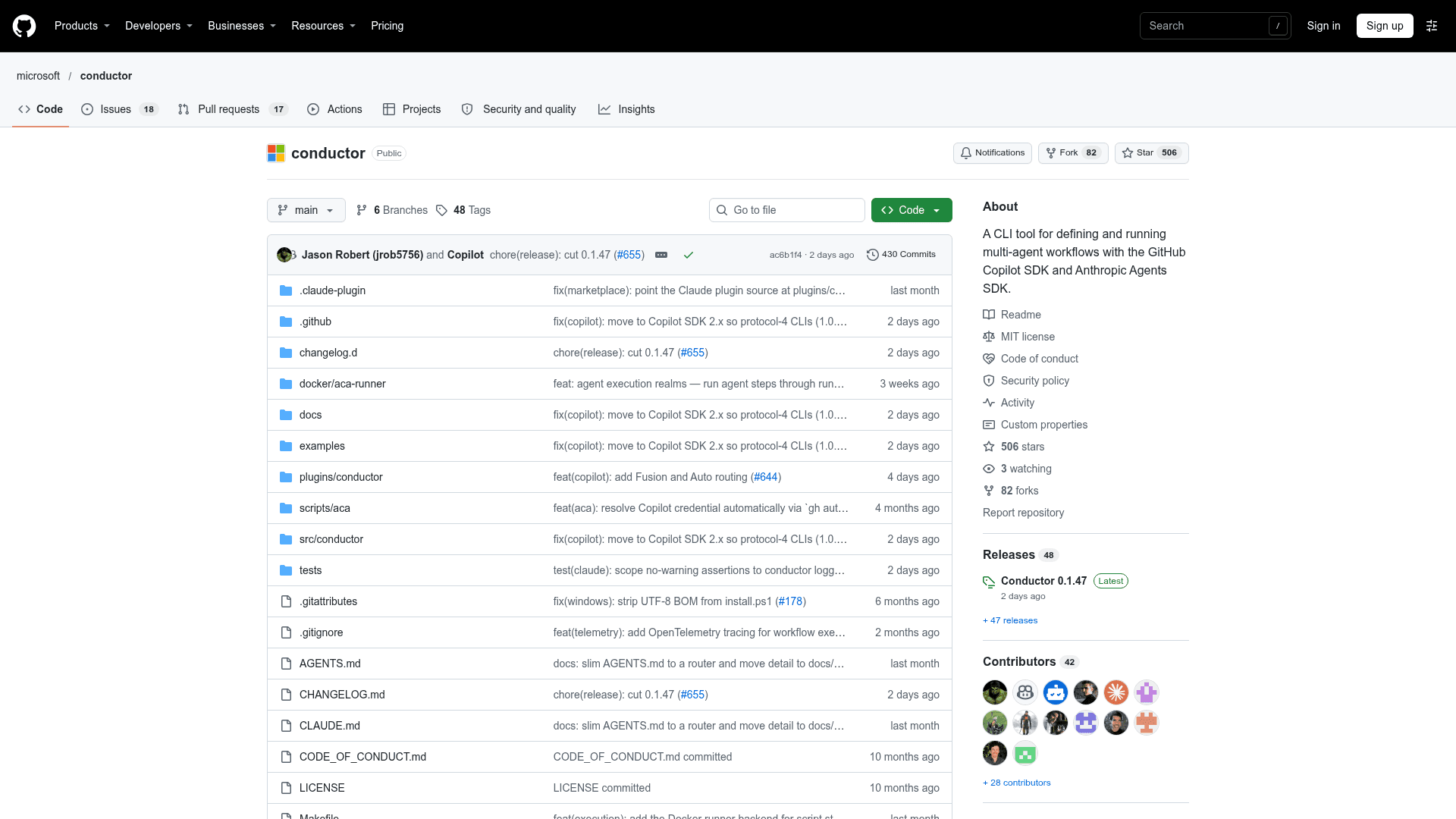
Conductor is an open-source command-line tool from Microsoft for defining and running multi-agent workflows. Agents, their prompts, and the routing between them are declared in a single YAML file, and workflows run through the conductor run command. Its latest listed release is v0.1.47.
What It Is
Conductor is a workflow orchestrator for AI agents. Workflows such as code review pipelines, research-then-synthesize flows, and plan-then-implement loops are described in plain YAML. Routing between agents uses Jinja2 templates and expression evaluation, where the first matching condition wins, so no LLM is used to decide what runs next. Because workflows are plain files, they can be diffed in pull requests, versioned with code, and run the same way locally and in CI.
Workflow Building Blocks
Beyond LLM agents, workflows can include script steps that run shell commands and route on exit code or parsed JSON output, set steps that bind Jinja2-evaluated values, MCP steps that call MCP server tools directly without an LLM, and terminate steps with an explicit success or failed status. Agents can run in parallel, either as static groups or as dynamic for-each fan-out, and sub-workflows can be composed with templated input mapping. Human-in-the-loop gates, dialog mode, safety limits on iterations and timeouts, and validation of template references and inputs before runtime are also documented.
Providers and Models
Copilot is the default provider. OpenAI and Claude are listed as stable, while Claude Agent SDK, NousResearch Hermes, and an Azure Container Apps sandboxed provider are marked experimental. A structured provider form can route the Copilot SDK at OpenAI-compatible, Azure, or Anthropic-shaped endpoints, including local inference servers such as Ollama, vLLM, and LM Studio. Reasoning effort can be set per agent or workflow-wide.
Monitoring and Operations
The --web option starts a real-time dashboard with an interactive DAG graph, live agent streaming, per-node detail, in-browser human gates, and mid-run guidance. A Fleet Manager TUI, installed as an optional extra, lists every running conductor process with status, tokens, cost, and gate alerts, and lets users drill into steps and launch new runs. OpenTelemetry traces can be exported to OTLP collectors, and named workflow registries allow running shared workflows by short name.
Setup Path
Install with the provided shell or PowerShell script, or via uv, pipx, or pip from the GitHub repository; Python 3.12+ is required for development. The repository also ships a conductor skill for Claude Code and GitHub Copilot CLI that teaches the assistant the workflow schema and CLI commands.
Community Discussions
Be the first to start a conversation about Conductor from Microsoft
Share your experience with Conductor from Microsoft, ask questions, or help others learn from your insights.
Pricing
Open Source (MIT)
Conductor CLI core is released under the MIT License, free to use, copy, modify, and distribute. Provider usage (GitHub Copilot, Anthropic) is an external cost.
- MIT License
- YAML-based multi-agent workflows
- Parallel execution
- Web dashboard
- Fleet Manager TUI
Capabilities
Key Features
- YAML-based multi-agent workflow definitions
- Deterministic routing with Jinja2 and expression evaluation
- Multiple providers: Copilot, OpenAI, Claude, Claude Agent SDK, Hermes, Azure Container Apps
- Parallel execution with static groups and dynamic for-each
- Sub-workflow composition
- Script, set, MCP, and terminate steps
- Human-in-the-loop gates and dialog mode
- Reasoning effort configuration
- Workspace instruction auto-discovery (AGENTS.md, CLAUDE.md)
- Real-time web dashboard with DAG graph
- Fleet Manager TUI
- Workflow validation before runtime
- OpenTelemetry tracing
- Workflow registries
- Local and custom LLM endpoint support