
coop
A Rust CLI that manages isolated, disposable virtual machines for running Claude Code and Codex agents safely, with full tool access and no risk to the host machine.
At a Glance
Free and open-source under the Apache License 2.0. Self-hosted CLI tool.
Engagement
Available On
Alternatives
Listed Sep 2026
About coop
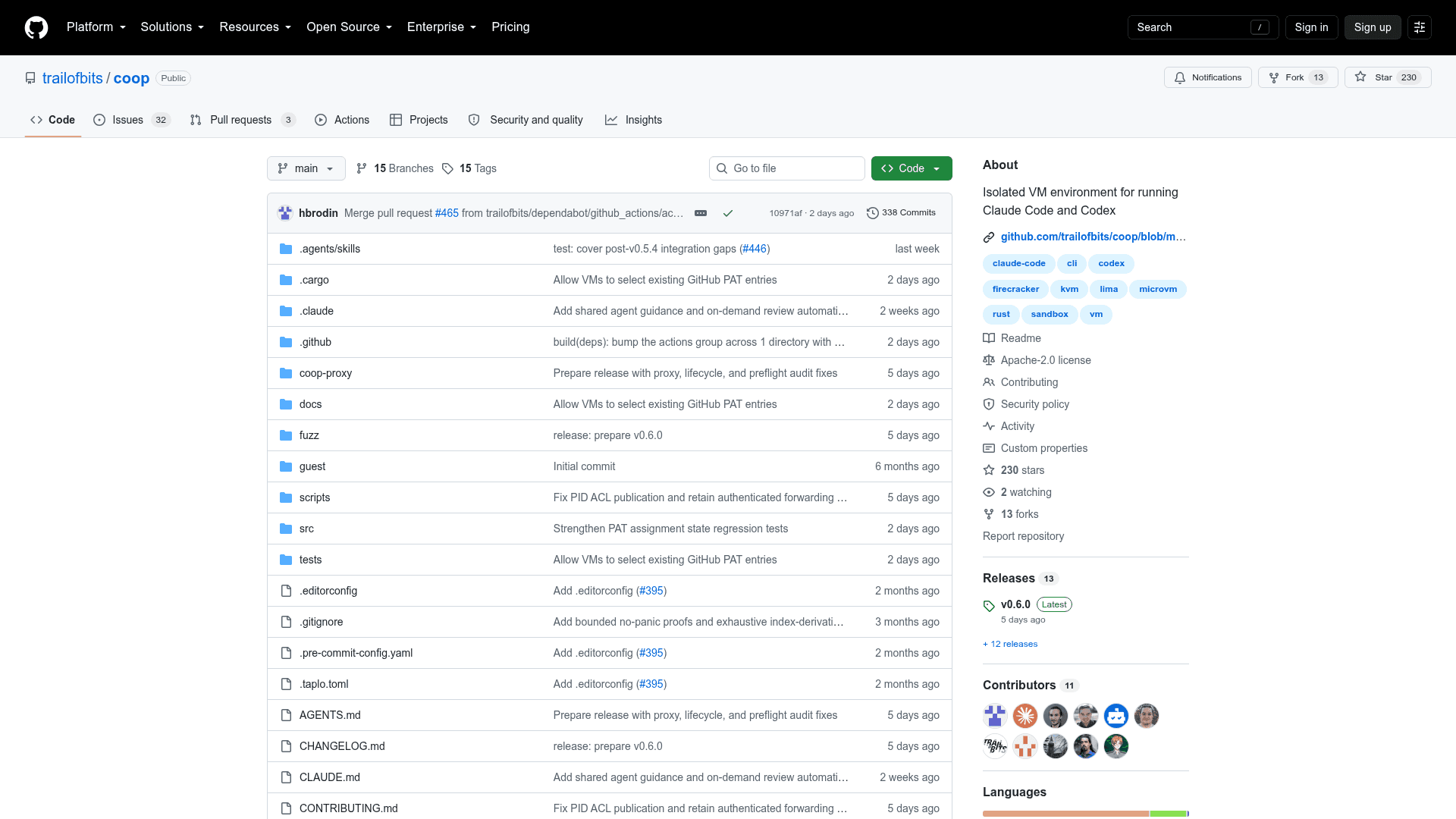
coop is an open-source Rust CLI tool built by Trail of Bits that creates and manages disposable virtual machine environments specifically designed for running AI coding agents like Claude Code and Codex. It is available under the Apache License 2.0 and supports macOS arm64 (Apple Silicon) and Linux x86_64 as primary platforms.
What It Is
coop sits in the category of sandboxed AI agent execution environments. Its core job is to give AI coding agents — Claude Code and Codex specifically — full, unrestricted tool access (Docker, git, compilers, package managers) inside an isolated VM, so that agent actions cannot affect the developer's host machine. Each VM is designed to be disposable, reproducible, and cheap to spin up and tear down.
How the Isolation Works
coop uses different virtualization backends depending on the host platform:
- Linux: Uses Firecracker microVMs (KVM-based), which
coop setupinstalls automatically along with a guest kernel. - macOS: Uses Lima, which must be installed separately via Homebrew (
brew install lima) before runningcoop setup.
The coop setup command builds a VM template image that subsequent instances are cloned from, making each new environment fast to create. A companion coop-proxy binary is also installed alongside the main CLI.
Workflow and Commands
The typical workflow is project-scoped: navigate to a project directory, run coop up to start a VM instance, then launch the desired agent with coop claude or coop codex. The tool also supports multi-instance configurations, workspace sync between host and VM, editor integration, and shell completion. Key documented capabilities include:
- Images and profiles for customizing VM environments
- Workspace sync for keeping host and VM files in sync
- Claude Code and Codex integrations with dedicated documentation
- Multi-instance support for running parallel agent sessions
- A trust model and architecture document for understanding the security boundaries
Platform and Architecture
coop is written in Rust and builds as two binaries: coop (the main CLI) and coop-proxy. It can be installed via a one-line curl script or built from source using Cargo and CMake. The project's GitHub topics include firecracker, kvm, lima, microvm, sandbox, and vm, reflecting its infrastructure-level approach to agent isolation.
Update: v0.6.0
The latest release is v0.6.0, published in September 2026. The repository was created in April 2026 and has seen active development, with the last push recorded in September 2026. The project has 223 stars and 13 forks on GitHub as of the last recorded update, with 35 open issues indicating active community engagement. Linux arm64 builds are available but listed as untested in the documentation.
Community Discussions
Be the first to start a conversation about coop
Share your experience with coop, ask questions, or help others learn from your insights.
Pricing
Open Source
Free and open-source under the Apache License 2.0. Self-hosted CLI tool.
- Isolated VM environments for Claude Code and Codex
- Firecracker and Lima backend support
- Full tool access inside VM
- Workspace sync
- Multi-instance support
Capabilities
Key Features
- Isolated VM environments for Claude Code and Codex
- Firecracker microVM backend for Linux (KVM-based)
- Lima backend for macOS (Apple Silicon)
- Disposable, reproducible VM instances
- Full tool access inside VM: Docker, git, compilers, package managers
- coop up / coop claude / coop codex CLI commands
- VM template image management via coop setup
- Workspace sync between host and VM
- Multi-instance support
- Editor integration
- Shell completion
- Images and profiles for environment customization
- Self-update via coop update
- Trust model and architecture documentation