
Empryo
An AI coding agent for desktop, terminal and CI that maps your codebase, edits code by symbol name, and runs your checks after each change.
At a Glance
Empryo v3 is free for personal and internal business use, including company development, paid client work and headless CI. Selling, hosting, wrapping or bundling Empryo itself as a commercial offering requires a separate commercial license. Model/provider costs (BYOK or subscriptions) are external.
Engagement
Available On
Alternatives
Listed Oct 2026
About Empryo
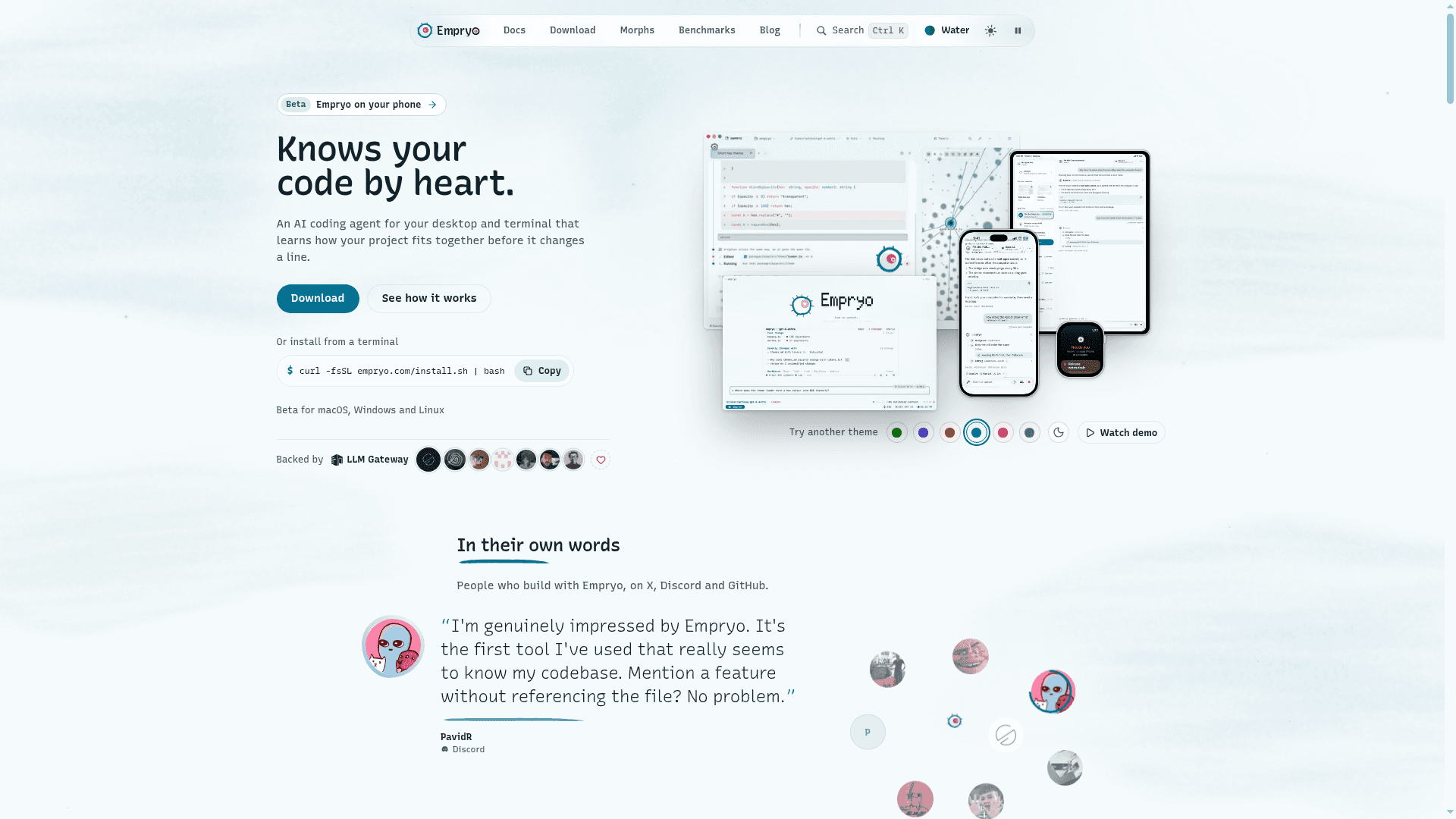
Empryo is an AI coding agent from proxySoul that runs as a desktop app, a terminal app or a headless CLI for scripts and CI. It builds a live map of a project, called the Genome, before it edits anything. It is in beta for macOS, Windows and Linux, and it works with subscriptions you already have, API keys or local models.
What It Is
Empryo is a coding harness that learns how a project fits together before it changes a line. The Genome is a ranked map of files, symbols and their dependencies, and a slice of it goes into each prompt so the agent can see what an edit will touch. Edits go through code structure and language servers. For TypeScript and JavaScript, functions and classes are replaced by name rather than by matching raw text; other languages use text edits plus whatever the language server supports.
How a Change Gets Made
After an edit, Empryo runs the project's typecheck, lint and tests through its project tool, which covers 23 ecosystems, and fixes failures in the same turn. A separate reviewer agent with a clean context can give a verdict, and the goal loop repeats work until a reviewer passes it. For larger changes, plan mode writes a plan first and edits only after approval. Checkpoints are saved after each turn so changes can be rolled back.
Memory and Model Access
Project memory keeps preferences, decisions and gotchas, and each turn recalls only the notes that match the message and files in play. Models can come from subscriptions such as Claude, ChatGPT, Copilot, Gemini and Grok, from API keys, or from local models. A task router can send cheap work to one model and code writing to another, and fallback chains cover provider outages.
Surfaces and Extensibility
The same agent runs in the desktop app, the terminal UI and headless mode, which emits JSON events for CI. Tabs run parallel agents, optionally in separate git worktrees. A beta phone app for iOS, iPadOS, watchOS and Android can steer sessions running on your computer. It also supports MCP servers, skills, hooks, custom subagents, browser and computer use, routines, and experimental Morphs that add panels to the desktop app. Empryo's own benchmarks page publishes comparisons against OpenCode, Claude Code and pi.
Licensing and Status
Empryo v3 is free for personal and internal business use, while commercial redistribution or hosting requires written permission. The public GitHub repository holds the earlier SoulForge v2 core and engine under a Business Source License. It is not the full source of Empryo v3, which is developed privately.
Community Discussions
Be the first to start a conversation about Empryo
Share your experience with Empryo, ask questions, or help others learn from your insights.
Pricing
Free
Empryo v3 is free for personal and internal business use, including company development, paid client work and headless CI. Selling, hosting, wrapping or bundling Empryo itself as a commercial offering requires a separate commercial license. Model/provider costs (BYOK or subscriptions) are external.
- Free for personal and internal business use
- Includes company development, paid client work and headless CI
- You can sell the work you create with it
- Selling, hosting, wrapping or bundling Empryo itself requires separate written commercial license
- Desktop, terminal and headless
Capabilities
Key Features
- Live Genome dependency map of files and symbols
- Edits by symbol name via AST and LSP
- Automatic typecheck, lint and test after edits
- Separate reviewer agent and goal loop
- Per-project memory
- Plan mode
- Parallel agents and worktrees
- Task router and model fallback chains
- Subscription sign-in, API keys and local models
- Browser and computer use
- Voice input
- Headless and CI mode with JSON events
- Checkpoints and session resume
- Routines for scheduled runs
- MCP servers, skills, hooks and custom agents
- Phone app for remote steering (beta)
- Neovim inside the terminal app
- Themes and five UI languages