
Factory.ai
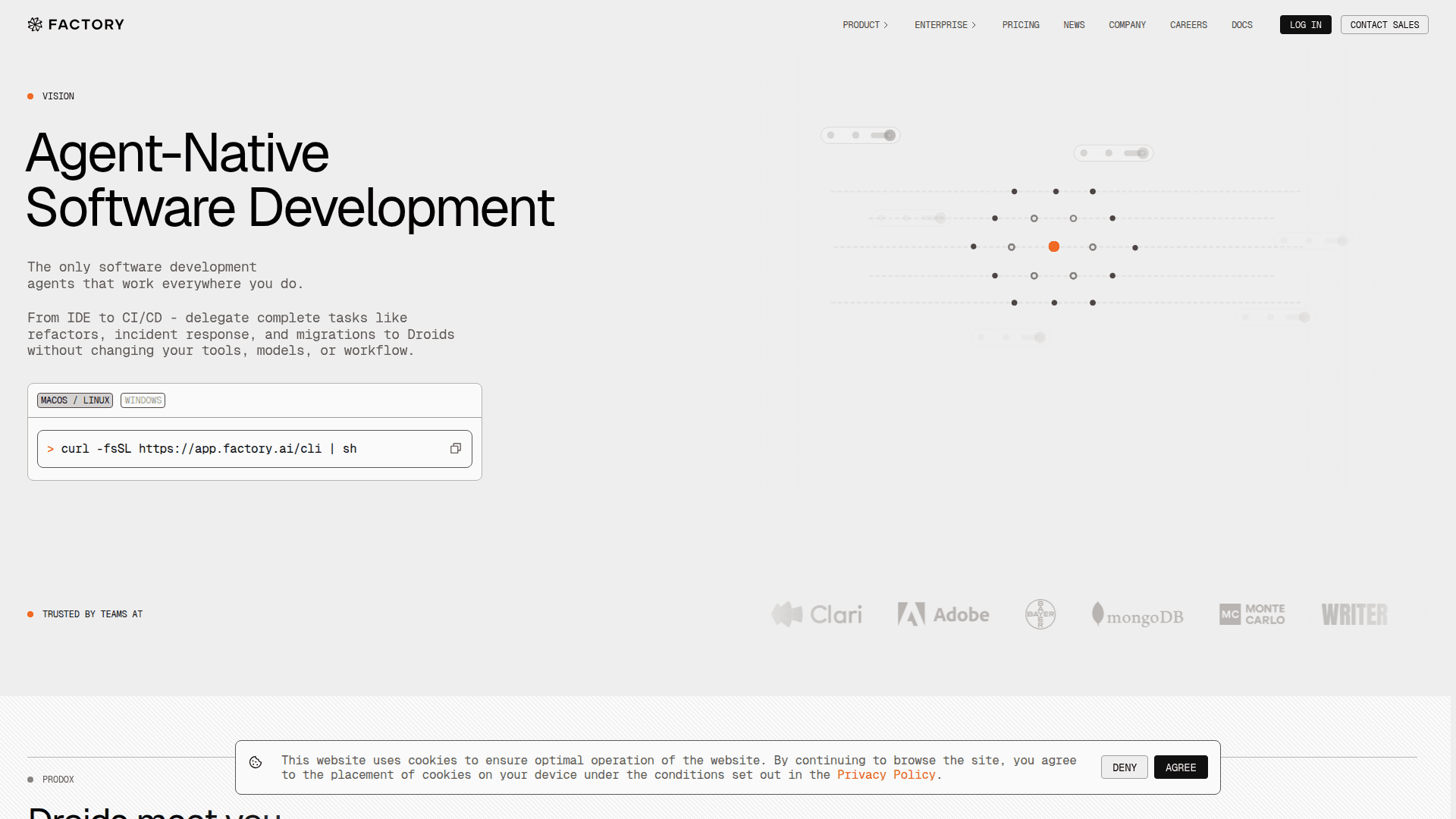
Factory.ai provides AI-powered software development agents (Droids) that work across IDE, CLI, web, Slack, and CI/CD to automate coding tasks like refactors, incident response, and migrations.
At a Glance
Engagement
Available On
Updated May 2026
About Factory.ai
Factory.ai builds agent-native software development tools called "Droids" that embed directly into engineering workflows across IDE, desktop, CLI, Slack, and project management tools. The company raised a $150M Series C from Khosla Ventures, Sequoia Capital, Blackstone, Insight Partners, and others at a $1.5B valuation, according to its own news page. Factory positions itself as an enterprise platform for delegating complete software tasks to AI agents without requiring teams to change their existing tools, models, or workflows.
What It Is
Factory.ai is an AI coding agent platform centered on autonomous "Droids" — agents that can handle end-to-end software development tasks such as code refactors, incident response, migrations, automated code review, and PR creation. Unlike single-interface AI coding assistants, Factory's Droids are designed to operate across multiple surfaces simultaneously: inside any IDE or terminal (VS Code, JetBrains, Vim), via a desktop/web app, through a CLI, inside Slack or Microsoft Teams, and triggered from project management tools like Linear or Jira.
How Droids Work Across the Stack
Factory's core product concept is that Droids "meet you where you work." The platform supports five primary interaction surfaces:
- Terminal / IDE: Delegates tasks from any editor or terminal without switching tools.
- Desktop / Web: A browser-based UI for delegating complex coding, refactoring, or debugging tasks with no setup required.
- Command Line: Scripts and parallelizes Droids at scale for CI/CD pipelines, migrations, and maintenance tasks including automated code review and self-healing builds.
- Slack / Teams: Allows support teams and engineers to delegate tasks in plain English and receive code-level solutions, targeting lower mean time to resolution (MTTR).
- Project Manager: Automatically triggers agents from issue assignment or mentions in tools like Linear, pulling context, implementing solutions, and creating PRs with full traceability from ticket to code.
Enterprise Architecture and Integrations
Factory's enterprise offering emphasizes security, compliance, and flexibility. The platform claims support for every major programming language, 100+ development frameworks, and native integrations with GitHub, GitLab, Jira, Linear, Notion, Sentry, PagerDuty, Slack, Asana, Microsoft Teams, Codecov, Google Cloud, Confluence, Google Drive, Azure, Docker, DX, and CircleCI. Security certifications listed on the enterprise page include SOC 2, GDPR, ISO 42001, and CCPA. Enterprise features include SSO/SAML, SCIM provisioning, Zero Data Retention (ZDR), audit logging, dedicated compute with partitioned inference pools, on-premise deployment options, and full admin controls covering encryption keys, data residency, session retention, and network policy.
Model Access and Vendor Agnosticism
Factory describes itself as "interface and vendor agnostic," supporting all leading frontier and open-weight models including GPT-5, Claude Opus and Sonnet, Gemini, and others. Users can bring their own API keys. The platform is designed so that as model providers and dev tooling evolve, Droids adapt without requiring workflow changes.
Update: Droid Computers and Automated QA
Recent product news from Factory's own news page highlights two notable launches: Droid Computers, described as persistent machines for remotely orchestrating Droids that can be spun up in Factory's cloud or converted from a user's own machine; and Automated QA, an end-to-end quality assurance feature that tests applications visually and posts evidence directly to pull requests. The company also published a benchmark of 13 models for AI code review price-performance tradeoffs, signaling an active research and product development cadence.
Who It's Built For
Factory targets engineering teams at growth-stage and enterprise companies. The enterprise page cites claimed metrics — 7x faster feature delivery, 96.1% reduction in migration time, and 95.8% time saved on on-call resolution — as vendor-published figures. The team page notes backgrounds from Nuro, Glean, Applied Intuition, Scale AI, and MongoDB, and the company operates out of San Francisco with an in-office culture.
Community Discussions
Be the first to start a conversation about Factory.ai
Share your experience with Factory.ai, ask questions, or help others learn from your insights.
Pricing
Pro
Complete software development agents for individuals.
- Desktop / CLI / SDK
- Cloud & local background agents
- Track billing and usage statistics
- Agent-readiness dashboard
Plus
Everything in Pro, with expanded rolling rate limits (~5x the usage of Pro) and Droid Computers.
- Everything in Pro
- ~5x the usage of Pro
- Droid Computers — access to Factory-managed cloud computers for remote Droids
Max
Everything in Plus, with expanded rolling rate limits (~10x the usage of Pro) and early access to new features.
- Everything in Plus
- ~10x the usage of Pro
- Early access to new features
Teams
Tailored plans for growing teams needing custom usage limits and enterprise security features.
- Multiple team members up to 150 seats
- Custom usage limits
- Dedicated onboarding and support
- Single Sign-On (SSO) integration
- SAML/SCIM provisioning
- Zero Data Retention (ZDR)
- Basic admin controls (model selection, autonomy level, model access controls, org-level deny lists)
Enterprise
Enterprise-scale deployment with unlimited seats, dedicated compute, advanced security, and premium support.
- Unlimited team members
- Dedicated compute with partitioned inference pool
- Audit logging and activity trails
- Agent-readiness Improvement Program
- Enterprise-specific automation cookbook
- On-premise deployment options
- Full admin controls (encryption keys, data residency, session retention, network policy)
- Dedicated Account Manager and Customer Engineer
- Priority support with SLAs
- Custom onboarding program
Capabilities
Key Features
- AI coding agents (Droids) for software development
- IDE and terminal integration (VS Code, JetBrains, Vim)
- Desktop and web-based agent interface
- CLI for scripting and parallelizing agents at scale
- Slack and Microsoft Teams integration for incident response
- Project manager integration (Linear, Jira) with auto-triggered agents
- Automated code review
- Automated QA with visual evidence posted to PRs
- Droid Computers for persistent remote agent orchestration
- CI/CD pipeline integration
- Support for 100+ development frameworks
- Multi-model support (GPT-5, Claude, Gemini, and more)
- Bring-your-own-key support
- SSO/SAML and SCIM provisioning
- Zero Data Retention (ZDR)
- Audit logging and activity trails
- On-premise deployment options
- Dedicated compute with partitioned inference pool
- Agent-readiness dashboard
- Admin controls (model selection, autonomy level, data residency)