
FuzzyAI
Open-source automated LLM fuzzing tool that helps developers and security researchers find jailbreaks in LLM APIs.
At a Glance
FuzzyAI Fuzzer core released under the Apache License 2.0; self-hosted, free to use, modify and distribute.
Engagement
Available On
Alternatives
Listed Oct 2026
About FuzzyAI
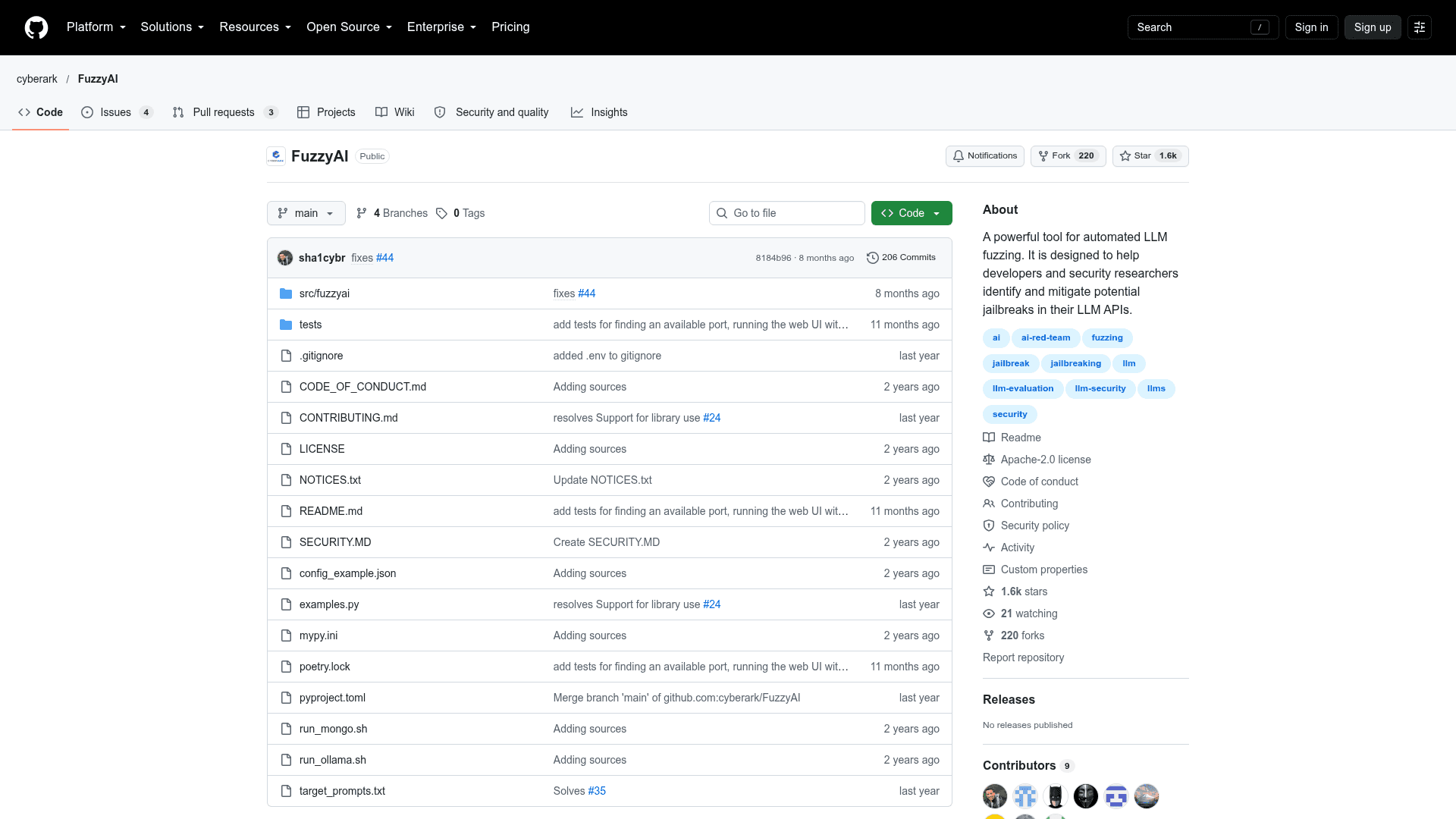
FuzzyAI is an open-source fuzzer from CyberArk for testing LLMs and LLM APIs. Developers and security researchers use it to run automated jailbreak attacks against hosted, local, or custom REST-based models and to identify potential vulnerabilities. It is installed as a Python package and run from a CLI, with an experimental Web UI also available.
What It Is
FuzzyAI is an LLM security testing tool in the AI red-teaming space. You provide a target model (or your own REST API endpoint), one or more prompts, and one or more attack methods. The fuzzer then sends adversarial variations of the prompt and evaluates the responses, optionally using a classifier model to judge whether outputs are harmful or unwanted.
Attacks and Techniques
The README lists implemented attacks drawn from published research and community techniques, including ArtPrompt, taxonomy-based paraphrasing, PAIR, many-shot jailbreaking, ASCII smuggling, genetic algorithms, DAN, WordGame, Crescendo, ActorAttack, best-of-n jailbreaking, and the text-based Shuffle Inconsistency Attack. Simpler prompt-framing attacks such as Back To The Past, Thought Experiment, and History/Academic framing are also included, along with a default mode that sends the prompt as-is.
Model and Provider Support
FuzzyAI works with cloud APIs including OpenAI, Anthropic, Gemini, Azure, AWS Bedrock, AI21, and DeepSeek. It also supports Hugging Face models, local models through Ollama, and custom REST APIs described by a raw HTTP request file. Support for newer models can be added following the project's DIY guide.
Setup Path
Install with pip from the GitHub repository or clone it and install with Poetry. Then run fuzzyai fuzz with options for model, attack, and target prompts, or launch fuzzyai webui. Jupyter notebooks and datasets are included, and the wiki holds detailed documentation. One documented caveat: not every classifier is compatible with every attack, since the attacks expect single-output classifiers.
Community Discussions
Be the first to start a conversation about FuzzyAI
Share your experience with FuzzyAI, ask questions, or help others learn from your insights.
Pricing
Open Source
FuzzyAI Fuzzer core released under the Apache License 2.0; self-hosted, free to use, modify and distribute.
- Apache License 2.0
- Automated LLM fuzzing and jailbreak testing via CLI
- Experimental Web UI
- Jupyter notebooks and datasets included
- Third-party LLM provider API costs (e.g. OpenAI, Anthropic) are external; local models via Ollama possible
Capabilities
Key Features
- Automated LLM fuzzing
- Mutation-based, generation-based, and intelligent fuzzing
- Many implemented jailbreak attacks (ArtPrompt, PAIR, Crescendo, many-shot, and others)
- Custom REST API targeting via raw HTTP request files
- Classifier models for output evaluation
- Experimental Web UI
- Jupyter notebooks and datasets
- Extensible architecture for adding models