
MotherDuck
Serverless cloud data warehouse built on DuckDB with isolated per-user and per-agent compute, MCP access, and agent-built dashboards and pipelines.
At a Glance
About MotherDuck
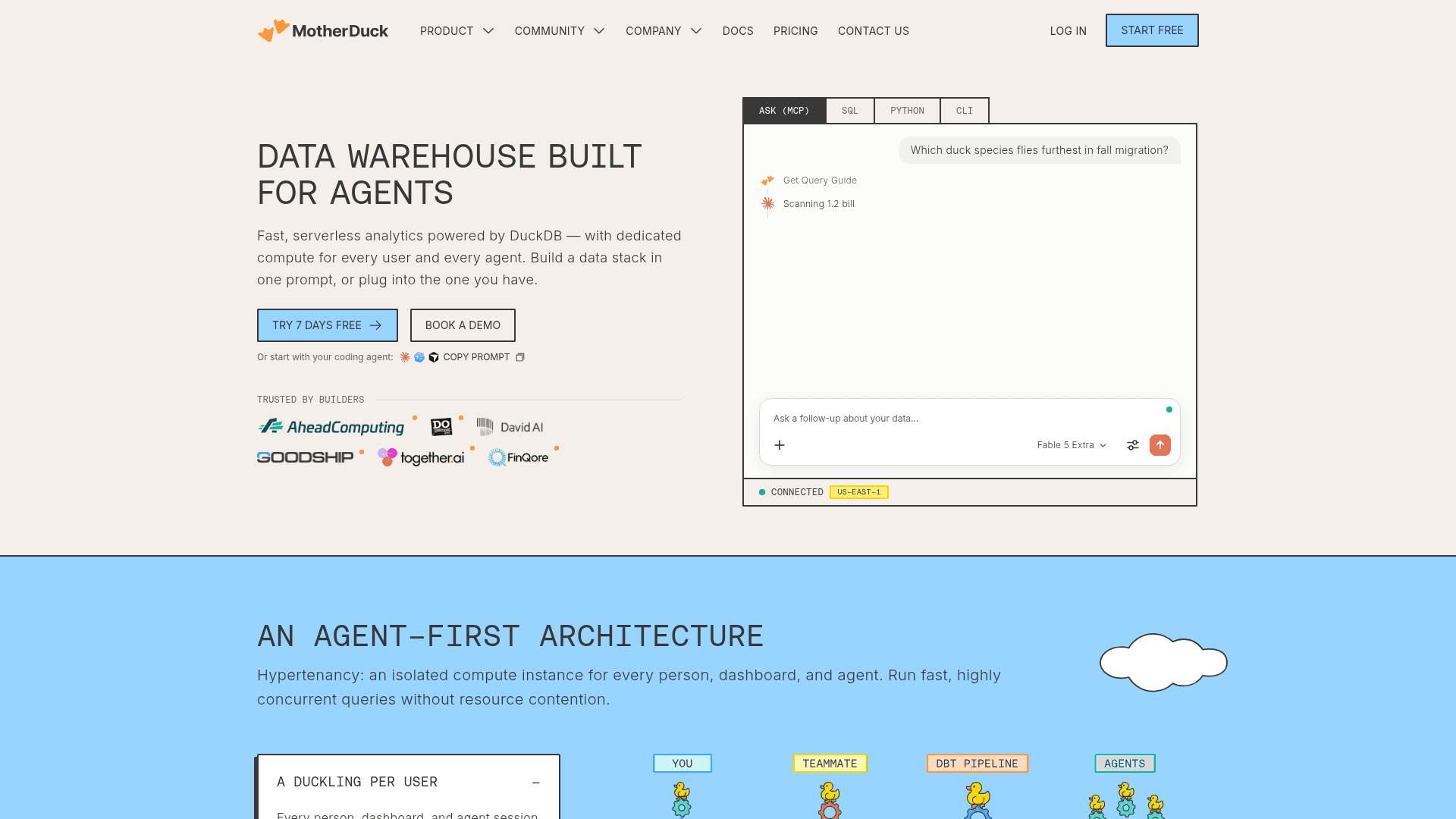
MotherDuck is a serverless cloud data warehouse powered by DuckDB, aimed at data teams, app developers, and AI agents. It gives each user, dashboard, or agent session its own isolated DuckDB instance, which MotherDuck calls a Duckling. Users can query through SQL, Python, a CLI, a REST API, a Postgres endpoint, or MCP-compatible agents.
What It Is
MotherDuck is a managed, cloud-hosted version of DuckDB for analytics. It runs SQL analytics in a serverless warehouse, and the product pages describe dual execution that can run query stages on a laptop, in the cloud, or across both. Databases can be shared through read-only, zero-copy shares, and MotherDuck can query data in S3 and other S3-compatible object storage. Storage options listed include Parquet, Apache Iceberg, DuckLake, differential storage, and cloud object storage.
Hypertenancy and Isolated Compute
Hypertenancy is MotherDuck's term for giving each user, customer, or AI agent an isolated DuckDB instance. According to the company, this avoids shared clusters and noisy neighbors, and cold starts land under 100ms. Instances can be sized from Pulse through Giga, and the product page mentions up to 16 read-scaling replicas. User-level CPU visibility and cost attribution are described as built in.
Agent-Native Tooling
The MCP Server lets agents such as Claude, ChatGPT, and Cursor inspect catalogs, run SQL, read Guides, create Dives, and manage Flights, with answers returned as readable SQL in sandboxed compute. Three product components support this workflow:
- Dives: interactive visualizations built by an agent or with SQL, which can be shared or embedded in an application.
- Flights: scheduled Python pipelines that run on MotherDuck compute for ingestion, enrichment, and transformation.
- Guides: shared business context that agents use to produce more accurate queries.
Agent Skills and a CLI are also offered.
Integrations and Ecosystem
MotherDuck lists integrations across ingestion (Fivetran, Airbyte, dlt), BI (Tableau, Power BI, Looker, Hex, Omni, Metabase), transformation (dbt), and orchestration (Airflow, Dagster, Prefect, Kestra). Language clients include Python, Node.js/TypeScript, Go, Java, Rust, R, C++, WebAssembly, and ODBC.
Community Discussions
Be the first to start a conversation about MotherDuck
Share your experience with MotherDuck, ask questions, or help others learn from your insights.
Pricing
Lite
For solo practitioners and hobbyists leaving the nest
- Up to 3 internal active users and 2 service accounts
- 10 GB free storage
- 10 hrs Pulse compute per month included
- Pulse instances only
- Role-based access control (preset roles)
Business Free trial
Free 7-day trial of the Business plan
Business
Everything you need for production analytics
- Up to 10 internal active users and unlimited service accounts
- 5 instance types and read-scaling replicas
- Flights: agent-native data pipelines
- 90-day snapshot retention
- Query history
- Role-based access control (preset and custom roles)
- Support from MotherDuck experts
- 99.9% availability SLA
- Usage: storage $0.04 per GB / month
- Pulse $0.60 per CU hour
- Standard $2.40 per hour
- Jumbo $4.80 per hour
- Mega $12.00 per hour
- Giga $24.00 per hour
Enterprise
Customized plans for large-scale deployments
- Everything in Business, plus:
- Unlimited internal active users and service accounts
- Fixed-cost capacity pricing
- AWS PrivateLink connectivity
- IP allowlisting
- HIPAA BAA
- Bring Your Own Compute (BYOC), available on request
Capabilities
Key Features
- Serverless DuckDB cloud data warehouse
- Hypertenancy: isolated DuckDB instance (Duckling) per user, customer, or agent
- Dual execution across local and cloud
- Zero-copy database shares
- MCP Server for AI agents
- Dives: agent-built interactive visualizations
- Flights: scheduled Python pipelines
- Guides: shared business context for agents
- DuckLake and Apache Iceberg support
- Postgres endpoint
- Read-scaling replicas
- User-level CPU visibility and cost attribution