
NodeTool
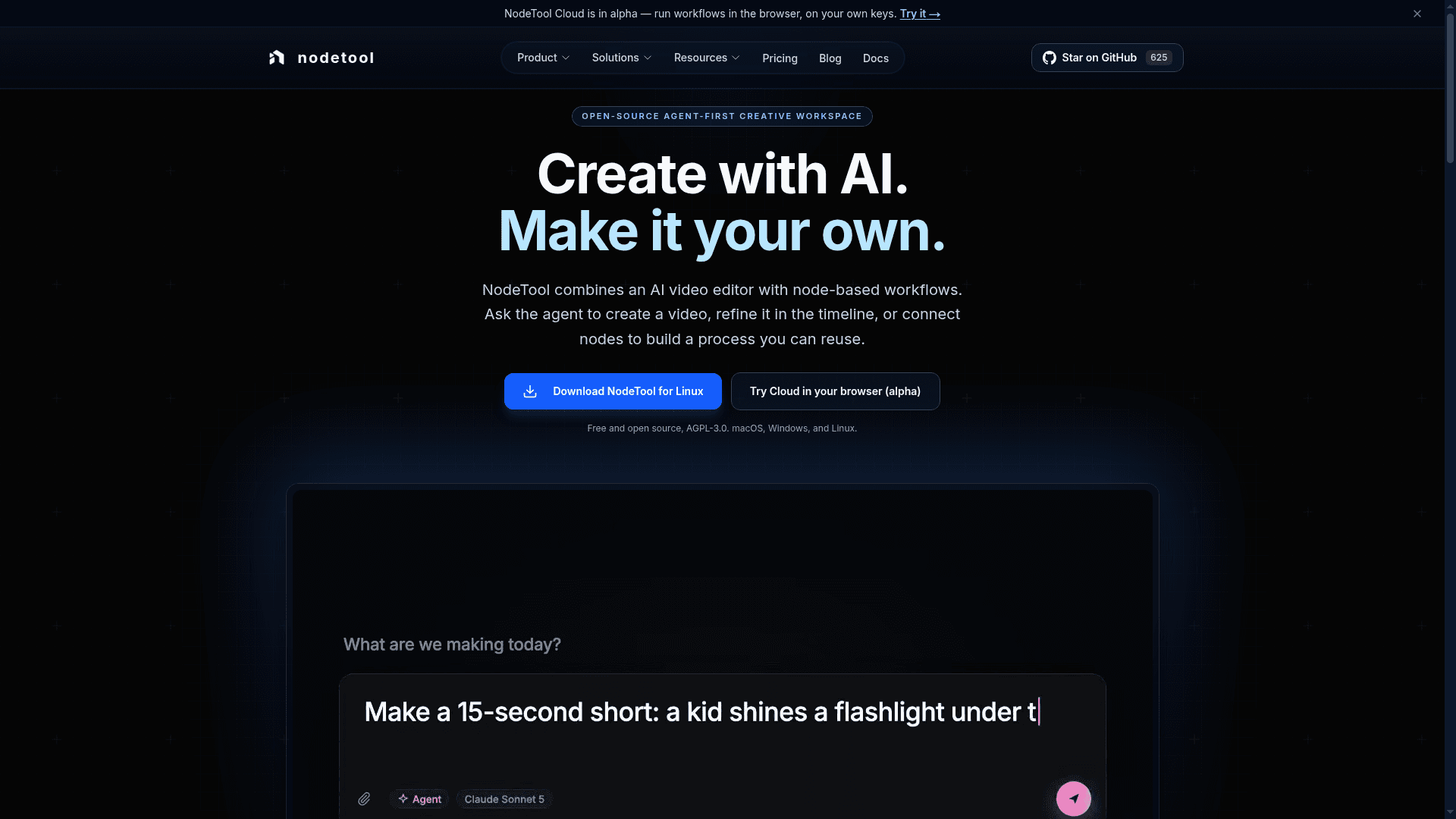
Open-source agent-first creative workspace that combines an AI video editor with node-based workflows for images, video, audio, and text.
At a Glance
Free, open-source (AGPL-3.0) desktop app that runs on your machine; provider costs are paid directly to providers at list price.
Engagement
Available On
Alternatives
Listed Nov 2026
About NodeTool
NodeTool is an open-source creative workspace for making images, video, audio, and text with AI. You describe what you want, a built-in agent builds it inside NodeTool's editors, and you can then change any part yourself. It is available as the Studio desktop app for macOS, Windows, and Linux, and as NodeTool Cloud, which runs in the browser and is in alpha.
What It Is
NodeTool pairs an AI video editor with a node-based workflow engine. Projects are editable rather than single exported files, so the graph, inputs, assets, and edits stay together. Seven editors share one project: storyboard, script and voice, timeline, sketch, 3D, game, and the node canvas. Each editor exposes its actions to the agent as tools.
From Brief to Final Cut
A brief becomes a screenplay with one shot per card, including action, camera, motion, and duration. Stills are generated first so you can approve them before paying for video clips, and a single shot can be revised without regenerating the whole film. The clips are then laid onto a timeline with narration and music, trimmed, and exported as MP4. Entities such as characters, locations, and props keep descriptors consistent across prompts.
Models and Keys
NodeTool calls providers with your own API keys. Documented providers include OpenAI, Anthropic, Gemini, FAL, KIE, Replicate, ElevenLabs, and HuggingFace. Open-weight models can run locally through Ollama, MLX, llama.cpp, vLLM, and LM Studio. In Studio, the agent can also run on a ChatGPT or Claude subscription.
Agents, MCP, and Developer Access
NodeTool runs as an MCP server, so coding agents such as Claude Code, Codex, OpenCode, Cursor, and Claude Desktop can generate media and build workflows through it. A one-line npx command registers the server with the clients it finds. Workflows can also run through a CLI, an HTTP API with WebSocket progress streaming, or a self-hosted Docker deployment. Custom nodes can be written in TypeScript or Python. The source is licensed under AGPL-3.0.
Community Discussions
Be the first to start a conversation about NodeTool
Share your experience with NodeTool, ask questions, or help others learn from your insights.
Pricing
NodeTool Studio
Free, open-source (AGPL-3.0) desktop app that runs on your machine; provider costs are paid directly to providers at list price.
- Runs on macOS, Windows, and Linux
- Local models through Ollama, MLX, and llama.cpp
- Your own accounts for supported cloud providers
- Your workflows and files stay on your machine
- Licensed AGPL-3.0; self-hosting available
Capabilities
Key Features
- Agent-first editors that the built-in agent and external agents can drive
- Node-based workflow canvas with typed ports and live intermediate output
- Storyboard editor that turns a brief into shots, stills, and clips
- Video timeline with MP4 export
- Script and voice editor with per-character voice casting
- Sketch editor with layers, masks, and model-bound generation
- 3D scene editor and 2D/3D game editor
- Mini apps and app builder for wrapping workflows in a UI
- MCP server for Claude Code, Codex, OpenCode, Cursor, and Claude Desktop
- CLI and HTTP/WebSocket API for running workflows
- Local models via Ollama, MLX, llama.cpp, vLLM, and LM Studio
- Bring-your-own provider keys
- Self-hosting with Docker
- Custom nodes in TypeScript or Python
- Built-in vector store for document search