
Oh My Hermes
An open-source all-in-one plugin for Hermes Agent that adds coding intelligence, long-term memory, and model-optimized workflow packages with explicit evidence boundaries.
At a Glance
Fully free and open-source under the MIT License. Install via Homebrew, Bun, npm, curl, or PowerShell.
Engagement
Available On
Alternatives
Listed Sep 2026
About Oh My Hermes
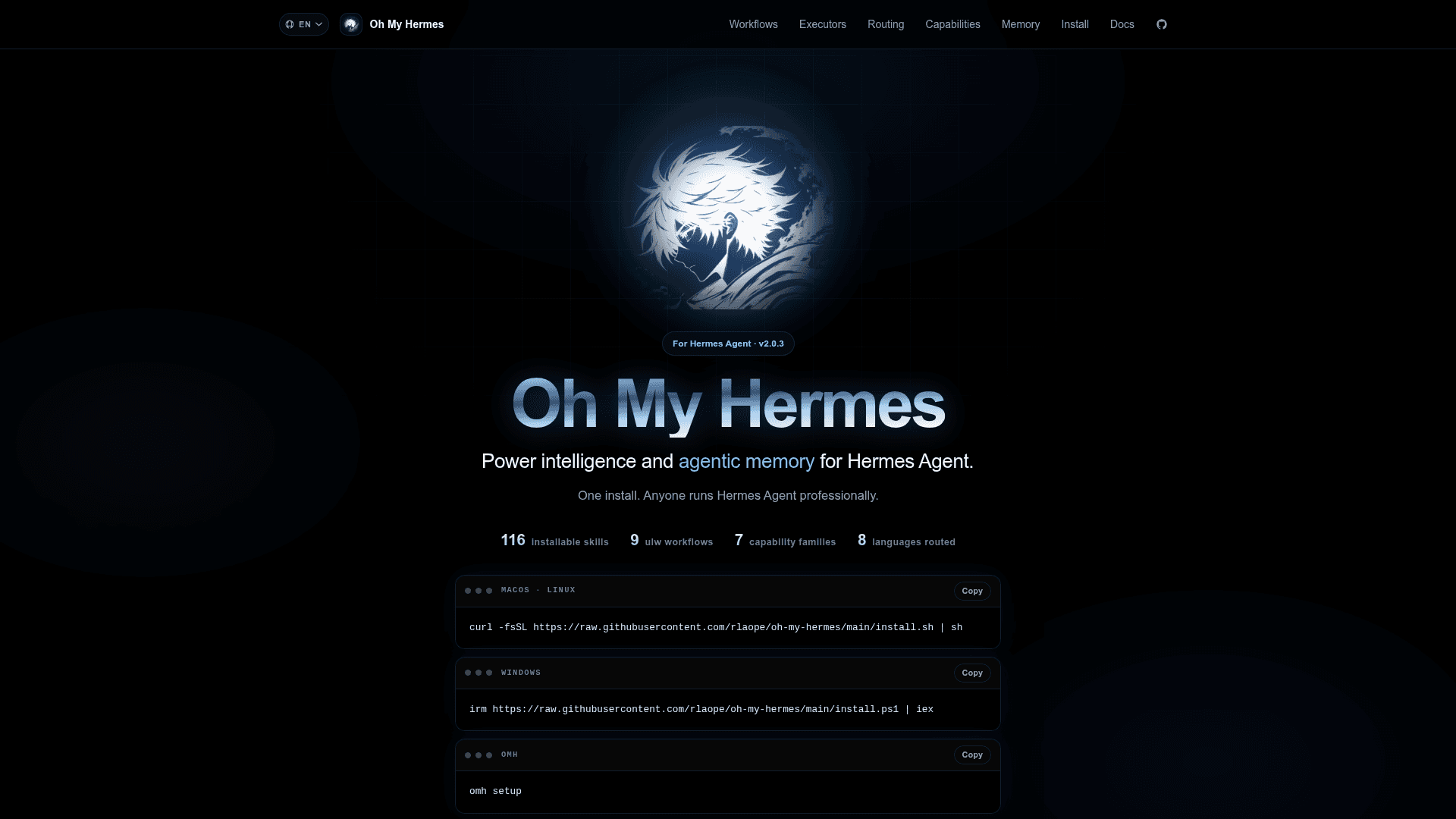
Oh My Hermes (OMH) is an open-source operating layer built on top of Hermes Agent, created by Hope Kim (@rlaope). It installs as a single plugin and adds a professional-grade intelligence layer — covering coding handoffs, agentic memory, multi-model routing, and long-horizon workflow engines — without patching or replacing Hermes itself. The project is MIT-licensed and available on GitHub.
What It Is
Oh My Hermes is a plugin for Hermes Agent (by Nous Research) that turns a standard Hermes request into a governed, evidence-bounded workflow. OMH frames the problem, selects the appropriate workflow and evidence gates, routes work to the right model and executor, and produces an honest record of what actually happened. It is executor-neutral — it works with Claude Code, Codex, and other coding agents — and never silently reports work as done unless it observed it happen.
The project ships three core capabilities as one plugin:
- Coding intelligence: per-model prompt calibration, complexity scoring, parallel work splitting, and specialist skill injection
- Long-term memory: a four-layer, review-gated memory system that never touches Hermes' own memory store
- Workflow packages: nine
ulw-*long-horizon workflow engines covering interview, research, planning, parallel delivery, QA, and performance optimization
Architecture and Evidence Boundaries
OMH introduces a strict evidence model with four named states: Plan · not run, Code · running, Code · reported done, and Test · verified. The distinction between "reported done" and "verified" is a first-class design constraint — an executor saying it finished is not the same as a gate having checked the result.
The operating layer sits above Hermes-native skills: it frames the problem, picks the workflow, and runs native skills as capabilities inside a governed path. Coding ownership and model choice are always separate decisions. Subagents read memory but never write it. Prepared handoffs are never reported as execution evidence.
Multi-Model Routing
OMH ships twelve editable model-routing categories — ultrabrain, deep, architect, unspecified-high, unspecified-low, quick, writing, visual-engineering, artistry, capable, simple-work, and deep-work — each backed by an ordered candidate chain. Setup interviews which providers and models are actually installed on the machine, then reorders chains accordingly. Missing models are skipped rather than causing failures; a dispatch that would silently downgrade is refused instead.
Supported model families include Claude, GPT, Gemini, DeepSeek, Qwen, Kimi, GLM, Mistral, and Grok. Chains are user-editable via ~/.omh/routing/model-chains.json or through an arrow-key TUI picker (omh model or /omh-model inside the Hermes Modern TUI). OMH stores only provider IDs, never credentials.
Skill Catalog and Workflow Engines
The plugin ships 116 installable skills across seven capability families: clarify and plan, build with leverage, research and learn, code and ship safely, create polished deliverables, remember and operate, and connect with clear boundaries. Skills are injected automatically into runs based on the request surface — frontend, backend, Rust, native debugging, inference serving, design quality gates, security review, and more.
The nine ulw-* flagship workflows cover:
ulw-context— terminology alignment before plans and handoffsulw-interview— one-question-at-a-time clarification, up to six roundsulw-research— source-backed evidence with freshness and citation trackingulw-plan— consensus planning with review gates and acceptance criteriaulw-work— parallel delivery in disjoint file-ownership lanesulw-maestro— external handoff to Claude Code or Codex via a steerable sessionulw-loop— interview → plan → research → build → review cycle until a real gate passesulw-qa— adversarial QA with hostile scenarios and fix loopsulw-perf— measured hot-path optimization
Agentic Memory Model
OMH implements a four-layer memory architecture: L0 (owner-written house rules, always loaded), L1 (capped core memory with loud failure on overflow), L2 (review-first, TTL-budgeted project memory in .omh/memory/), and L3 (zero-token-until-queried full message history via SQLite + FTS5). Nothing is remembered silently — every candidate goes through a review card and is admitted, refused, or deferred with a written reason. Recall packs are ranked for the current task and cut to a token budget, with conflicts and duplicates resolved before delivery.
Update: v2.0.3
The latest release is v2.0.3, published on September 12, 2026. The repository was last pushed on September 18, 2026. Homebrew, Bun, and npm package-manager installs became public as of v1.0.6. The project is actively developed in the open as part of Team Art & Engineering, with updates shared on @rlaope on X and in the Oh-My-Hermes Community Discord.
Community Discussions
Be the first to start a conversation about Oh My Hermes
Share your experience with Oh My Hermes, ask questions, or help others learn from your insights.
Pricing
Open Source
Fully free and open-source under the MIT License. Install via Homebrew, Bun, npm, curl, or PowerShell.
- 116 installable skills
- 9 ulw-* workflow engines
- Multi-model routing with 12 editable categories
- Four-layer agentic memory system
- Maestro handoff to Claude Code and Codex
Capabilities
Key Features
- 116 installable skills across 7 capability families
- 9 ulw-* long-horizon workflow engines
- Multi-model routing with 12 editable categories
- Per-model-family prompt calibration (13 families)
- Parallel work splitting with disjoint file ownership
- Four-layer agentic memory system with review-gated writes
- Evidence boundary enforcement (Plan/Running/Reported/Verified states)
- Maestro handoff lane for Claude Code and Codex
- Live HUD with per-lane cost, token, and evidence state
- Phase-structured TODO above the Hermes prompt
- Structural code search via ast-grep (28 languages)
- Codebase UML generation from code
- Toolcall guardrails and completion-integrity gates
- Mixture-of-Models routing with fallback chains
- SQLite + FTS5 full message history at L3 memory
- omh doctor for verification and troubleshooting
- omh update for self-updating via owning package manager
- Arrow-key TUI model picker (omh model / /omh-model)
- Executor-neutral design (Claude Code, Codex, pi)
- Surfaces: CLI, Desktop, Slack, Discord, Telegram